
Auray
Auray is a commune in the Morbihan department of Brittany, northwestern France, known for its historical significance as the site of the last battle of the Breton War of Succession and as a port that hosted notable historical arrivals like Benjamin Franklin. The town's geography is defined by the Loch river and the Armorican plateau, with its historic port of Saint-Goustan playing a crucial role in maritime trade and later as a tourist destination. Auray has a rich linguistic history, with Breton spoken historically and French emerging from the eighteenth century onward, and remains a vibrant administrative region with various historical sights and modern transport links.
Key Facts
- ›Site of the Battle of Auray on September 29, 1364, the final conflict of the Breton War of Succession.
- ›The port of Saint-Goustan served as a significant trading port and hosted Benjamin Franklin's arrival in 1776.
- ›In 1795, Auray became a site for the execution of royalist prisoners after the Quiberon Expedition.
- ›The town has a historical connection to the Breton language, with Breton used in parishes until the 1930s.
- ›Auray railway station is a key transport hub, connecting to major lines and the seasonal Auray-Quiberon line.
- ›Notable architectural sites include the 13th-century Chapel of the Holy Spirit and the 17th-century Church of St Gildas.

Port of Saint-Goustan, Church of St Gildas, Chapel of the Holy Spirit, Town Hall, Church of Saint-Sauveur, Saint-Goustan Bridge, Chazelles Fountain, Auray Railway Station
An Alre, Alre
Benjamin Franklin, Cardinal Richelieu, Sombreuil
- Battle of Auray
- Departure of Sailors From Saint-Goustan To Re-Capture Port Royal
- Arrival of Benjamin Franklin
- Transfer of Prisoners From the Quiberon Expedition
About Auray
Auray: A Historic Commune in Brittany
Auray is a commune situated in the Morbihan department of Brittany, in northwestern France. Historically, it is renowned for being the location of the Battle of Auray on September 29, 1364, which marked the conclusion of the Breton War of Succession. The town's geography is shaped by the Loch river, which flows into the Gulf of Morbihan, with the main urban area situated on the elevated west bank of the River Auray.
Historical Significance and Port Development
The port of Saint-Goustan, located in the river valley, has been a focal point of Auray's history. It served as the original settlement and functioned as a significant trading port until the nineteenth century, with notable maritime connections to Spain and Britain. The port also holds historical importance for its role in the American War of Independence, as Benjamin Franklin arrived there on December 3, 1776, to seek military aid. In a more somber chapter of its history, Auray became a place of execution in 1795 following the Quiberon Expedition, where hundreds of royalist prisoners were shot and buried in what is now known as the Champ des martyrs.
Linguistic and Cultural Heritage
Auray possesses a rich linguistic background. Historically, the Vannes dialect of Breton was spoken by its inhabitants. While French gained prominence from the eighteenth century, Breton continued to be used in local parishes for religious services until the 1930s. Today, Auray is a commune with a blend of historical sites, including the thirteenth-century Chapel of the Holy Spirit and the seventeenth-century Church of St Gildas, and modern infrastructure, including a strategically important railway station that facilitates both national and seasonal tourist travel.
Source: Wikipedia ↗
Frequently Asked Questions
What major historical event took place in Auray?
Auray was the site of the Battle of Auray on September 29, 1364. This battle was the final engagement of the Breton War of Succession, a significant conflict in medieval French history.
What is the significance of the port of Saint-Goustan?
The port of Saint-Goustan was historically the original town and a vital trading port, active in routes with Spain and Britain. It gained further historical note when Benjamin Franklin arrived there in 1776 seeking aid for the American War of Independence.
What happened in Auray after the Quiberon Expedition?
Following the failure of the Quiberon Expedition in 1795, many royalist prisoners were transferred to Auray. After summary trials, approximately 750 individuals were executed and buried in a field that is now known as the Champ des martyrs (Martyrs' field).
What is the linguistic heritage of Auray?
Historically, the inhabitants of Auray spoke the Vannes dialect of Breton. While French usage increased from the eighteenth century onwards, Breton was still used for preaching in local parishes until the 1930s.
What are some notable historical buildings in Auray?
Auray features several significant historical structures. The Chapel of the Holy Spirit, dating back to the thirteenth century, is notable as a remnant of the Ordre du Saint-Esprit. The Church of St Gildas, built in 1636, is also a classified historic monument.
Related Monasteries
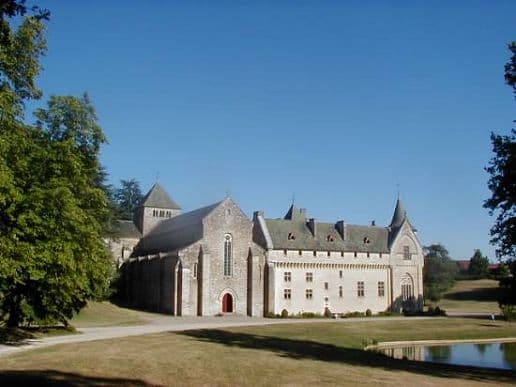
Abbey of Loc-Dieu
Abbey of Loc-Dieu is a Cistercian abbey situated in Aveyron, France, founded in 1123 on a site historically known as "devil's place" before being renamed "place of God" by its monastic inhabitants. Despite facing destruction and rebuilding, it became a significant Gothic architectural site and, during World War II, served as a safe haven for artworks from the Louvre, including the Mona Lisa. Today, the abbey and its park are open to the public.

Abbey of Saint-Germain-des-Prés
The Abbey of Saint-Germain-des-Prés, originally a Benedictine abbey founded in 558, is one of the oldest churches in Paris. It served as a significant center for scholarship, producing illuminated manuscripts, and was a royal necropolis. Despite destruction by Vikings and damage during the French Revolution, the church has undergone numerous rebuilds and restorations, incorporating Romanesque, Gothic, and later decorative styles, and remains an active Catholic parish church.

Abbey of Sénanque
Sénanque Abbey is a Cistercian monastery founded in 1148 in Provence, France, renowned for its remarkably preserved Romanesque architecture. Initially thriving, it experienced decline and was suppressed during the French Revolution, only to be re-established in 1854 and later reactivated in 1988. Today, it houses an active monastic community and is known for its lavender fields and spiritual retreats.