
Ascension Convent
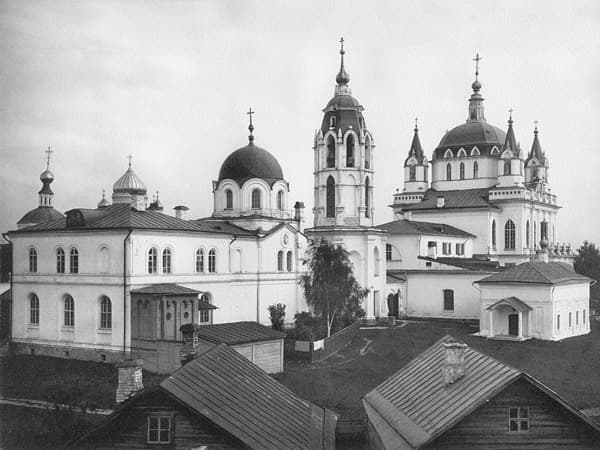
Ascension Convent, formerly known as the Starodevichy Convent or Old Maidens' Convent, was a significant Russian Orthodox nunnery located within the Moscow Kremlin. It served as the burial site for royal princesses, tsarinas, and noble ladies of the Muscovite court. The convent, a notable monument of conservative architecture, was ultimately destroyed in 1929 on the orders of Joseph Stalin.
Key Facts
- ›Founded in 1389 by Eudoxia Dmitriyevna, widow of Dmitry Donskoy.
- ›Served as a burial place for numerous grand princesses, tsarinas, and noble ladies.
- ›The cathedral was rebuilt multiple times, notably in 1467, 1518-1519, and 1587-1588.
- ›Used as a residence for royal fiancées before weddings.
- ›Destroyed in 1929 by the Soviet government to make way for a military school.
- ›Some of its icons and the iconostasis were relocated to other museums and cathedrals.

Conservative Russian Architecture, Neo-Gothic
Burial Site For Royal Women, Icon of the Virgin Hodegetria By Dionisius, Church of Saint Catherine By Carlo Rossi
Starodevichy Convent, Old Maidens' Convent, Voznesensky Monastyr
Eudoxia Dmitriyevna, Princess Maria of Borovsk, Sophia Vitovtovna, Sophia Paleologue, Ivan the Terrible, Grand Duchess Eudoxia Alexeyevna, Tsarin Maria Vladimirovna, Ivan Iv, Maria Nagaya, Marina Mnishek, False Dmitry I, Michael I of Russia, Michael Maleinos, Vasili Yermolin, Peter the Great, Anna Ioannovna, Dionisius, Carlo Rossi, Boris Godunov
- Fire In 1415
- Restoration In 1467
- Fire and Restoration In 1518–1519
- Rebuilding In 1587–1588
- Commissioning of the Church of Michael Maleinos In 1634
- Renovation In 1721
- Damage By Fire and Renovation In 1737
- Icon of the Virgin Hodegetria Moved To Vologda In 1812
- Addition of A Two-Storey Almshouse In 1823
- Damage By Bolshevik Artillery Fire During the October Revolution
- Destruction In 1929
About Ascension Convent
Ascension Convent, historically known as the Starodevichy Convent or Old Maidens' Convent, was a prominent Russian Orthodox nunnery situated within the Moscow Kremlin. Its significance stemmed largely from its role as the final resting place for numerous grand princesses, tsarinas, and other noblewomen from the Muscovite royal court. The convent's architecture evolved over centuries, with its main cathedral undergoing multiple reconstructions and expansions, notably in the late 16th century to mirror the nearby Archangel Cathedral and in the early 19th century with the addition of a Neo-Gothic church.
History and Architecture
The convent is believed to have been founded in 1389 by Eudoxia Dmitriyevna, the widow of Dmitry Donskoy, who later took the veil there. The foundation stone for its cathedral was laid just prior to her death in 1407. The structure suffered damage from fires in 1415 and again in the early 16th century, leading to significant rebuilds. The 1587–1588 reconstruction resulted in a five-domed edifice that reflected the conservative architectural preferences of Boris Godunov's era. Significant additions were made throughout its history, including a new church dedicated to St. Michael Maleinos commissioned in 1634 and a distinctive Neo-Gothic Church of Saint Catherine designed by Carlo Rossi in the 19th century.
Royal Burials and Function
Ascension Convent was a crucial site for the Muscovite dynasty, serving not only as a burial ground for prominent royal women such as Sophia Vitovtovna, Sophia Paleologue, and several wives of Ivan the Terrible, but also as a venue for royal fiancées to reside before their weddings. It was within its walls that Ivan IV's widow, Maria Nagaya, received Marina Mnishek before her marriage to False Dmitry I.
Destruction and Legacy
By the early 20th century, the monastery housed a significant community of nuns and lay sisters. However, its existence was tragically cut short. The ancient buildings sustained damage during the October Revolution and were completely demolished in 1929 on the orders of Joseph Stalin to make way for a military school. While the physical structures are gone, the legacy of Ascension Convent endures. Many of its precious icons were transferred to institutions like the State Tretyakov Gallery, and the iconostasis of the Ascension Cathedral was relocated to the Cathedral of Twelve Apostles. The tombs of the Muscovite royalty were moved to an annex of the Archangel Cathedral, preserving their historical significance. In recent years, archaeological studies have been conducted at the site, and the Moscow Kremlin Museums have opened an exhibition dedicated to the history of the ruined shrines, offering a glimpse into its past.
Source: Wikipedia ↗
Frequently Asked Questions
When was Ascension Convent founded?
Ascension Convent is believed to have been founded in 1389. The foundation stone for its cathedral was laid in 1407.
What was the primary function of Ascension Convent?
The convent's primary function was to serve as a burial place for grand princesses, tsarinas, and other noble ladies of the Muscovite royal court. It also functioned as a residence for royal fiancées before their weddings.
What happened to Ascension Convent?
Ascension Convent was destroyed in 1929 on the orders of Joseph Stalin. The Soviet government demolished the complex to create space for a military school.
Are there any remains of Ascension Convent today?
While the convent buildings were demolished, the tombs of the Muscovite royalty were transferred to an annex of the Archangel Cathedral within the Moscow Kremlin, where they can be found today. An exhibition dedicated to its history is also open in the Archangel Cathedral.
What architectural styles were present at Ascension Convent?
The convent featured a five-domed structure mirroring the Archangel Cathedral, embodying a conservative architectural approach. Later additions included a fanciful Neo-Gothic Church of Saint Catherine designed by Carlo Rossi.
Related Monasteries

Abbaye-aux-Bois
The Abbaye-aux-Bois, originally founded in 1202 as Notre-Dame-aux-Bois in Ognolles, was a Bernardine (Cistercian) convent that relocated to Paris in 1654. Renowned for educating daughters of aristocratic families and later hosting a significant literary salon, its buildings underwent numerous transformations after being expropriated in 1792. The abbey was ultimately destroyed in 1907 to facilitate urban expansion, with its site later occupied by a theater.
Conception Convent
The Conception Convent, also known as the Zachatyevsky Monastery, is a Russian Orthodox convent located on the Moskva River in Moscow. Originally believed to occupy the site of the oldest nunnery in Moscow, it was reestablished in 1995 after being closed by the Bolsheviks in 1918 and undergoing significant damage and repurposing during the Soviet era. Its reconstruction has seen the rebuilding of its katholikon in a Russian Revival style.

Ferapontov Monastery
The Ferapontov Monastery is a historically significant Russian Orthodox monastery located in the Vologda Oblast, founded in 1398 by Saint Ferapont. It gained prominence under Saint Martinian and was favored by Ivan III's family, eventually housing invaluable frescoes by the medieval painter Dionisius, making it the last surviving Russian medieval church with fully painted walls. Though it experienced periods of decline, devastation, and closure, it was reinstituted as a convent and later transformed into a museum, recognized as a UNESCO World Heritage Site in 2000.