
Somaskanda
Shaivism·Male·8th century·South India
Somaskanda is a medieval Hindu iconographic representation of the divine family of Shiva, his consort Uma (Parvati), and their son Skanda (Murugan). Originating in South India during the 6th-8th centuries CE, this depiction is considered a syncretic product, blending Puranic traditions with folk deities. It is significant for portraying Shiva as a householder with his family, a theme that gained prominence during the Pallava period.
Key Facts
- ›Somaskanda depicts Shiva, Uma (Parvati), and their son Skanda (Murugan) together.
- ›This iconographic form originated in South India between the 6th and 8th centuries CE.
- ›It is considered a product of syncretism, combining Puranic Shiva with folk deities.
- ›Shiva is typically shown with four arms in the Somaskanda representation.
- ›Uma is depicted seated, while Skanda is shown as an infant dancing or standing.
- ›The representation became prominent during the Pallava dynasty.

Somaskanda icon
Shiva With Four Arms, Shiva Seated In Sukhasana Pose, Mazhu In Shiva's Right Upper Hand, Deer In Shiva's Left Upper Hand, Parvati Seated In Sukhasana Pose, Skanda As An Infant Dancing Or Standing, Skanda Holding Shakti In His Right Hand, Skanda Holding Vajra In His Left Hand
Consort of Uma, Father of Skanda
Skanda
Mazhu, Shakti, Vajra
Deer
Iconographic Representation
About Somaskanda
Somaskanda is a notable medieval iconographic form within Hinduism, specifically representing the divine family of Shiva, his consort Uma (Parvati), and their son Skanda (Murugan). This depiction emerged in South India during the 6th to 8th centuries CE, a period marked by the influence of the Pallava dynasty.
Description and Origin
The Somaskanda representation is characterized by Shiva seated in a graceful pose, often with four arms. His consort, Uma, is depicted alongside him, and crucially, their son Skanda is shown as an infant or young child dancing in ecstasy between them. This iconographic style is considered a significant product of syncretism, blending the established Puranic traditions of Shiva with the veneration of folk deities like Korravai, who was identified with Parvati, and Murugan, identified with Skanda.
Iconographic Details
In the Somaskanda composition, Shiva typically adopts the sukhasana posture, with his left leg folded. His upper hands perform the kartarimukha-hasta, with the right holding a Mazhu (Axe) and the left a deer. His lower hands are held in specific mudras. Parvati is also seated in sukhasana, her right leg folded and left leg extended, with her hands in the kapittha-hasta mudra. The infant Skanda is portrayed either dancing in the araimandi pose or standing in vaitastika-sthanaka, his knees slightly bent. He is depicted holding a shakti in his right hand and a vajra in his left.
Source: Wikipedia ↗
Frequently Asked Questions
What does Somaskanda represent?
Somaskanda represents a divine family scene from Hinduism, featuring the god Shiva, his consort Uma (Parvati), and their son Skanda (Murugan). It is an iconographic form that portrays them together in a specific artistic depiction.
When and where did the Somaskanda depiction originate?
The Somaskanda representation originated in South India during the medieval period, specifically between the 6th and 8th centuries CE. This era corresponds to the rule of the Pallava dynasty.
What is the significance of the Somaskanda iconography?
The Somaskanda iconography is significant as it represents a syncretic fusion of Puranic traditions with indigenous folk deities. It highlights the aspect of Shiva as a householder and father, which was particularly emphasized during the Pallava period.
How is Shiva depicted in Somaskanda iconography?
In the Somaskanda depiction, Shiva is usually shown seated in the sukhasana pose with four arms. His upper hands hold a Mazhu (Axe) and a deer, while his lower hands are in specific mudras (hand gestures).
How are Parvati and Skanda depicted in Somaskanda?
Parvati is portrayed seated in a sukhasana pose, facing Shiva. Their son, Skanda (Murugan), is depicted as an infant or young child dancing ecstatically between them, or standing with bent knees.
Related Hindu deities
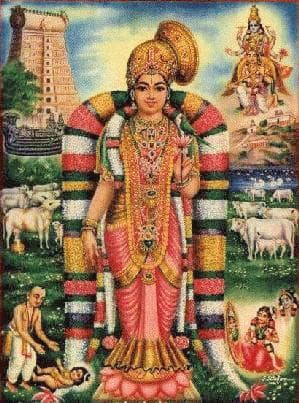
Andal
Andal, also known as Kotai and Nachiyar, is a revered Tamil saint and the only female Alvar among the 12 Alvars who championed Vaishnavism during the Bhakti movement. Considered an avatar of the earth goddess Bhumi, an aspect of Lakshmi, she is celebrated for her profound devotion to Lord Vishnu, particularly Krishna, and her poetic compositions, Tiruppavai and Nachiyar Tirumoli.

Bholenath
Bholenath, meaning 'lord of innocence,' is a popular epithet for the Hindu deity Shiva. This name highlights Shiva's aspect as the benevolent and guileless lord. The epithet is often invoked in narratives emphasizing Shiva's vulnerability and divine protection.

Hara
Shiva, also known as Mahadeva and Hara, is a principal deity in Hinduism and the Supreme Being in Shaivism. He is revered as the creator, protector, and transformer of the universe. Shiva embodies both benevolent and fearsome aspects, appearing as an ascetic yogi, a householder, and a slayer of demons, making him the patron god of yoga, meditation, and the arts.