
Navagrahas
The Navagraha are nine celestial bodies and deities in Hinduism, each influencing human life according to Hindu mythology. They consist of the Sun, Moon, five visible planets, and the lunar nodes Rahu and Ketu. These nine deities form a foundational framework in Jyotisha (Hindu astrology) and are widely worshipped in temples across the world.
Key Facts
- ›The Navagraha are nine planets and deities that govern human destiny in Hinduism.
- ›They include the Sun, Moon, Mercury, Venus, Mars, Jupiter, Saturn, and the lunar nodes Rahu and Ketu.
- ›The concept of Grahas, or seizing planets, is deeply integrated into Hindu astrology (Jyotisha).
- ›Each Graha is associated with specific colors, vehicles, weapons, and directional orientations.
- ›Worship of the Navagraha is common in Hindu temples, often in a dedicated shrine.
- ›Their influence extends beyond Hinduism to Jainism and Buddhism.

Nine Planets, Nine Heavenly Bodies
- Anthropomorphized Forms
- Distinct Colors
- Specific Vehicles
- Associated Weapons
- Directional Orientations
- Surya On A Chariot Pulled By Seven Horses
- Rahu As A Severed Head
- Ketu As A Headless Torso With A Serpent's Tail
Rigveda, Atharvaveda, Chandogya Upanishad, Mahabharata, Ramayana, Markandeya Purana, Vamana Purana, Vishnu Purana, Devi-Bhagawat Purana
Navagraha Temples of Tamil Nadu
Trident, Mace
Antelope, Hare, Ram, Serpent
Deity, Astrological Influence
About Navagrahas
Navagraha
The Navagraha, meaning 'Nine Planets' in Sanskrit, are a group of nine celestial bodies and deities central to Hindu cosmology and astrology. These nine entities are believed to exert influence over human lives on Earth. The group comprises the Sun (Surya), the Moon (Chandra), the planets Mercury (Budha), Venus (Shukra), Mars (Mangala), Jupiter (Brihaspati), and Saturn (Shani), along with the lunar nodes Rahu and Ketu.
Origins and Development
The conceptual roots of the Navagraha can be traced to the earliest Vedic literature, such as the Rigveda and Atharvaveda, which mention celestial bodies as cosmic agents. The Chandogya Upanishad acknowledges Rahu as a shadowy entity responsible for eclipses, an early precursor to the 'chaya graha' concept. Significant development occurred through contact with Hellenistic culture and Babylonian astronomy, leading to the integration of visible planets and the adoption of the seven-day week structured around these planets. By the 8th to 9th century CE, Rahu and Ketu were firmly established as 'chaya grahas', completing the canonical Navagraha.
Iconography and Worship
Each of the nine Grahas is depicted with a unique iconography that evolved during the early medieval period, often showing Hellenistic influence in their attributes. They are associated with specific colors, vehicles (vahanas), weapons, and directional orientations. For instance, Surya is typically shown on a chariot drawn by seven horses, while Rahu is depicted as a severed head and Ketu as a headless torso with a serpent's tail. Navagraha worship is prevalent in both domestic settings and Hindu temples, where dedicated shrines, known as 'Navagraha mandapas', are common. These shrines usually feature Surya at the center, surrounded by the other eight deities.
Role in Jyotisha
The Navagraha form the core of Jyotisha, the Hindu system of astrology. Each Graha governs specific zodiac signs (rashis), influences particular domains of human life, and presides over defined periods known as dashas. They are categorized as benefics (shubha grahas) and malefics (krura grahas), with Saturn, Mars, Rahu, and Ketu often considered the most challenging influences. The influence of the Navagraha extends beyond Hinduism, having been integrated into Jainism and Buddhism as well.
Source: Wikipedia ↗
Frequently Asked Questions
What are the Navagraha?
The Navagraha are nine celestial bodies and deities in Hinduism that are believed to influence human life. They are comprised of the Sun, Moon, the planets Mercury, Venus, Mars, Jupiter, Saturn, and the two lunar nodes, Rahu and Ketu.
What is the significance of the Navagraha in Hinduism?
The Navagraha are central to Jyotisha, or Hindu astrology, where they govern specific zodiac signs, aspects of human life, and time periods. They are also worshipped in temples as cosmic influencers.
Which celestial bodies are included in the Navagraha?
The Navagraha include the Sun (Surya), the Moon (Chandra), Mercury (Budha), Venus (Shukra), Mars (Mangala), Jupiter (Brihaspati), Saturn (Shani), and the lunar nodes Rahu and Ketu.
How are the Navagraha depicted in iconography?
Each Navagraha is anthropomorphized with distinct iconographic features, including specific colors, vehicles, numbers of arms, and weapons. For example, Surya is often depicted on a chariot pulled by seven horses, while Rahu is shown as a severed head.
Where are the Navagraha typically worshipped?
Navagraha worship takes place at both domestic levels and in Hindu temples. Many temples feature a designated shrine or 'Navagraha mandapa' where the nine deities are installed in a specific arrangement.
What is the astrological classification of Navagraha?
The Navagraha are divided into natural benefics (Shubha Grahas) such as Jupiter, Venus, Mercury, and the waxing Moon, and natural malefics (Krura Grahas) like Mars, Saturn, Rahu, Ketu, and sometimes the Sun. Negative influences are termed 'dosha'.
Related Hindu deities

Nataraja
Nataraja is a depiction of the Hindu deity Shiva as the divine cosmic dancer, known for his tandava dance. This iconic form symbolizes Shiva's cosmic functions of creation, preservation, and destruction, and is widely revered as one of the highest forms of Shiva, particularly in Tamil Nadu. The Nataraja sculpture is a significant symbol of Indian culture and Hindu art, representing the interconnectedness of religion and the arts.

Narmada
The Narmada River, also known as Narbada or Nerbudda, is the fifth longest river in India and the longest west-flowing river. It is considered a goddess and a mother figure in Hinduism, revered for its sacredness and the banalinga pebbles found in its bed. The river originates from the Amarkantak Plateau and flows through Madhya Pradesh and Gujarat, forming a traditional boundary between North and South India.
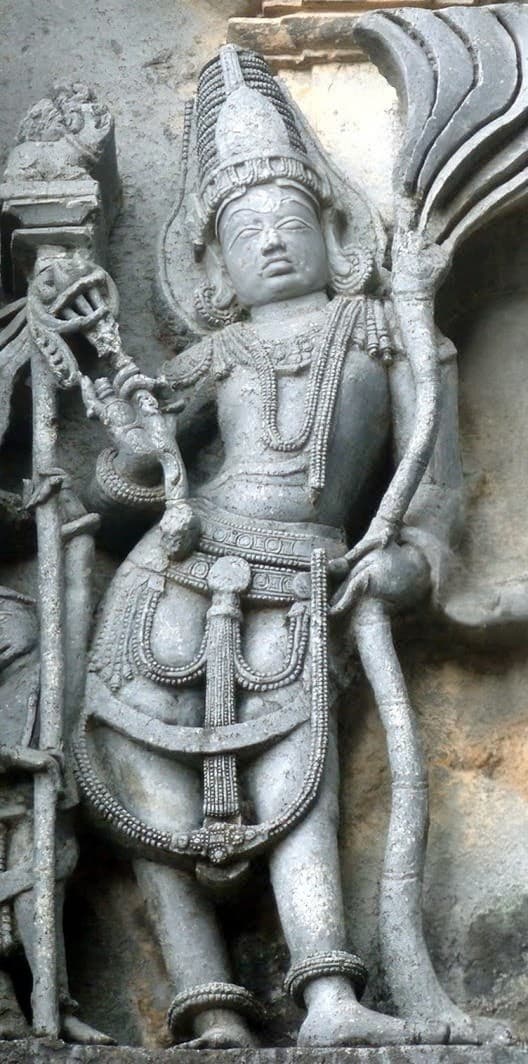
Kamadeva
Kamadeva is the Hindu god of love, attraction, pleasure, and beauty, as well as the personification of kāma (desire). He is depicted as a handsome youth armed with a bow of sugarcane and flower arrows, often accompanied by his consort Rati. Kamadeva's mythology is prominent in the Puranas, where he is known for being incinerated by Shiva's third eye and subsequently reborn as Pradyumna.