
Kurma
Kurma is the second avatar of the Hindu preserver deity Vishnu, most famously appearing in the legend of the churning of the Ocean of Milk. He is also identified with Kashyapa, a Vedic sage and progenitor of all life, and Akupara, the cosmic turtle that supports the Earth. Kurma symbolizes steadfastness, spiritual regeneration, and the churning of the mind through meditation.
Key Facts
- ›Kurma is the second of the ten principal incarnations of Vishnu (Dashavatara).
- ›He is closely identified with the Vedic sage Kashyapa, who is considered the progenitor of all living beings.
- ›Kurma plays a pivotal role in the Samudra Manthana (Churning of the Ocean of Milk) legend, supporting Mount Mandara.
- ›The deity is also equated with Akupara, the World-Turtle that bears the Earth.
- ›Kurma symbolizes firmness, steadiness, and the process of spiritual regeneration.
- ›He is associated with meditation and the symbolic churning of the mind for liberation.

Kacchapa, Kamaṭha, Akupara, Ambucara-Atmana, Kurma-raja, Kurma-avatar
- Depicted As A Tortoise
- Often Shown Supporting Mount Mandara
- Sometimes Depicted With Multiple Heads Or Arms In Certain Puranic Narratives
- Associated With the Shaligram Stone Described As Black With Circular Lines and An Elevated Hinder Part
Yajurveda, Mahabharata, Agni Purana, Vishnu Purana, Bhagavata Purana, Matsya Purana, Kurma Purana, Shatapatha Brahmana, Taittiriya Samhita, Taittiriya Aranyaka, Vajasaneyi Samhita, Atharvaveda
- Identified With Kashyapa, Progenitor of Beings
- Son of Vairaja and Sambhuti
Bharata, Himalayan Continent
Sudarshana Chakra
Turtle, Tortoise
Divine Incarnation, Mythological Figure
About Kurma
Kurma: The Tortoise Avatar of Vishnu
Kurma is revered as the second avatar of the Hindu preserver deity, Vishnu. His most prominent appearance is in the ancient legend of the Samudra Manthana, or the Churning of the Ocean of Milk, where he assumes the form of a giant tortoise to support Mount Mandara, the cosmic churning rod. This act was crucial for the gods (devas) and demons (asuras) to churn the ocean and obtain the nectar of immortality (amrita).
Origins and Syncretism
The concept of Kurma has roots in Vedic literature, where he is identified with the sage Kashyapa, a revered figure considered the progenitor of all living beings. Kashyapa, whose name also means 'Tortoise,' signifies a deep connection to creation and sustenance. In later post-Vedic texts, particularly the Puranas, this association solidifies, and Kurma is explicitly listed as one of Vishnu's ten principal incarnations (Dashavatara). He is also linked with Akupara, the cosmic turtle that metaphorically supports the Earth, emphasizing his role as a foundational supporter.
Symbolism and Significance
Kurma embodies qualities of steadfastness, immovability, and profound patience, reflecting the nature of the tortoise. His involvement in the Samudra Manthana is interpreted allegorically as the churning of the mind through meditation to achieve spiritual liberation (Moksha). The tortoise form represents a stable foundation, essential for navigating the complexities of existence and for spiritual advancement. He is also seen as a symbol of cosmic creation and regeneration, linking the primordial tortoise with the emergence of life and divine elements from the cosmic ocean.
Role in Scriptures
While not explicitly appearing in the Rigveda, Kurma's origins are traced to the Yajurveda and Shatapatha Brahmana, where the tortoise is associated with Prajapati, the creator god. His narrative is extensively detailed in various Puranas, including the Vishnu Purana, Bhagavata Purana, and Kurma Purana, which bear his name. These texts elaborate on his participation in the Samudra Manthana, his role in supporting the Earth, and his divine attributes, solidifying his place as a significant deity within the Vaishnava tradition.
Source: Wikipedia ↗
Frequently Asked Questions
What does the name 'Kurma' mean?
The Sanskrit word 'Kurma' (कूर्म) translates to 'Tortoise' or 'Turtle'. This name reflects the form taken by the avatar.
What is the significance of Kurma in the Samudra Manthana?
In the legend of the Churning of the Ocean of Milk, Kurma serves as the colossal base upon which Mount Mandara is placed as the churning rod. His steadfastness is crucial for the gods and demons to extract the nectar of immortality.
How is Kurma related to the sage Kashyapa?
Vedic literature, such as the Yajurveda, explicitly states that Kurma and the sage Kashyapa are synonymous. Kashyapa, also meaning 'Tortoise,' is revered as the progenitor of all living beings.
What does Kurma symbolize in Hindu philosophy?
Kurma symbolizes firmness and steadiness, representing the ability to remain grounded amidst the chaos of existence. He is also seen as a representation of spiritual regeneration and the process of churning one's mind through meditation to achieve liberation.
Where does the origin of Kurma's concept lie?
The concept of Kurma originates in Vedic literature, specifically the Shatapatha Brahmana, where the tortoise is equated with the creator deity Prajapati. Later Puranic literature further develops his role as an avatar of Vishnu.
Related Hindu deities

Buddha
In Hinduism, particularly within the Vaishnava tradition, the Buddha is revered as the ninth avatar of the god Vishnu. This integration into Hindu cosmology aimed to absorb and account for the rise of Buddhism, with some Hindu texts describing Vishnu taking the form of Buddha to delude demons and restore cosmic order. While many Hindus today still consider Buddhism a form of Hinduism and revere the Buddha, some scholars and religious figures reject this identification, asserting that Gautama Buddha and the Vishnu avatar are distinct individuals.

Caturvyūha
Caturvyūha, meaning 'four emanations,' is an ancient Indian religious concept that initially referred to the four earthly emanations of the Supreme deity Nārāyaṇa, later identified as Viṣṇu. These emanations are primarily associated with the Vrishni heroes, with Vāsudeva being the first and most prominent. The concept evolved from earlier cults of heroes into a doctrine of divine incarnations, becoming a foundational element in the development of Vaishnavism.
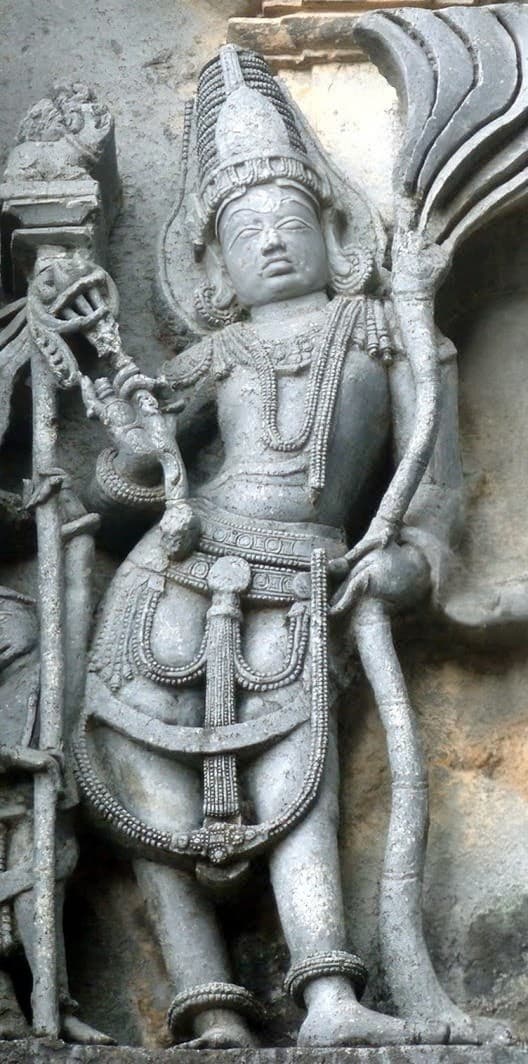
Kamadeva
Kamadeva is the Hindu god of love, attraction, pleasure, and beauty, as well as the personification of kāma (desire). He is depicted as a handsome youth armed with a bow of sugarcane and flower arrows, often accompanied by his consort Rati. Kamadeva's mythology is prominent in the Puranas, where he is known for being incinerated by Shiva's third eye and subsequently reborn as Pradyumna.