
Jyotirlinga
A Jyotirlinga is a devotional representation of the Hindu god Shiva, symbolizing a pillar of light. The concept originates from a legend in the Shiva Purana where Shiva appeared as an infinite pillar of light to settle a dispute between Brahma and Vishnu. The Jyotirlinga shrines are considered sacred sites where Shiva manifested in this form, with twelve particularly auspicious sites.
Key Facts
- ›Jyotirlinga translates to 'lingam of light' and is a representation of Lord Shiva.
- ›The concept originates from a legend in the Shiva Purana involving Brahma and Vishnu.
- ›Shiva appeared as a pillar of light to establish his supremacy.
- ›Brahma was cursed for lying about finding the end of the light, while Vishnu was praised for his honesty.
- ›There are believed to be 64 original Jyotirlinga shrines in India.
- ›Twelve of these Jyotirlinga sites are considered especially auspicious and holy.

Jyotirlingam
Pillar of Light, Lingam
Shiva Purana, śAtarudra SaṁHitā, Kotirudra SaṁHitā, DvāDaśA JyotirliṅGa Stotram
Jyotirlinga Shrines
About Jyotirlinga
What is a Jyotirlinga?
A Jyotirlinga, meaning 'lingam of light,' is a devotional representation of the Hindu god Shiva. This concept originates from the Shiva Purana, a significant Hindu scripture. The term is a Sanskrit compound derived from 'jyotis' (radiance) and 'linga' (sign or symbol), collectively representing a radiant symbol of Shiva.
Legend of Origin
The legend behind the Jyotirlinga describes a dispute between Brahma, the god of creation, and Vishnu, the god of preservation, regarding their supremacy. To resolve this, Shiva appeared as a colossal, infinite pillar of light, the Jyotirlinga, piercing the three worlds. Brahma and Vishnu attempted to find the extremities of this light pillar. Vishnu, in his Varaha avatar, tried to descend, while Brahma rode a swan to ascend. Brahma falsely claimed to have found the end of the light, presenting a ketakī flower as false evidence. Vishnu, however, honestly admitted his inability to find the end. This dishonesty angered Shiva, leading him to curse Brahma, decreeing that he would not be worshipped. Conversely, Vishnu was eternally praised for his honesty.
Significance and Shrines
The Jyotirlinga shrines are recognized as the sacred places where Shiva manifested in this form of a fiery column of light. Originally, 64 Jyotirlingas were believed to exist throughout India. Among these, twelve are considered exceptionally auspicious and holy, each embodying a distinct manifestation of Shiva. At each of these twelve sites, the principal image is the lingam, which symbolizes the beginningless and endless pillar, representing the infinite nature of Shiva.
Source: Wikipedia ↗
Frequently Asked Questions
What is a Jyotirlinga?
A Jyotirlinga is a devotional representation of the Hindu god Shiva. The word combines 'jyotis' (radiance) and 'linga' (sign), signifying a lingam of light.
What is the origin of the Jyotirlinga concept?
According to a legend in the Shiva Purana, Shiva appeared as a huge, infinite pillar of light, a Jyotirlinga, to settle an argument between Brahma and Vishnu about their supremacy.
Why did Brahma and Vishnu try to find the end of the light?
Brahma and Vishnu decided to find the end of the pillar of light to prove their supremacy. Vishnu descended and Brahma ascended, but Brahma lied about finding an end, while Vishnu truthfully admitted he could not.
What was the consequence of Brahma's lie?
Shiva, angered by Brahma's dishonesty, cursed him, stating that Brahma would not be worshipped. In contrast, Vishnu was eternally praised for his honesty.
How many Jyotirlinga shrines are there?
The Shiva Purana mentions 64 original Jyotirlinga shrines across India. Of these, twelve are considered particularly auspicious and holy.
What is the significance of the Jyotirlinga shrines?
These shrines are considered sacred sites where Shiva manifested as a fiery column of light. Each of the twelve most sacred sites is seen as a different manifestation of Shiva, with the primary image being a lingam symbolizing Shiva's infinite nature.
Related Hindu deities

Bholenath
Bholenath, meaning 'lord of innocence,' is a popular epithet for the Hindu deity Shiva. This name highlights Shiva's aspect as the benevolent and guileless lord. The epithet is often invoked in narratives emphasizing Shiva's vulnerability and divine protection.
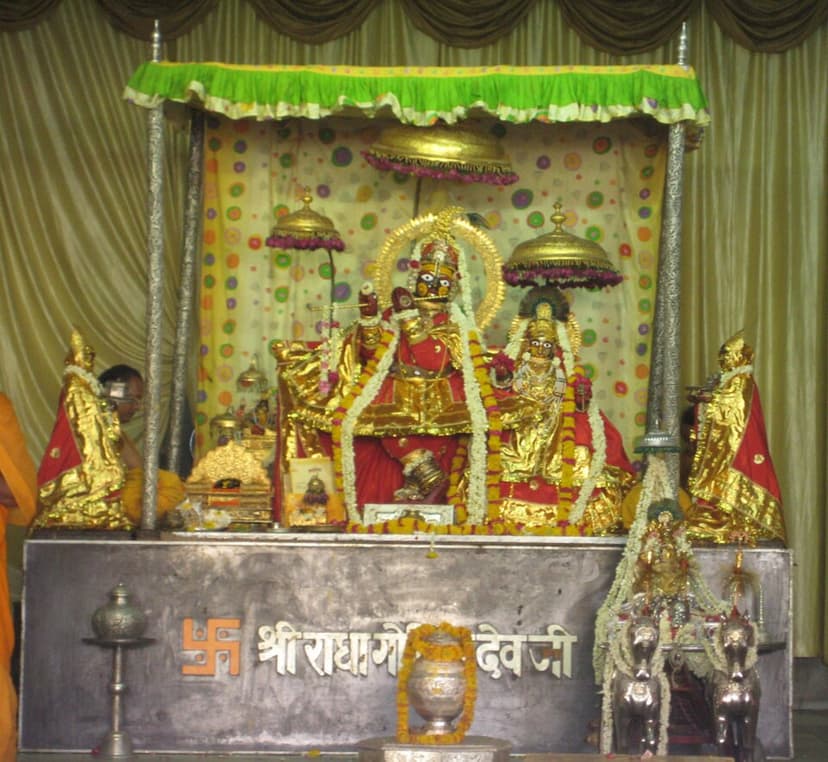
Govinda
Govinda is a significant epithet primarily associated with the Hindu deity Vishnu and his prominent avatars, most notably Krishna. The name signifies "protector of cows" and also refers to the deity as the "master of the senses" or the supreme being known through the Vedas. Worship of Govinda is believed to help devotees transcend the cycle of birth and death.

Madhava
Madhava is a significant epithet primarily associated with the Hindu deities Vishnu and Krishna. The name derives from 'Madhu,' meaning honey, and can refer to Krishna's lineage or his role as the consort of Lakshmi, the mother of the universe. He is invoked in scriptures for protection and is depicted as a powerful deity wielding divine weapons.