
Central Sikh Temple
Singapore·Singapore·20th·Historic
The Central Sikh Temple is a prominent Sikh gurdwara located in Singapore, serving as a spiritual and cultural center for the Sikh community. Established in 1912 and relocated several times, its current site was established in 1986 following urban redevelopment initiatives. It is recognized as a historical site by the National Heritage Board.
Key Facts
- ›Established in 1912, it has undergone multiple relocations.
- ›The current site at Towner Road was established in 1986.
- ›It was designated a historical site by the National Heritage Board on May 8, 1999.
- ›The temple's construction at its current location cost S$6.5 million.
- ›It is one of seven Sikh temples in Singapore.
- ›A seven-story Sikh community building is situated beside the temple.

Central Sikh Gurdwara, Queen Street Gurdwara Sahib (historical name), Wadda Gurdwara (historical name)
- Establishment of the Queen Street Gurdwara Sahib in 1912.
- Confiscation of temple control by the government in 1917.
- Protests for the return of control in the 1930s.
- Passing of the Queen Street Gurdwara Ordinance in 1940.
- Government acquisition of the Queen Street site in 1977 for urban redevelopment.
- Relocation of Guru Granth Sahib to Bukit Ho Swee Community Centre in 1979.
- Laying of the foundation stone for the new shrine in 1983.
- Completion of construction in 1986.
- Official opening by President Wee Kim Wee in 1986.
- Designation as a historical site in 1999.
Sant Baba Nahar Singh Ji Sunehranwale
Guru Nanak Gurpurab
About Central Sikh Temple
The Central Sikh Temple, also known as the Central Sikh Gurdwara, stands as a significant religious and cultural institution for the Sikh community in Singapore. Established in 1912, the temple has a history marked by several relocations, with its current site at Towner Road being inaugurated in 1986.
History and Development
The origins of the Central Sikh Temple trace back to 1912 when the Singaporean Sikh community, with support from Sindhis and the Straits Settlements Police, decided to construct a new place of worship. Initially, a bungalow was purchased at Queen Street and developed into the Queen Street Gurdwara Sahib, also referred to as 'Wadda Gurdwara' or 'The Big Temple.' Internal community divisions led to government control of the temple by the Muslim and Hindu Endowment Board in 1917. However, following advocacy by Sikhs like Sham Singh Rumi, the Queen Street Gurdwara Ordinance was passed in 1940, establishing a representative Sikh board of trustees to manage the complex.
In the 1950s, plans for expansion were made at the Queen Street site, but these were superseded when the government acquired the land in 1977 as part of an urban redevelopment program. The community was then directed to a new site at Towner Road. The Guru Granth Sahib was temporarily housed at the Bukit Ho Swee Community Centre before the foundation stone for the new shrine was laid in 1983. Construction commenced in 1984 and concluded in 1986, coinciding with Guru Nanak Gurpurab. The temple was officially opened by President Wee Kim Wee on November 16, 1986.
Recognition and Facilities
The Central Sikh Temple was officially designated as a historical site by the National Heritage Board on May 8, 1999, recognizing its long-standing presence and importance within Singapore's historical landscape. Adjacent to the main temple is a seven-story building that serves as a community center, facilitating cultural activities and religious education for Sikhs in Singapore. The temple is one of seven Sikh gurdwaras located within the country.
Source: Wikipedia ↗
Frequently Asked Questions
When was the Central Sikh Temple established?
The Central Sikh Temple was established in 1912. It has since relocated several times to accommodate the growing Sikh community.
Where is the Central Sikh Temple located?
The Central Sikh Temple is located at Towner Road, at the junction of Serangoon Road in Kallang, Singapore, near Boon Keng MRT station.
What is the history behind the Central Sikh Temple's location?
The temple was originally established as the Queen Street Gurdwara Sahib. Due to urban redevelopment, the government acquired the site in 1977, leading to the relocation to Towner Road, with construction completed in 1986.
Has the Central Sikh Temple been recognized for its historical significance?
Yes, the Central Sikh Temple was designated as a historical site by the National Heritage Board on May 8, 1999, acknowledging its importance to Singapore's heritage.
What is the significance of the seven-story building next to the temple?
The adjacent seven-story structure serves as a hub for the Sikh community, hosting various cultural activities and religious classes.
Related Gurdwaras

Gur Sikh Temple
The Gur Sikh Temple in Abbotsford, British Columbia, is the oldest existing Sikh gurdwara in North America and a National Historic Site of Canada. Established in 1911, it holds significant historical and cultural importance as a testament to the early Sikh diaspora's establishment on the continent.
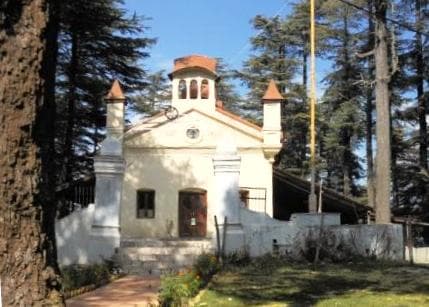
Chail Gurudwara
The Chail Gurudwara is a Sikh temple established in 1907 in Chail, Himachal Pradesh, by Maharaja Bhupinder Singh of Patiala. Its architecture, which notably resembles a church, has been preserved through renovations. After the partition of Punjab, the building came under the management of the Himachal Pradesh government and is currently overseen by the Department of Art & Culture, with support from the Chail Heritage Foundation and a Gurudwara Management Committee.
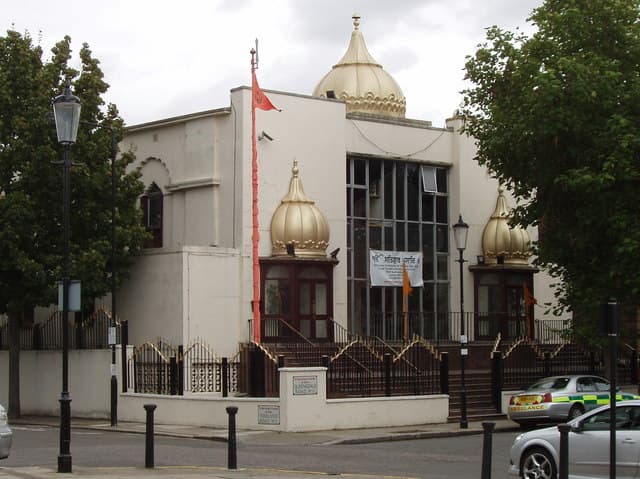
Central Gurdwara (Khalsa Jatha) London
The Central Gurdwara (Khalsa Jatha) London is the oldest Sikh place of worship in the United Kingdom and Europe, established in 1908. It is affiliated with the Chief Khalsa Dewan of Amritsar and maintains traditional Khalsa practices, including displaying the original Sikh flag symbol. The gurdwara moved to its current Queensdale Road location in 1969.