
Bukavac
Slavic mythology·mythology·Slavic·demonic mythical creature
The Bukavac is a demonic mythical creature found in Slavic mythology, particularly in the region of Syrmia. It is depicted as a monster that emerges from lakes and pools at night to make loud noises and attack people and animals by strangling them.
Key Facts
- ›The Bukavac is a demonic mythical creature from Slavic mythology.
- ›Belief in the Bukavac was present in Syrmia.
- ›It is described as a six-legged monster with gnarled horns and bright blue eyes.
- ›The creature inhabits lakes and pools.
- ›It emerges at night to make loud noises, a characteristic reflected in its name (buka means 'noise').
- ›The Bukavac would attack people and animals by jumping on them and strangling them.
Strangulation, Terror, Night Attacks
Making Loud Noises, Strangling Victims, Nighttime Emergence
About Bukavac
What is the Bukavac?
The Bukavac is a fearsome demonic mythical creature found in Slavic mythology, with specific belief in its existence recorded in the region of Syrmia.
Appearance and Habitat
This creature is sometimes described as a monstrous being possessing six legs, adorned with gnarled horns, and featuring striking bright blue eyes. The Bukavac is said to make its home in lakes and pools, emerging from these watery depths under the cover of night.
Behavior and Notoriety
The creature's name itself is derived from the Slavic word 'buka,' meaning 'noise,' a testament to its nocturnal habits. It is known to leave its aquatic dwelling to create loud sounds. Its terrifying nature is further amplified by its predatory behavior; the Bukavac would reportedly jump onto people and animals, strangling them. This makes it a symbol of nocturnal danger and a creature that instills fear within the folklore of the regions where its belief persisted.
Source: Wikipedia ↗
Frequently Asked Questions
What is a Bukavac?
The Bukavac is a demonic mythical creature from Slavic mythology. It is known for its terrifying appearance and its habit of attacking living beings.
Where does the Bukavac come from?
Belief in the Bukavac existed in Syrmia, a region within Slavic mythology. It is associated with lakes and pools.
What does a Bukavac look like?
The Bukavac is sometimes imagined as a monster with six legs, gnarled horns, and bright blue eyes. Its appearance is meant to be frightening.
What does the Bukavac do?
At night, the Bukavac emerges from its watery habitat to make loud noises. It then attacks people and animals, jumping on them and strangling them.
What is the origin of the Bukavac's name?
The name 'Bukavac' is derived from the Slavic word 'buka,' which means 'noise.' This refers to the loud sounds the creature makes when it emerges at night.
Related Demons
Lechies
The Leshy is a tutelary spirit of the forest in pagan Slavic mythology, embodying the wilderness and its resources. While often depicted as a masculine humanoid, the Leshy can change its appearance and size, and its attitude towards humans varies greatly depending on their behavior towards the forest. It is notable for its role as both a protector and a trickster, capable of misguiding wanderers or abducting children.
Boruta
Boruta is a fictional character from Polish mythology and folklore, most notably associated with the town of Łęczyca. Originally a pagan Slavic leshy, he transformed in post-Christianization times and is often depicted as a nobleman whose primary role was to corrupt other nobles. His depiction as a nobleman is debated by ethnologists, with some suggesting it is a 19th-century fakelore.
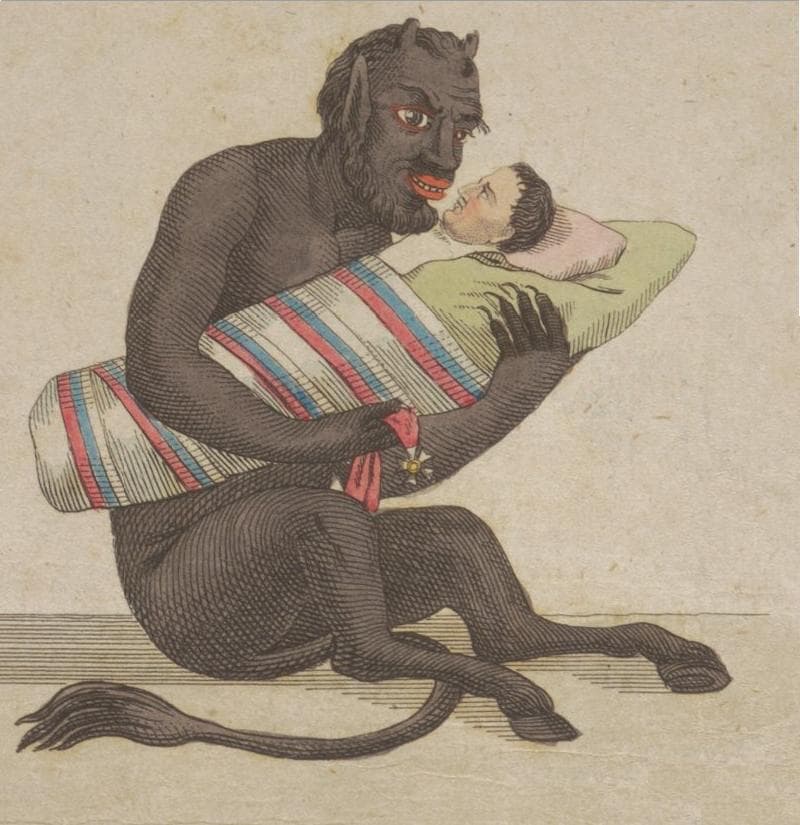
Chort
A chort is an anthropomorphic malign spirit or demon found in Slavic folk tradition, often depicted with Christian devil-like features such as horns, hooves, and a tail. In some traditions, a singular chort is considered a son of the god Chernobog and goddess Mara, and in folk Christianity, they are seen as lesser minions of Satan. The term also appears in various Russian curses and expressions denoting frustration or misfortune.