
Abraxas
Gnosticism·Demonology, Mythology, Esotericism·Greco-Roman, Early Christian·Archon, Deity, Spirit
Abraxas, also known as Abrasax, is a significant figure in Gnostic Christianity, often referred to as the "Great Archon." His name appears in key Gnostic texts and ancient magical papyri, and he is notably associated with engraved gemstones known as Abraxas stones, which were used as amulets. The precise origin and meaning of his name are debated, with theories linking it to Egyptian, Hebrew, and Greek etymologies, and his role varies from a supreme deity to a cosmic ruler within Gnostic cosmology.
Key Facts
- ›Abraxas is identified as the "Great Archon" in Gnostic Christianity.
- ›His name appears in Gnostic texts like the Holy Book of the Great Invisible Spirit and the Apocalypse of Adam.
- ›Abraxas stones, engraved gemstones featuring his name or iconography, were used as amulets.
- ›The numerical value of the Greek letters in ΑΒΡΑΣΑΞ is 365, representing the days in a year, and this connects him to the 365 heavens in some Gnostic systems.
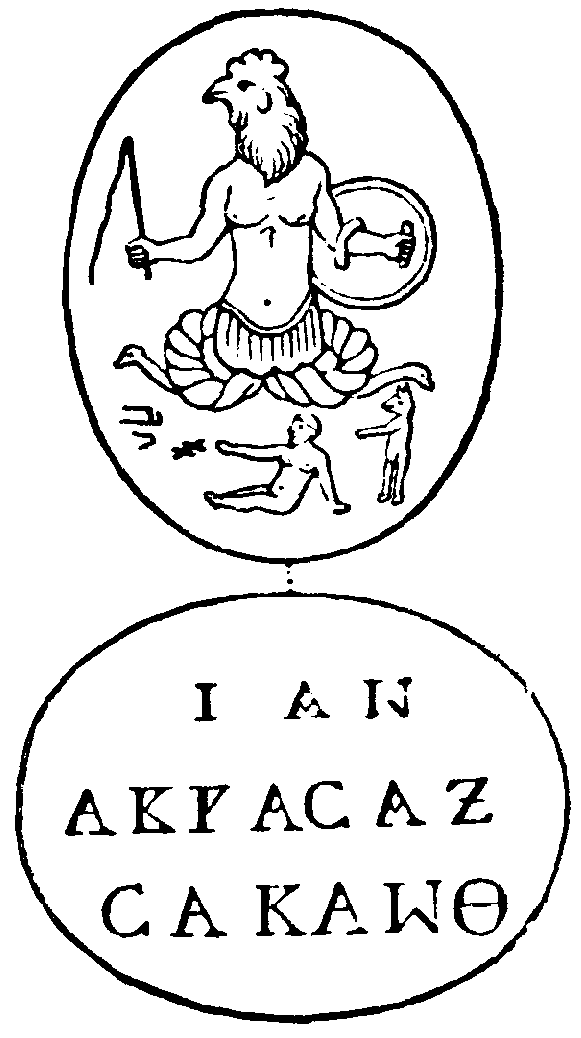
- ›His appearance is often depicted as a composite figure with a cock's head, a human body, and serpent legs, sometimes called the Anguipede.
- ›His exact role and origin within Gnostic traditions remain subject to scholarly interpretation.
Abrasax, ἀβράξας, ἀβρασάξ
Cosmic Order, Creation, Salvation, Mystical Power
Controlling 365 Heavens, Sending Christ, Protecting Wearers of Amulets
Holy Book of the Great Invisible Spirit, Apocalypse of Adam, Greek Magical Papyri, Irenaeus's Against Heresies, Hippolytus's Refutation of All Heresies, Epiphanius's Panarion, Pseudo-Tertullian's Adversus Omnes Haereses
Basilides, Sophia, Nous, Logos, Phronesis, Dynamis, Aeons, Archons, Demiurge, Mithras, Phre, Harpocrates
Cosmic Order, Yearly Cycles, Divine Power, Gnostic Salvation
- Engraved On Amulets For Protection and Magical Purposes.
- Associated With Incantations and Mystic Names In Magical Writings.
- Used In Gnostic Ceremonies, Possibly Involving Figurative Representations.
Iao, Elohi, Adonai, Sabaoth, Angels
- In Some Gnostic Traditions, Abraxas Is Seen As A Supreme Creator Deity Or Archon Ruling Over 365 Heavens. In Other Texts, Like Those From the Nag Hammadi Library, He Appears As An Aeon Within the Pleroma, Associated With Sophia and the Outer Borders of the Divine Realm.
Cock's Head, Serpent Legs, Shield, Club, Flail, Scorpions, Sun, the Number 365
About Abraxas
Abraxas, also known as Abrasax, is a significant figure within Gnostic Christianity, often identified as the "Great Archon" or a supreme cosmic power. His name and imagery are found in ancient Gnostic texts, including the Holy Book of the Great Invisible Spirit and the Apocalypse of Adam, as well as in the Greek Magical Papyri. The term "Abraxas stones" refers to antique gemstones engraved with his name or iconography, which were widely used as amulets and charms.
Etymology and Meaning
The precise origin and meaning of the name Abraxas remain a subject of scholarly debate. Various theories propose derivations from Egyptian, Hebrew, or Greek, with potential interpretations ranging from "the honorable and hallowed word" to "hurt me not" or "the beautiful, the glorious Savior." The numerical value of the Greek letters in ΑΒΡΑΣΑΞ is 365, corresponding to the days of the solar year, a detail that holds significance in some Gnostic cosmological systems.
Role in Gnosticism
In heresiological accounts, particularly concerning the teachings of Basilides, Abraxas is described as the ruler of 365 heavens, containing within himself the number of days in a year. He is sometimes depicted as the progenitor of Mind (Nous) and the creator of the world and its heavens, with Christ sent not by the world's maker but by Abraxas. However, primary Gnostic sources, such as those from the Nag Hammadi library, suggest a different placement for Abraxas, often identifying him as an Aeon dwelling near Sophia within the Pleroma, involved in the interactions between the divine realm and the material world.
Iconography and Magical Objects
Abraxas is frequently associated with a distinctive composite figure known as the Anguipede. This imagery typically features a cock's head, a human body, and serpent legs, sometimes ending in scorpions. He is often depicted holding a shield and a club or flail. These figures, along with inscriptions, are commonly found on "Abraxas stones," which served as powerful amulets. The iconography of Abraxas stones often incorporates symbols and divine names from various traditions, including Jewish, Persian, Egyptian, and Greek mythologies, reflecting the syncretic nature of Gnosticism and ancient magic.
Source: Wikipedia ↗
Frequently Asked Questions
Who is Abraxas in Gnosticism?
Abraxas is a term for the "Great Archon" within Gnostic Christianity. He is a prominent figure in various Gnostic cosmologies, though his exact role and significance can vary between different texts and interpretations.
What are Abraxas stones?
Abraxas stones are antique gemstones engraved with the name Abraxas or related symbols and figures. These stones were commonly used as amulets or charms for protection and mystical purposes.
What is the meaning of the name Abraxas?
The etymology of the name Abraxas is uncertain and debated. Theories suggest origins in Egyptian, Hebrew, or Greek, with proposed meanings ranging from "the honorable and hallowed word" to "hurt me not" or "the beautiful, the glorious Savior."
What does Abraxas look like?
Abraxas is frequently depicted as a composite figure, often with the head of a cock, the body of a man, and serpent legs. This form is sometimes referred to as the Anguipede and may include attributes like a shield, club, or whip.
What is the significance of the number 365 in relation to Abraxas?
The Greek spelling of Abraxas (ΑΒΡΑΣΑΞ) has a numerical value of 365 when letters are assigned their isopsephic values. This number is significant in some Gnostic systems, often representing the number of heavens or days in a year, linking Abraxas to cosmic order.
Related Demons
Archon
Archons are malevolent spiritual rulers in Gnosticism and related traditions, responsible for creating the physical universe and preventing souls from ascending to the divine realm. They are often associated with the seven planets and are depicted as demonic entities with bestial, androgynous appearances. Their role as builders and jailers of the material world makes them significant figures in Gnostic cosmology and eschatology.
Aamon/Amon
Aamon, also known as Amon, is a Grand Marquis of Hell in demonology, commanding 40 infernal legions according to the Ars Goetia. He is notable for his knowledge of the past and future, his ability to reconcile friends and foes, and his association with life and reproduction. His origins are linked to ancient Libyan and Punic deities.

Abyzou
Abyzou is a female demon prominently featured in the folklore and demonological texts of the Near East and Europe, especially known for causing miscarriages and infant mortality. Driven by envy due to her own infertility, she is depicted as a malevolent entity with numerous names and forms. Her fullest depiction is in the Testament of Solomon, and she is also associated with figures like Gylou and Alabasandria, appearing on ancient magical amulets.