
Toulon Cathedral
Toulon Cathedral, also known as Notre-Dame-de-la-Seds or Sainte-Marie-Majeure, is a historic Catholic cathedral in Toulon, France. It has served as the seat of bishops since the 5th century and currently functions as the ecclesiastical seat for the Diocese of Fréjus-Toulon. The cathedral is a national monument, notable for its long construction history spanning from the 11th to the 18th century.
Key Facts
- ›The present cathedral's construction began in 1096.
- ›It was temporarily used as a mosque in 1543-1544 for Ottoman admiral Hayreddin Barbarossa's fleet.
- ›Additions were made between 1654 and 1659, enclosing the original Romanesque structure.
- ›The classical façade was constructed between 1696 and 1701.
- ›A clock tower, 36 meters high, was built between 1737 and 1740.
- ›The Baroque retable in the Corpus Christi chapel was originally designed by Pierre Puget.

Romanesque Nave Bays, Chapel of Relics, Classical FaçAde, Clock Tower, Baroque Retable By Christophe Veyrier, Memorial Plaque From 1239
Pierre Puget, Christophe Veyrier
About Toulon Cathedral
Toulon Cathedral, officially known as Cathédrale Notre-Dame-de-la-Seds de Toulon and also referred to as Sainte-Marie-Majeure, is a significant Catholic church located in the city of Toulon, within the Var department of France. It holds the status of a national monument and has a history stretching back to at least the 5th century when it first served as the seat for the Bishops of Toulon. Since 1957, it has been the ecclesiastical center for the Diocese of Fréjus-Toulon.
History and Construction
The origins of a cathedral in Toulon date back to the 5th century, though no remnants of this earliest structure survive. The foundation of the present building is traditionally attributed to Gilbert, Count of Provence, who initiated its construction in 1096, purportedly in gratitude for his safe return from the Crusades. The earliest surviving parts of the cathedral are the first three bays of the nave, which date from the Romanesque period of the 11th century. The Chapel of Saint Joseph was originally the choir apse of this early church.
Significant modifications and additions have shaped the cathedral over the centuries. The Chapel of Relics was added in the 15th century. A notable, albeit temporary, historical event occurred in the winter of 1543–1544 when the cathedral was converted into a mosque to accommodate the large fleet of the Ottoman-Barbary admiral Hayreddin Barbarossa, who was an ally of Francis I of France at the time. The city's residents were temporarily relocated to make way for the sailors.
As Toulon grew in importance as a naval port under Henri IV and Louis XIV, the cathedral also underwent expansion. Additions made between 1654 and 1659 effectively enclosed the original Romanesque structure and integrated the Chapel of Relics. The cathedral's classical façade was constructed between 1696 and 1701 during the reign of Louis XIV, featuring a massive porch supported by Corinthian columns and adorned with angels holding the arms of Toulon. This façade suffered damage during the French Revolution but was restored to its original appearance in 1816. A memorial plaque dating back to 1239 is also preserved within the cathedral.
The clock tower, a prominent feature, was erected between 1737 and 1740. It stands 36 meters high and is three meters thick at its base. Topped with an iron campanile, it houses bells that have marked time in Toulon since 1524, though the original bells were melted down during the Revolution and replaced in 1806-1807.
Art and Interior
The interior of Toulon Cathedral contains notable works of art, the most prominent being the 18th-century Baroque retable located in the Corpus Christi chapel. This elaborate structure was designed to house the Holy Sacrament. The original retable, crafted from wood by the sculptor and painter Pierre Puget, was lost in a fire in 1661. It was subsequently replaced in 1681 by a replica in marble and stucco, created by Christophe Veyrier, who was both Puget's nephew and student.
Source: Wikipedia ↗
Frequently Asked Questions
When was Toulon Cathedral built?
Construction of the present Toulon Cathedral began in 1096. The building process was extensive, with additions and modifications continuing over centuries, concluding with the clock tower built between 1737 and 1740. The overall construction period spans from the 11th century to the 18th century.
What is the historical significance of Toulon Cathedral?
Toulon Cathedral has been the seat of the Bishops of Toulon since the 5th century and is now the ecclesiastical seat of the Diocese of Fréjus-Toulon. It holds national monument status and has played a role in significant historical events, including its temporary use as a mosque during an alliance with the Ottoman Empire.
What is the architectural style of Toulon Cathedral?
The cathedral exhibits a blend of architectural styles due to its long construction period. The original structure features Romanesque elements from the 11th century, with later additions in the classical style for the façade and Baroque elements in its interior art.
Are there any notable works of art within Toulon Cathedral?
Yes, one of the most significant artworks is the 18th-century Baroque retable in the Corpus Christi chapel. Originally conceived by Pierre Puget, the current marble and stucco replica was created by his nephew, Christophe Veyrier, after the original was destroyed by fire.
Has Toulon Cathedral ever been used for purposes other than worship?
Indeed, during the winter of 1543–1544, the cathedral was temporarily transformed into a mosque to accommodate the large fleet of Ottoman-Barbary admiral Hayreddin Barbarossa, an ally of France at the time.
Related Cathedrals
Fréjus Cathedral
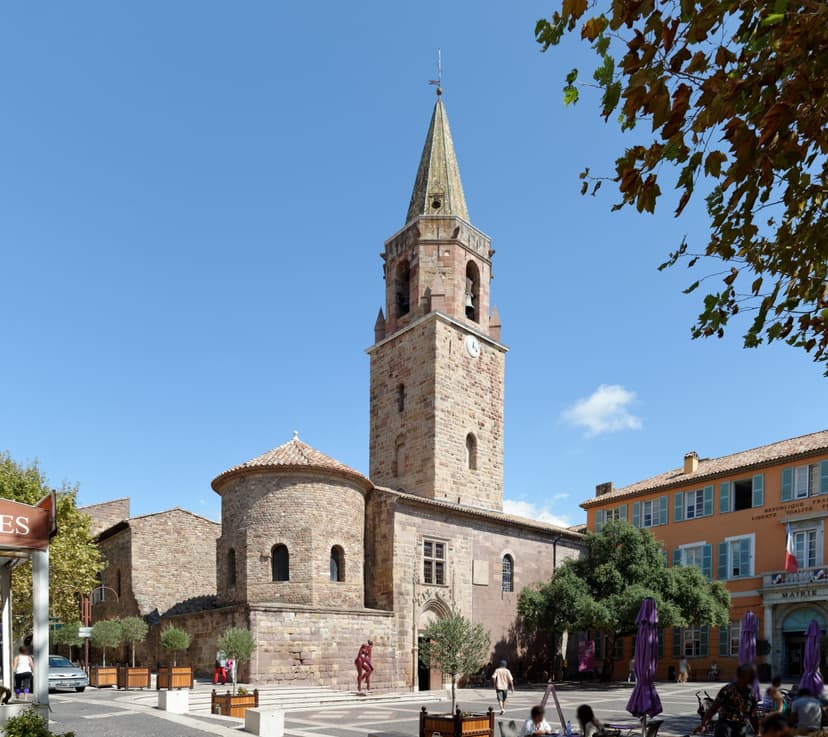
Fréjus Cathedral, officially Cathédrale Saint-Léonce de Fréjus, is a Roman Catholic church in Fréjus, France, dedicated to Saint Leontius of Fréjus. It served as the seat of the Bishop of Fréjus from the 5th century until the diocese was merged with Toulon in 1957, after which it became a co-cathedral. The complex includes a baptistery considered the oldest Christian structure in Provence.

Orléans Cathedral
Orléans Cathedral, officially the Basilique Cathédrale Sainte-Croix d'Orléans, is a significant Roman Catholic cathedral in Orléans, France. It holds historical importance, having been visited by Joan of Arc during the Siege of Orléans, and stands as one of the largest and last Gothic cathedrals constructed in France. The cathedral has undergone multiple reconstructions and renovations throughout its history.

Dax Cathedral
Dax Cathedral, officially known as Cathédrale Notre-Dame de Dax, is a Roman Catholic cathedral located in Dax, France. It serves as the principal church of the Diocese of Aire and Dax, with its bishop's seat officially transferred to Dax in 1833, making it a significant religious and historical landmark in the region.