
Todi Cathedral
Todi Cathedral, officially the Concattedrale della Santissima Annunziata, is a Roman Catholic cathedral in Todi, Umbria, Italy. Primarily Gothic in style, it was formerly the seat of the bishops of Todi and now serves as a co-cathedral within the Diocese of Orvieto-Todi. The cathedral stands on the site of a Roman edifice and has undergone centuries of reconstruction and alteration.
Key Facts
- ›Originally dedicated to the Annunciation of the Virgin Mary, it became a co-cathedral in 1986.
- ›Built on the site of a Roman forum, its construction spanned centuries due to fires, earthquakes, and collapses.
- ›The main facade dates from the 13th century with modifications in the 16th century, including a central rose window.
- ›The interior features a Latin cross plan with a nave divided into three aisles, supported by Corinthian columns.
- ›Notable interior artworks include a 1596 fresco of the Last Judgment by Ferraù Fenzoni and choir stalls by Antonio Bencivenga.
- ›The crypt contains sculptures attributed to Giovanni Pisano and "IL Rubeus".

- Central Rose Window
- Carved Wooden Double Door By Antonio Bencivenni
- Fresco of the Last Judgment By Ferraù Fenzoni
- Wooden Choir Stalls By Antonio Bencivenga
- 13th-Century Painted Crucifix
- Cesi Chapel With Frescoes By Il Faenzone
- Crypt With Sculptures Attributed To Giovanni Pisano
Antonio Bencivenni, Piero Di Moricone, Ferraù Fenzoni, Antonio Bencivenga, Sebastiano Bencivenga, Giovanni Pisano, "Il Rubeus"
About Todi Cathedral
Todi Cathedral, officially the Concattedrale della Santissima Annunziata, is a significant Roman Catholic cathedral located in the historic city of Todi, Umbria, Italy. Its primary architectural style is Gothic, though it has been subject to numerous modifications and refurbishments throughout its long history. The cathedral stands in the Piazza del Popolo, on the site of a former Roman edifice.
History and Construction
The early history of Todi Cathedral is not well-documented. It is believed that an earlier church was constructed on the site around the year 1000. This structure was largely destroyed by fire in 1190, necessitating a lengthy reconstruction process that spanned centuries. This rebuilding was further complicated by events such as an earthquake in 1246 and a roof collapse in 1322, with the cathedral only being completed in the late 14th century. Subsequent alterations and renovations have continued into modern times.
Architectural Features and Interior
The cathedral presents a striking exterior, with its main facade facing Southwest dating from the 13th century but significantly modified in the 16th century. A notable feature is the central rose window, begun in 1515 and completed by 1523. The central portal is adorned with a carved wooden double door from 1521 by Antonio Bencivenni, depicting various religious figures. The frame of this portal features intricate spiral carvings. To the east, a 13th-century campanile rises, with its base predating the facade.
Internally, Todi Cathedral follows a Latin cross plan. The nave is divided into three aisles, with the central aisle being the widest and tallest, separated by arcades of round arches supported by Corinthian columns. The roof of the nave and side aisles is constructed with wooden beams, while the transept features groin vaulting.
Notable Artworks and Elements
The interior houses several significant artworks. At the entrance to the southern aisle is a font crafted in 1507 by Piero di Moricone. The counterfacade is dominated by a large fresco depicting the Last Judgment, painted in 1596 by Ferraù Fenzoni, also known as "Il Faenzone." This work draws inspiration from Michelangelo's famous fresco in the Sistine Chapel. The wooden choir stalls, dating from 1521 to 1530, are the work of Antonio Bencivenga and his son Sebastiano. In the apse, a painted crucifix on a panel from the mid-13th century is displayed. The Cesi Chapel, established by Bishop Angelo Cesi, features vault frescoes from 1599 also by Il Faenzone, who also created the altar painting for the chapel. The crypt contains three sculptures previously on the west front, attributed to Giovanni Pisano and "Il Rubeus."
Significance
Formerly the seat of the bishops of Todi, the cathedral has served as a co-cathedral of the Diocese of Orvieto-Todi since 1986. Its layered history, architectural evolution, and preserved artworks make it a vital historical and religious landmark in Umbria.
Source: Wikipedia ↗
Frequently Asked Questions
What is Todi Cathedral dedicated to?
Todi Cathedral is dedicated to the Annunciation of the Virgin Mary. Its full name is Concattedrale della Santissima Annunziata.
When was Todi Cathedral built?
The reconstruction of Todi Cathedral took centuries, with the structure being finished only in the late 14th century. Its early history is obscure, but an earlier church on the site was built around 1000 AD and largely destroyed by fire in 1190.
What architectural style is Todi Cathedral?
Todi Cathedral is mainly in the Gothic style. Its facade also shows modifications from the 16th century.
What are some notable artworks inside Todi Cathedral?
Inside, visitors can see a large fresco of the Last Judgment (1596) by Ferraù Fenzoni, wooden choir stalls created by Antonio Bencivenga and his son Sebastiano between 1521 and 1530, and a 13th-century painted crucifix in the apse.
Has Todi Cathedral undergone significant damage or rebuilding?
Yes, the cathedral's reconstruction was prolonged due to significant events. These included a fire in 1190 that destroyed much of the earlier church, an earthquake in 1246, and a roof collapse in 1322.
Related Cathedrals

Orvieto Cathedral
Orvieto Cathedral, officially the Cattedrale di Santa Maria Assunta, is a magnificent 14th-century Roman Catholic cathedral located in Orvieto, Umbria, Italy. It was commissioned by Pope Urban IV to house the relic of the Corporal of Bolsena, a significant artifact from a Eucharistic miracle. The cathedral is renowned for its stunning façade, a blend of Romanesque and Gothic styles adorned with mosaics and sculptures, and its interior, which features two richly frescoed chapels showcasing dramatic depictions of the Last Judgment.

Pistoia Cathedral
Pistoia Cathedral, officially the Cathedral of Saint Zeno, is the principal religious edifice in Pistoia, Tuscany, central Italy. Located in the Piazza del Duomo, it serves as the seat of the Bishop of Pistoia and is dedicated to Saint Zeno of Verona. Its history spans from likely origins in the 10th century, with significant architectural modifications over subsequent centuries, including Romanesque, Gothic, and Baroque influences, culminating in a major restoration in the late 20th century.
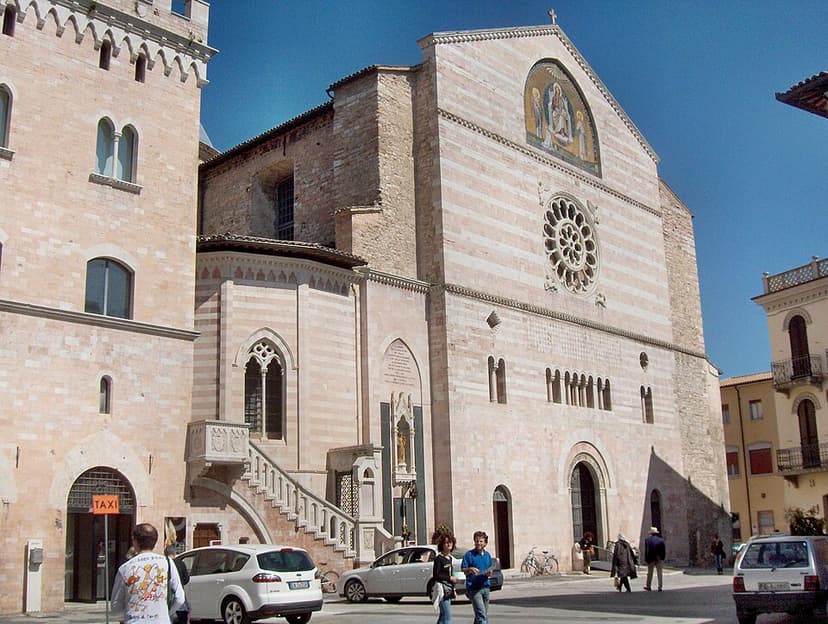
Foligno Cathedral
Foligno Cathedral, formally the Basilica Cattedrale di San Feliciano, is the principal Catholic church in Foligno, Italy, serving as the seat of the Bishop of Foligno. Built on the site of an earlier basilica, it is dedicated to Saint Felician of Foligno, the city's patron saint and martyr, who was buried there in the 3rd century AD. The cathedral holds significant historical and artistic importance, showcasing a blend of Romanesque, Gothic, and Neoclassical architectural elements.