
Foligno Cathedral
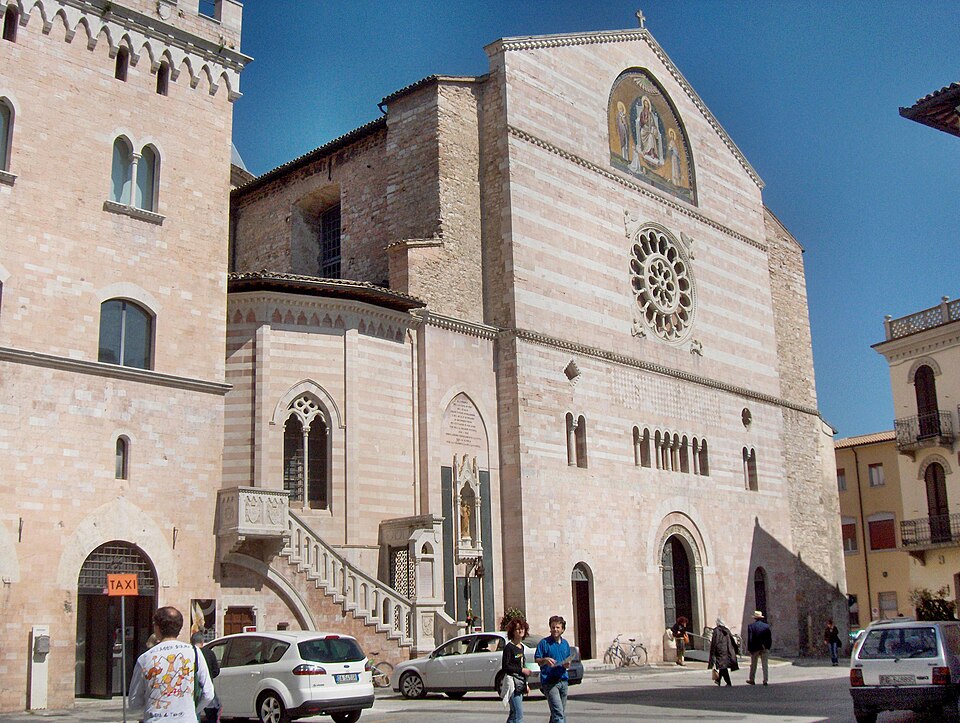
Foligno Cathedral, formally the Basilica Cattedrale di San Feliciano, is the principal Catholic church in Foligno, Italy, serving as the seat of the Bishop of Foligno. Built on the site of an earlier basilica, it is dedicated to Saint Felician of Foligno, the city's patron saint and martyr, who was buried there in the 3rd century AD. The cathedral holds significant historical and artistic importance, showcasing a blend of Romanesque, Gothic, and Neoclassical architectural elements.
Key Facts
- ›The cathedral is dedicated to Saint Felician of Foligno, the city's patron saint, who was martyred and buried on the site in 251 AD.
- ›Its construction began in the Romanesque style in 1133, with significant rebuilding and modifications occurring throughout the centuries.
- ›The cathedral features two distinct façades: the principal west façade and a secondary façade on the Piazza della Repubblica, both with unique sculptural and decorative elements.
- ›The interior underwent a Neoclassical redesign by Giuseppe Piermarini, working from plans by Luigi Vanvitelli, with only the crypt remaining from the original Romanesque structure.
- ›Notable artworks include the Chapel of the Sacrament by Antonio da Sangallo the Younger and a gilded Baroque baldachin over the main altar.
- ›Foligno Cathedral suffered significant damage from earthquakes in 1997 and 2016, leading to closures and ongoing restoration efforts.
- Two Distinct FaçAdes
- Rose Windows On the Secondary FaçAde
- Bronze Door Flanked By Stone Lions
- Chapel of the Sacrament By Antonio Da Sangallo the Younger
- Silver Statue of San Feliciano
- Gilded Baroque Baldachin Over the Main Altar
- Crypt
Rodolfo, Binello, Giuliano Di Baccio D'Agnolo, Cola Di Caprarola, Giuseppe Piermarini, Luigi Vanvitelli, Vincenzo Benvenuti, Vitali
About Foligno Cathedral
Foligno Cathedral, officially known as the Basilica Cattedrale di San Feliciano, stands as the principal Catholic church and the seat of the Bishop of Foligno, located in the heart of Foligno, Italy, on the Piazza della Repubblica. The cathedral is dedicated to the city's patron saint and martyr, Felician of Foligno, who is believed to have been buried on the site in 251 AD. Built upon the foundations of an earlier basilica, the present structure is a testament to centuries of architectural evolution and religious significance.
History and Architecture
The Romanesque construction of the cathedral commenced in 1133 under Bishop Marco, and the renewed church was consecrated in 1149. Over time, the cathedral acquired a unique dual-façade design: a principal west front facing the Piazza Grande and a secondary façade oriented towards the Piazza della Repubblica. The north transept and the secondary façade were commissioned in 1204, while the south transept was added in 1513, completing the church's Latin cross configuration.
The principal façade, dating from 1133, features a 16th-century tympanum and was restored in 1904 with a mosaic depicting Christ enthroned. The secondary façade, completed in 1201 by sculptors Rodolfo and Binello, is renowned for its multiple arches, three rose windows, and sculpted griffins. Its upper sections were enhanced in the 14th century and later enlarged, with a significant restoration in 1904 aiming to recapture its original appearance.
Interior and Artistry
The interior of Foligno Cathedral has undergone numerous redesigns, with its current grandiose appearance being largely Neoclassical, attributed to the reconstruction efforts by Giuseppe Piermarini. Working from plans by Luigi Vanvitelli, Piermarini oversaw modifications that shaped the cathedral's present form, leaving only the crypt from the original Romanesque edifice. The cathedral's artistic treasures include the Chapel of the Sacrament, designed by Antonio da Sangallo the Younger, featuring frescoes by Vespasiano Strada and Baldassare Croce.
Other significant artworks include an elaborate silver statue of San Feliciano, canvases dating from the 13th to 19th centuries, a fresco of Angela of Foligno by Francesco Mancini, a painted Crucifixion by Niccolò Alunno, and two busts by Gian Lorenzo Bernini. The gilded Baroque baldachin over the main altar, a 18th-century work by Antonio Calcioni, is a notable reproduction of Bernini's design for St. Peter's Basilica. The cathedral also features stucco statues of saints and a modern work by Cody Swanson.
Recent History and Significance
The cathedral's elegant dome was added between 1543 and 1548. The bell tower's upper section was renovated in 1847, preserving its original lower portion. The cathedral holds historical importance as the site where Angela of Foligno made her confession, marking a pivotal moment in her spiritual journey. Tragically, Foligno Cathedral has suffered severe damage from recent earthquakes, notably in 1997 and 2016, leading to periods of closure and ongoing restoration, underscoring its resilience and continued importance to the community.
Source: Wikipedia ↗
Frequently Asked Questions
What is the history of Foligno Cathedral?
Construction of Foligno Cathedral began in the Romanesque style in 1133 and was consecrated in 1149. The church has undergone several modifications, including the addition of transepts in the 16th century to give it a Latin cross configuration and a Neoclassical redesign of its interior.
Who is Foligno Cathedral dedicated to?
The cathedral is dedicated to Saint Felician of Foligno (San Feliciano), the patron saint of the city. He was a martyr buried on the site in 251 AD, and his relics are housed within the cathedral.
What are the main architectural styles of Foligno Cathedral?
The cathedral exhibits a blend of architectural styles. Its original structure was Romanesque, with later additions and modifications in Gothic and Neoclassical styles. The secondary façade, in particular, displays notable Romanesque and Gothic features.
Are there any famous artworks inside Foligno Cathedral?
Yes, Foligno Cathedral houses several important works of art. These include the Chapel of the Sacrament by Antonio da Sangallo the Younger, frescoes depicting the life of San Feliciano by Vespasiano Strada and Baldassare Croce, and a gilded Baroque baldachin over the main altar.
Has Foligno Cathedral been affected by earthquakes?
Yes, the cathedral sustained heavy damage from the 1997 earthquake, which caused the detachment of its façade. It was reopened in 1999 but was again damaged in the 2016 earthquake and is currently closed awaiting further restoration.
Related Cathedrals

Arras Cathedral
Arras Cathedral, officially named Cathédrale Notre-Dame-et-Saint-Vaast d'Arras, serves as the principal church and seat of the Bishops of Arras in France. The current structure is built upon the site of the former Abbey Church of Saint-Vaast, which was consecrated in 1834 after a significant rebuilding in neoclassical style following the French Revolution.

Ivrea Cathedral
Ivrea Cathedral is a Roman Catholic church in Ivrea, Italy, with a history stretching back to the late 4th century. Originally built on the site of a Roman temple, it underwent significant rebuilding in the Romanesque style under Bishop Warmund in the 10th century and has seen further architectural modifications throughout its existence. It is a significant example of Romanesque architecture in the Canavese region.

Metz Cathedral
Metz Cathedral, officially dedicated to Saint Stephen, is the principal church of the Catholic Diocese of Metz and the seat of its bishops. Renowned for its exceptionally large expanse of stained glass, it is nicknamed "the Good Lord's lantern." The present Gothic structure evolved over centuries, incorporating elements from pre-Romanesque to Neo-Gothic styles, and it boasts one of the highest naves in France.