
Terracina Cathedral
Terracina Cathedral, formerly the episcopal seat of its diocese, is now a co-cathedral dedicated to Saint Caesarius of Terracina. Originally built in the 5th-6th centuries on the remains of a Roman temple, it has undergone numerous alterations throughout its history, including significant Baroque restorations in the 18th century that reshaped its interior.
Key Facts
- ›Built in the 5th-6th centuries on the ruins of a Roman temple.
- ›Dedicated to Saint Caesarius of Terracina, with earlier dedication to Saint Peter.
- ›Underwent major Baroque restoration in the 18th century, reducing it from five to three naves.
- ›Hosted the Papal conclave of 1088 where Pope Urban II was elected.
- ›Features a Romanesque campanile raised on pilasters and a portico with reused Classical columns.
- ›Contains notable interior elements such as Cosmatesque pavement and a medieval pulpit.

- Portico With Reused Classical Columns and Mosaic Decorations
- Romanesque Campanile On Pilasters
- Cosmatesque Pavement
- Medieval Pulpit
- Spiral Column With Inscription
- 18th-Century Frescoes Depicting Pope Urban Ii's Election
About Terracina Cathedral
Terracina Cathedral, officially known as the Duomo di Terracina, stands as a significant religious and historical landmark in Terracina, Italy. It is currently a co-cathedral within the Diocese of Latina-Terracina-Sezze-Priverno, having formerly served as the episcopal seat for the Diocese of Terracina. The cathedral is primarily dedicated to Saint Caesarius of Terracina, though it was once also dedicated to Saint Peter.
History and Architectural Evolution
The origins of Terracina Cathedral trace back to the 5th and 6th centuries when it was constructed using materials salvaged from a Roman temple situated in the city forum. This foundational structure has undergone numerous transformations and restorations over the centuries. Key interventions include significant alterations in the 11th century, which coincided with the change in its dedication. Further modifications occurred in the 13th century. The most substantial reshaping took place in the 18th century through an extensive Baroque restoration. This period saw the reduction of the church from its original five naves to three, the addition of side chapels, and the replacement of the Romanesque ceiling with barrel vaulting.
Historical Significance
Beyond its architectural evolution, Terracina Cathedral holds historical importance as the venue for the Papal conclave of 1088. This conclave led to the election of Pope Urban II. As of recent records, the cathedral continues to undergo restoration efforts to preserve its heritage.
Description and Notable Features
The cathedral's exterior is marked by an artistic portico, approached by a flight of 30 steps, which stands atop the podium of the ancient Roman temple. This portico showcases six repurposed Classical columns and a central triumphal arch, adorned with an ancient entablature featuring mosaic decorations. Elements like a winged monster, an eagle, palms, deer, and bulls are depicted in these mosaics.
Beneath the portico lie a funerary basin from the Roman era and pairs of crouching beasts flanking the column bases. An additional seven steps lead to the cathedral's two entrances, with the main entrance distinguished by marble friezes dating from the Augustan period.
To the north of the portico rises the Romanesque campanile, uniquely elevated above ground level on four pilasters. The interior of the cathedral is characterized by three naves separated by reused Roman columns, leading to side chapels. The two side naves conclude in apses, while the central nave, which also possesses an apse dating to 1729, terminates in a quadrangular space housing the choir. The presbytery and choir are elevated approximately one meter above the naves.
Artistically, the cathedral is renowned for several key features: the Cosmatesque pavement in the central nave, dating from the 12th-13th centuries; a medieval pulpit from the first half of the 13th century, supported by five columns; a spiral column from the medieval period, used for the Easter candle, with a marble inscription attributing its creation to 'Crudele' on October 31, 1245; and 18th-century frescoes in the presbytery and choir that illustrate episodes from the election of Pope Urban II.
Source: Wikipedia ↗
Frequently Asked Questions
What is the history of Terracina Cathedral's dedication?
The cathedral was initially dedicated to Saint Peter. In 1074, its dedication was changed to Saint Caesarius of Terracina, the city's patron saint.
What significant historical event took place at Terracina Cathedral?
The cathedral was the site of the Papal conclave of 1088. This conclave resulted in the election of Pope Urban II.
What architectural changes occurred during the 18th-century restoration?
The 18th-century restoration significantly altered the cathedral's structure. It reduced the church from five naves to three, introduced side chapels, and covered the original Romanesque ceiling with barrel vaulting.
What are some notable artistic features inside Terracina Cathedral?
Inside, visitors can admire the 12th-13th century Cosmatesque pavement in the central nave, a medieval pulpit from the first half of the 13th century, and a unique spiral column dated October 31, 1245.
Can you describe the exterior portico of Terracina Cathedral?
The portico is an area of artistic interest, accessible via 30 steps from the Roman temple's podium. It features six reused Classical columns, a central triumphal arch, and an ancient entablature with mosaic decorations.
Related Cathedrals
Latina Cathedral
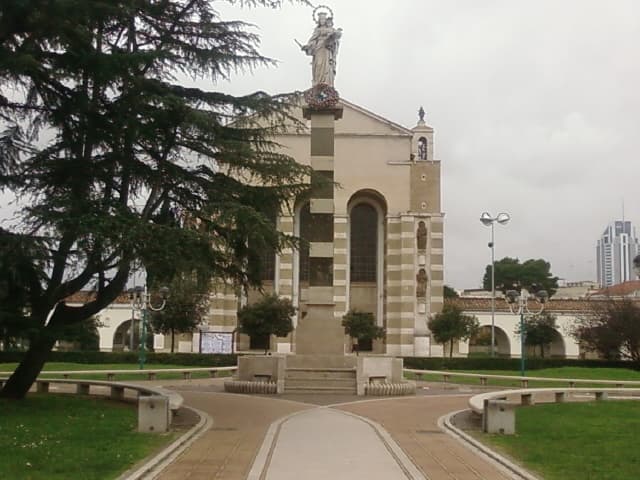
Latina Cathedral, officially the Cattedrale di San Marco, is the seat of the Roman Catholic bishops of Latina-Terracina-Sezze-Priverno in Lazio, Italy. Constructed starting in 1932, it was inaugurated and consecrated in 1933 as part of the new city of Littoria, later renamed Latina. The cathedral is dedicated to Saint Mark and features a distinctive exterior with alternating bands of tuff and travertine.

Asti Cathedral
Asti Cathedral, officially the Cathedral of Santa Maria Assunta and San Gottardo, is the principal church of the Diocese of Asti in Piedmont, Italy. It is a significant example of Gothic architecture in the region and a notable instance of Lombard Romanesque style in northern Italy, boasting considerable length and impressive dimensions.

Ardmore
Ardmore Cathedral, officially the ruins of St. Declan's Monastery, is a significant historical and architectural site in County Waterford, Ireland. Traditionally founded in the 5th century by St. Declan, it served as the seat of the Bishop of Ardmore before its diocese was merged into Lismore by the 13th century. The site features a remarkable collection of medieval structures, including a round tower, an oratory, and the remains of the cathedral itself, showcasing centuries of architectural development.