
Latina Cathedral
Latina Cathedral, officially the Cattedrale di San Marco, is the seat of the Roman Catholic bishops of Latina-Terracina-Sezze-Priverno in Lazio, Italy. Constructed starting in 1932, it was inaugurated and consecrated in 1933 as part of the new city of Littoria, later renamed Latina. The cathedral is dedicated to Saint Mark and features a distinctive exterior with alternating bands of tuff and travertine.
Key Facts
- ›Construction began in 1932 and was completed in 1933.
- ›The church was inaugurated and consecrated on December 18, 1933.
- ›It serves as the cathedral for the diocese of Latina-Terracina-Sezze-Priverno.
- ›The exterior walls feature alternating bands of tuff and travertine.
- ›The interior consists of a single nave with four chapels on each side.
- ›A tall campanile stands to the south of the church, topped with a replica of Milan Cathedral's Madonnina.
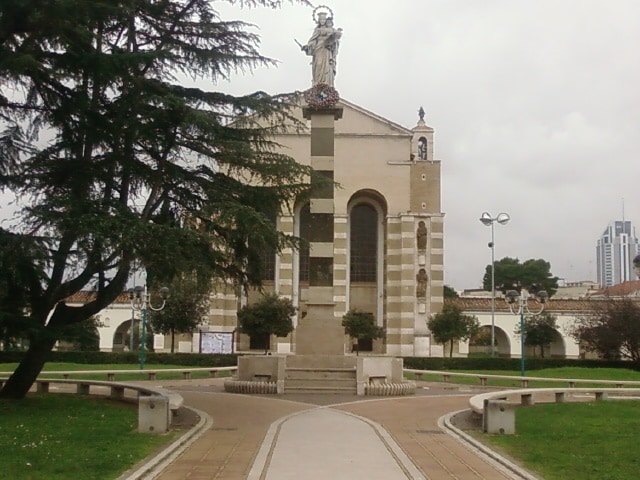
- Alternating Bands of Tuff and Travertine On Exterior Walls
- Portico With Three Round-Arched Openings On the West Front
- Tall Campanile With A Replica of Milan Cathedral's Madonnina
- Single Nave With Four Chapels Per Side
- Modern Mosaics By V. Cinti In the Apse
Oriolo Frezzotti
About Latina Cathedral
Latina Cathedral, known in Italian as Cattedrale di San Marco, stands as the principal church and episcopal seat for the Roman Catholic Diocese of Latina-Terracina-Sezze-Priverno. Located in the heart of Latina, Lazio, Italy, this cathedral was a significant part of the planned development of the city, originally named Littoria, which was established in the early 1930s.
History and Foundation
The foundation stone for the city of Littoria was laid on June 30, 1932. Architect Oriolo Frezzotti was commissioned to design the new town, which included a central church. Construction of the church commenced in 1932 and was completed by the following year. It was officially inaugurated and consecrated on December 18, 1933. Initially established as a parish, the church was entrusted to the Salesians of Don Bosco. The city's territory later became part of the diocese of Terracina-Latina, Priverno and Sezze. In a move to centralize the episcopal administration, the bishops decided to establish a single main residence in Latina. This led to the church of San Marco becoming the cathedral of the "new" diocese of Latina-Terracina-Sezze-Priverno on September 30, 1986, following the decree "Instantibus votis" by the Congregation for Bishops.
Architectural Features
The exterior of Latina Cathedral is characterized by its distinctive use of alternating bands of tuff and travertine stone, a common material in the region. The gabled west front is adorned with a portico featuring three prominent round-arched openings supported by square pilasters. Above each archway, corresponding to the doorways within, is a single stained-glass window. The pediment displays the sculpted coat of arms of Pope Pius XI, and the pilasters are decorated with statues of the Four Evangelists. To the south of the main structure stands a tall campanile, also constructed with alternating bands of tuff and travertine, and built on a square base. The bell chamber at its summit features windows with single openings and is crowned by a marble replica of the "Madonnina" from Milan Cathedral.
Interior Design
The cathedral's interior is designed as a single-aisled nave. It is flanked by four chapels on each side, each covered by barrel vaulting and illuminated by high single windows. These chapels are connected by a series of high round arches. The nave itself is covered by an open wooden A-framed roof, divided into four sections by lesene made of yellow marble. The fourth chapel on the south side is notably deeper than the others and contains a marble altar dedicated to the Virgin Mary, surmounted by a polychrome wooden statue of the Madonna and Child. The nave culminates in a long apse, situated between a tabernacle on the north side and a statue of Saint Mark by F. Magni on the south. The presbytery is elevated above the main body of the church by several steps, with the high altar at its center beneath a crucifix. The bishop's throne, or cathedra, is also located here. The rear wall of the apse is embellished with a band of modern mosaics created by V. Cinti.
Source: Wikipedia ↗
Frequently Asked Questions
When was Latina Cathedral built?
Construction of Latina Cathedral began in 1932 and was completed the following year. It was inaugurated and consecrated on December 18, 1933.
What is the history of Latina Cathedral's status?
Initially a parish church built for the new city of Littoria (later Latina), it became the seat of the bishops of Latina-Terracina-Sezze-Priverno on September 30, 1986, following the union of several ancient episcopal seats.
Who is Latina Cathedral dedicated to?
The cathedral is dedicated to Saint Mark the Evangelist.
What are the architectural features of Latina Cathedral?
The exterior is characterized by alternating bands of tuff and travertine. The west front has a portico with three round-arched openings, and a tall campanile stands to the south. Inside, there is a single nave with four chapels on each side, covered by a wooden roof.
Which diocese does Latina Cathedral belong to?
Latina Cathedral is the seat of the Roman Catholic diocese of Latina-Terracina-Sezze-Priverno.
Related Cathedrals

La Spezia Cathedral
La Spezia Cathedral, also known as the Cathedral of Christ King, is a Roman Catholic cathedral serving as the seat for the Diocese of La Spezia-Sarzana-Brugnato. Constructed between 1956 and 1975, its modern design by Adalberto Libera emphasizes monumentality and features a striking hyperboloid exterior and a domed interior.

Terracina Cathedral
Terracina Cathedral, formerly the episcopal seat of its diocese, is now a co-cathedral dedicated to Saint Caesarius of Terracina. Originally built in the 5th-6th centuries on the remains of a Roman temple, it has undergone numerous alterations throughout its history, including significant Baroque restorations in the 18th century that reshaped its interior.

Acerno Cathedral
Acerno Cathedral, also known as Duomo di Acerno or Concattedrale di San Donato, is a Roman Catholic cathedral dedicated to Saint Donatus of Arezzo, located in Acerno, Campania, Italy. It served as the seat of the Bishop of Acerno from the 11th century until the bishopric was united with Salerno in 1818, eventually becoming a co-cathedral in the Archdiocese of Salerno-Campagna-Acerno. The present structure, begun in 1575, has undergone significant restoration after damage from earthquakes and fire.