
St Albans Cathedral
St Albans Cathedral, officially the Cathedral and Abbey Church of St Alban, is a Church of England cathedral in St Albans, England. Much of its architecture dates from Norman times, with significant Gothic and 19th-century additions. It transitioned from an abbey to a cathedral in 1877 and currently serves as both a cathedral and a parish church.
Key Facts
- ›The present building is primarily Norman or Romanesque architecture from the 11th century, with later Gothic and 19th-century additions.
- ›It was founded as an abbey in 793 by King Offa of Mercia and consecrated as a monastic church in 1115.
- ›The cathedral stands near the supposed site of the martyrdom of St Alban, Britain's first Christian martyr.
- ›Much of the current structure's layout and proportions were established by the first Norman abbot, Paul of Caen, starting in 1077.
- ›It became a cathedral in 1877 with the creation of the See of St Albans.
- ›The cathedral utilizes Roman materials, including bricks and flint, from the nearby ruins of Verulamium.

Norman Crossing Tower, Use of Roman Materials From Verulamium, Shrine of St Amphibalus, St Albans Psalter, Matthew Paris Manuscripts
Robert the Mason, Lewis Nockalls Cottingham, George Gilbert Scott, Edmund Beckett, 1st Baron Grimthorpe, John Oldrid Scott
About St Albans Cathedral
St Albans Cathedral, officially known as the Cathedral and Abbey Church of St Alban, is a prominent Church of England cathedral situated in the city of St Albans, England. Its architectural heritage is deeply rooted in Norman design, with significant Gothic additions from medieval periods and extensive restoration work undertaken in the 19th century. The cathedral holds a unique position as it functions both as a cathedral church and an active parish church, with the dean serving as rector.
Historical Significance and Foundation
The history of St Albans Cathedral is intrinsically linked to St Alban, considered Britain's first Christian martyr. According to tradition, Alban sheltered a Christian priest and subsequently converted to Christianity, leading to his martyrdom. A memoria over his execution site existed from the mid-4th century. The present abbey was likely founded in the 8th century, with King Offa of Mercia credited with establishing a Benedictine monastery on Holmhurst Hill in 793. The Roman site of Verulamium, located nearby, served as a crucial source of building materials, including bricks, tiles, and stone, for the abbey's construction.
Architectural Evolution
The core of the present building dates from the Norman period, with construction commencing under Abbot Paul of Caen in 1077. Influenced by French monastic architecture, the Norman abbey was one of the largest built in England at that time, featuring a cruciform plan and a notable crossing tower, the only 11th-century example of its kind still standing in England. Over centuries, the cathedral underwent numerous transformations. The nave was extended westward in the 1190s, and the structure was significantly rebuilt and updated following an earthquake in 1250 and a pier collapse in 1323. The 15th century saw further modifications, including the addition of a large west window and alterations to the spire and roofline.
Dissolution and Transformation into a Cathedral
The abbey suffered greatly during the Dissolution of the Monasteries in the 16th century, with its treasures looted and buildings neglected or dismantled. The church itself was sold to the town in 1553 to serve as a parish church. Despite periods of dilapidation and ongoing repair challenges throughout the 17th and 18th centuries, significant restoration efforts began in the 19th century under architects like George Gilbert Scott and the controversial Edmund Beckett, 1st Baron Grimthorpe. These efforts culminated in the abbey's elevation to cathedral status in 1877, becoming the seat of the newly created See of St Albans.
Source: Wikipedia ↗
Frequently Asked Questions
When was St Albans Abbey founded?
King Offa of Mercia is said to have founded St Albans Abbey in 793, following the Benedictine rule. The present building's construction began in the Norman era.
What is the architectural style of St Albans Cathedral?
The cathedral's architecture is predominantly Norman or Romanesque, dating from the 11th century. It also features Gothic elements from medieval rebuilding and extensions, as well as 19th-century restoration work.
Why is St Albans Cathedral significant?
It is significant as the site of Britain's first Christian martyr, St Alban, and its architecture represents a long history of construction and adaptation from Norman to Gothic and Victorian periods. It also holds the distinction of being both a cathedral and an active parish church.
When did St Albans Abbey become a cathedral?
St Albans Abbey officially became a cathedral in 1877, following the passing of the Bishopric of St Albans Act in 1875 and the creation of the See of St Albans.
What is notable about the construction of St Albans Cathedral?
Much of the building material was sourced from the Roman ruins of Verulamium, including bricks, flint, and stone. The Norman construction, particularly the crossing tower, was a significant engineering feat for its time.
Related Cathedrals
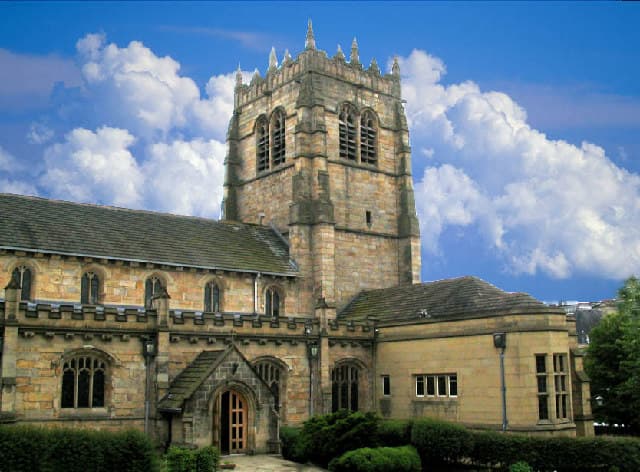
Bradford Cathedral
Bradford Cathedral, officially the Cathedral Church of St Peter, is an Anglican cathedral in Bradford, West Yorkshire, England. Its site has been a place of Christian worship since the 7th century, and it served as a parish church for many centuries before achieving cathedral status in 1919. It is now one of three co-equal cathedrals within the Diocese of Leeds.

London Orthodox Cathedral SW7
The Russian Orthodox Cathedral of the Dormition of the Mother of God and All Saints serves as the cathedral for the Russian Orthodox Diocese of Sourozh in London, England. Originally built as an Anglican church, it was later consecrated as an Orthodox cathedral and is a significant spiritual center for the Russian Orthodox community in the city, hosting administrative meetings and regular services.
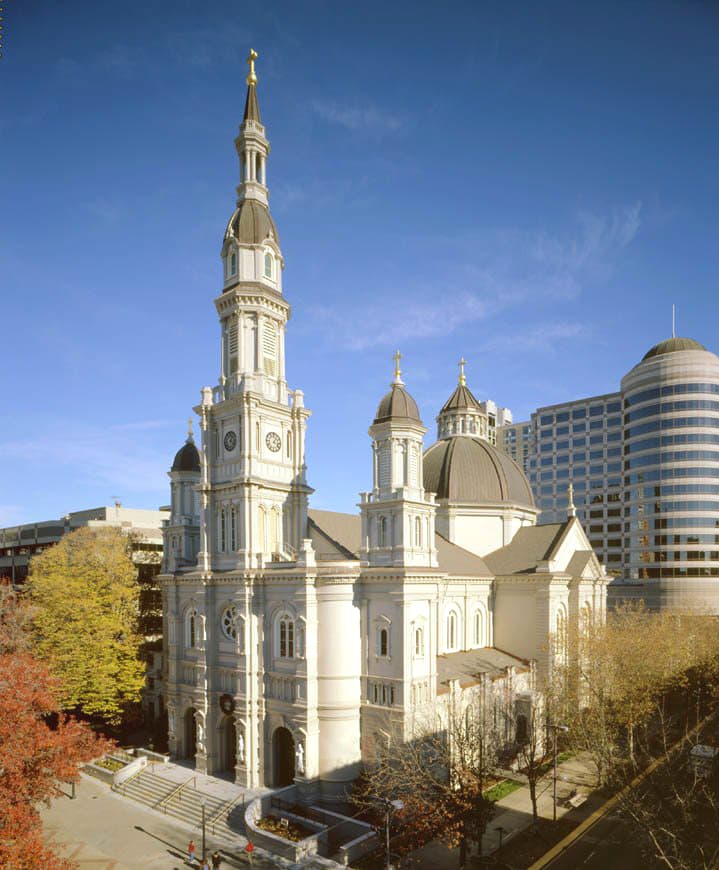
Blessed Sacrament Cathedral
The Cathedral of the Blessed Sacrament serves as the mother church of the Roman Catholic Diocese of Sacramento, located in Sacramento, California. It is a significant religious and civic landmark, recognized as one of the largest cathedrals west of the Mississippi River. The cathedral's history is intertwined with the California Gold Rush and its architecture reflects both Italian Renaissance and Victorian styles, with extensive renovations aimed at preserving its historical integrity while adapting it for modern use.