
Southwark Cathedral
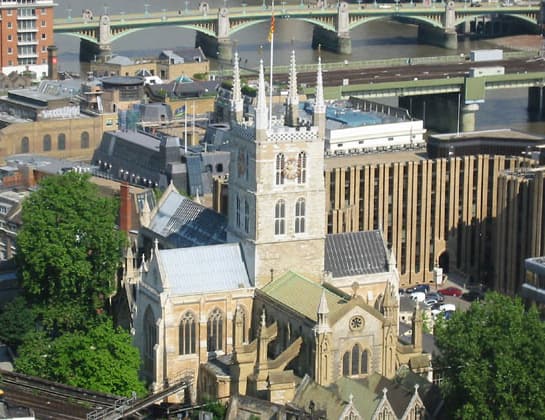
Southwark Cathedral, formally the Cathedral and Collegiate Church of St Saviour and St Mary Overie, is the mother church of the Diocese of Southwark in London. With a history of Christian worship spanning over a millennium, it was elevated to cathedral status in 1905. The present Gothic structure, largely built between 1220 and 1420, showcases architectural developments and has been a site of significant historical events and figures.
Key Facts
- ›The site has been used for Christian worship for over 1,000 years, with the current Gothic building dating primarily from 1220-1420.
- ›It was originally an Augustinian priory dedicated to St Mary 'Overie' (over the river) before becoming the parish church of St Saviour after the dissolution of the monasteries.
- ›The cathedral was raised to its current status in 1905 with the creation of the Diocese of Southwark.
- ›Notable figures associated with the church include the poet John Gower, dramatists like Shakespeare's brother Edmund, and John Harvard, the namesake of Harvard University.
- ›The building suffered damage during World War II, with shrapnel damage still visible on the exterior.
- ›Southwark Cathedral is known for its resident cats, including the celebrity cat Doorkins Magnificat.

John Gower's Tomb and Memorial, Shakespeare Memorial Window, Harvard Chapel, Bishop Fox's Altar Screen, Resident Cats, Remnants of Winchester Palace
George Gwilt Jun., Robert Wallace, Henry Rose, Arthur Blomfield
About Southwark Cathedral
Southwark Cathedral, officially the Cathedral and Collegiate Church of St Saviour and St Mary Overie, is a prominent Church of England cathedral situated in Southwark, London, near the south bank of the River Thames and close to London Bridge. It holds the significant role of being the mother church for the Diocese of Southwark. The site has a long and rich history of Christian worship, with evidence suggesting continuous use for over a thousand years. However, it was not until the creation of the Diocese of Southwark in 1905 that the church was officially elevated to cathedral status.
History and Development
From 1106 to 1538, the church served as the ecclesiastical heart of the Augustinian priory, Southwark Priory, dedicated to the Virgin Mary and known as St Mary Overie ('over the river'). Following the dissolution of the monasteries under Henry VIII, it transitioned into a parish church, taking on the dedication to the Holy Saviour (St Saviour). Historically, it belonged to the Diocese of Winchester until 1877, when it was transferred to the Diocese of Rochester. The current building largely retains the Gothic architectural outline established between 1220 and 1420, though its nave is a reconstruction from the late 19th century.
Legend attributes the priory's origins to a maiden named Mary, who inherited wealth from a ferry business and founded a nunnery. This tale, though popular, has been subject to historical rationalization, with some suggesting a possible connection to Bishop Swithun of Winchester. While evidence for a convent in 606 AD or a monastery founded by St Swithun in the 9th century is lacking, the site's ecclesiastical significance is undeniable. The earliest documented reference dates to the Domesday Book of 1086, when a "minster" on the site was noted.
Architectural Significance and Notable Features
The church suffered damage in the Great Fire of 1212, necessitating a significant rebuilding effort throughout the 13th century. The reconstructed church, whose basic layout persists today, is cruciform and features an aisled nave, a crossing tower, transepts, and a choir. Later centuries saw further modifications, including rebuilding of chapels and the addition of wooden vaults in the 15th century after a ceiling collapse. The 14th-century poet John Gower is interred within the church, marked by a notable memorial.
The 16th and 17th centuries brought further changes, including improvements by Bishop Richard Foxe and the church's acquisition by parishioners after the dissolution. During the reign of Queen Mary, heresy trials were held in the retrochoir. This period also saw the church's association with Elizabethan dramatists; Edmund Shakespeare, brother of William, is buried there, and John Harvard, who lent his name to Harvard University, was baptized in its font.
Significant restoration and rebuilding efforts occurred in the 19th century, particularly between 1890 and 1897 under Arthur Blomfield, aiming to recreate its 13th-century appearance. The cathedral's proximity to the railway viaduct, built in 1852, presented a challenge, with the construction requiring a compromise to avoid demolishing the building.
Modern Era and Cultural Connections
Elevated to cathedral status in 1905, Southwark Cathedral continued to evolve. It sustained damage during the Second World War, with visible shrapnel marks remaining. In recent times, it has become a site for commemorations, including memorials to Nelson Mandela and Desmond Tutu. The cathedral has also gained recognition for its resident cats, such as Doorkins Magnificat, who became a local celebrity.
Southwark Cathedral is not only a place of worship but also a venue for academic ceremonies, including those for London South Bank University and King's College London. Its rich history, architectural evolution, and connections to literature, education, and notable figures solidify its importance within London's ecclesiastical and cultural landscape.
Source: Wikipedia ↗
Frequently Asked Questions
What is the history of Southwark Cathedral?
Christian worship has occurred on the site for over 1,000 years. It began as a nunnery, then a college of priests, before becoming an Augustinian priory in 1106. Following the dissolution of monasteries, it became the parish church of St Saviour, and finally a cathedral in 1905.
When was the current building of Southwark Cathedral constructed?
The present building largely retains the form of the Gothic structure built between 1220 and 1420. The nave, however, is a late 19th-century reconstruction.
What famous people are connected to Southwark Cathedral?
The church has connections to John Gower, who is entombed there, and William Shakespeare's brother Edmund, who was buried there. John Harvard, founder of Harvard University, was baptized in the church.
Has Southwark Cathedral been damaged by bombing?
Yes, the cathedral was damaged by bombs during the Second World War. Shrapnel damage is still visible on the exterior of the building.
What is the architectural style of Southwark Cathedral?
The main structure of Southwark Cathedral is Gothic, built between the 13th and 15th centuries. The nave was rebuilt in the late 19th century in a style intended to recreate its 13th-century predecessor.
Is Southwark Cathedral an active place of worship?
Yes, Southwark Cathedral is an active Church of England cathedral and serves as the mother church for the Diocese of Southwark. It hosts regular services and events.
Related Cathedrals
Southwark
Southwark is a historic district on the south bank of the River Thames in Central London, renowned for its ancient origins and role as the southern gateway to the city via London Bridge. Its development was intrinsically linked to the bridge, which facilitated Roman settlement and later became a crucial defensive point. Today, Southwark is a vibrant area known for its cultural landmarks, including Southwark Cathedral, and its ongoing regeneration.

Dorchester Abbey
Dorchester Abbey, officially the Abbey Church of St Peter and St Paul, is a historic Church of England parish church situated in Dorchester on Thames, Oxfordshire. It holds significant historical importance, having been built on the site of a Saxon cathedral and formerly serving as a Norman abbey church for Augustinian Canons Regular.

Birmingham Cathedral
The Birmingham Cathedral, officially the Cathedral Church of Saint Philip, is the principal Anglican cathedral in Birmingham, England. Originally built as a Baroque parish church designed by Thomas Archer and consecrated in 1715, it was elevated to cathedral status in 1905, becoming the seat of the Bishop of Birmingham. It is recognized as a Grade I listed building and is a significant example of English Baroque architecture.