
Southwark
Southwark is a historic district on the south bank of the River Thames in Central London, renowned for its ancient origins and role as the southern gateway to the city via London Bridge. Its development was intrinsically linked to the bridge, which facilitated Roman settlement and later became a crucial defensive point. Today, Southwark is a vibrant area known for its cultural landmarks, including Southwark Cathedral, and its ongoing regeneration.
Key Facts
- ›Southwark's strategic location at the southern end of London Bridge made it a vital crossing point since Roman times.
- ›The area has a rich history, evolving from a Roman settlement to a Saxon burh, and later a significant medieval borough.
- ›It was historically a place of entertainment and less regulated activity, particularly in the Liberty of the Clink.
- ›Key historical figures like King Alfred the Great and St Olaf are associated with Southwark's defenses.
- ›Southwark Cathedral, originally the priory of St Mary Overie, became a cathedral in 1905.
- ›The district has experienced significant urbanisation and regeneration, becoming a major business and cultural centre.
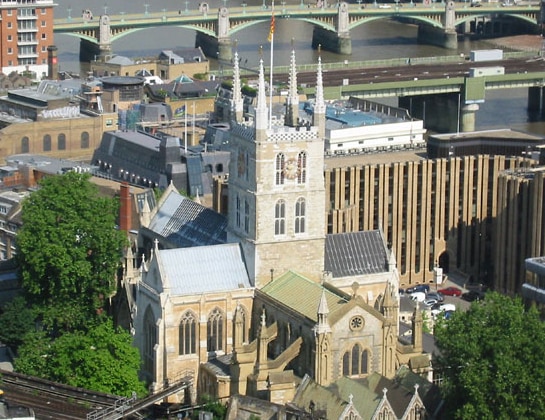
Southwark Cathedral, Borough Market, Shakespeare's Globe Theatre, the Shard, Tower Bridge, Butler's Wharf, Tate Modern
About Southwark
What is Southwark?
Southwark is a historic district situated on the south bank of the River Thames in Central London. It is recognized as the oldest part of South London, its development fundamentally shaped by its crucial position at the southern end of London Bridge. This strategic location made it a vital crossing point since the Roman era and a significant area for trade, defense, and later, entertainment.
Historical Development
The area's history is deeply intertwined with the River Thames and London Bridge. Roman engineers first established a bridge here around 43 AD, laying the groundwork for the settlement of Londinium. Over centuries, Southwark evolved from a fortified burh under King Alfred the Great to a thriving ancient borough, renowned for its inns, such as The Tabard, the starting point for Geoffrey Chaucer's pilgrims.
During the medieval and post-medieval periods, Southwark also became known for its entertainment district, particularly the Liberty of the Clink, which hosted theatres like The Rose and Shakespeare's Globe, as well as other less regulated attractions. The district's administrative history is complex, with periods of governance by the City of London and its own borough authorities, culminating in its integration into the modern London Borough of Southwark.
Key Landmarks and Modern Significance
Southwark is now a vibrant and regenerated area, home to numerous cultural and modern landmarks. Southwark Cathedral, originally the priory of St Mary Overie, stands as a significant religious and architectural site, having been elevated to cathedral status in 1905. The district also boasts attractions like Borough Market, a well-known food market, and is in close proximity to modern icons such as The Shard and Shakespeare's Globe.
Economically, Southwark has transformed into a major business centre, with extensive regeneration bringing new residential developments, offices, shops, and restaurants. Its accessibility to the City and West End further bolsters its role as a dynamic part of contemporary London.
Source: Wikipedia ↗
Frequently Asked Questions
What is the historical significance of Southwark?
Southwark's significance stems from its position as the southern terminus of London Bridge, the only dry crossing of the Thames for centuries. This made it crucial for Roman settlement and trade, and a key defensive location throughout its history.
When was Southwark first settled?
Evidence suggests pre-Roman activity, but significant settlement began around 43 AD when Roman engineers established the first London Bridge at this location, leading to the development of Londinium.
What is Southwark Cathedral's history?
Southwark Cathedral was originally the priory of St Mary Overie, with significant monastic history. It was made a cathedral in 1905 and is noted for its Merbecke Choir.
What were some of the entertainment venues in historical Southwark?
The Liberty of the Clink area was known for its entertainment, featuring bull and bear-baiting, taverns, theatres like The Rose and Shakespeare's Globe, and brothels.
How has Southwark changed over time?
Southwark has transformed from a marshy area and a strategic defensive point into a regenerated district with modern residential developments, shops, restaurants, galleries, and major office buildings, becoming a significant cultural and business hub.
Related Cathedrals

Southwark Cathedral
Southwark Cathedral, formally the Cathedral and Collegiate Church of St Saviour and St Mary Overie, is the mother church of the Diocese of Southwark in London. With a history of Christian worship spanning over a millennium, it was elevated to cathedral status in 1905. The present Gothic structure, largely built between 1220 and 1420, showcases architectural developments and has been a site of significant historical events and figures.

Reims Cathedral
Reims Cathedral, officially Notre-Dame de Reims, is a preeminent example of Gothic architecture and held immense historical significance as the traditional site for the coronation of French kings. Dedicated to the Virgin Mary, it has been a focal point of French monarchy and religious life for over a millennium, attracting a million visitors annually and recognized as a UNESCO World Heritage Site.

Ardmore
Ardmore Cathedral, officially the ruins of St. Declan's Monastery, is a significant historical and architectural site in County Waterford, Ireland. Traditionally founded in the 5th century by St. Declan, it served as the seat of the Bishop of Ardmore before its diocese was merged into Lismore by the 13th century. The site features a remarkable collection of medieval structures, including a round tower, an oratory, and the remains of the cathedral itself, showcasing centuries of architectural development.