
Sherborne Abbey
Sherborne (former), Salisbury (current)·Church of England·England
Sherborne Abbey, also known as the Abbey Church of St. Mary the Virgin, is a historic Church of England church in Sherborne, Dorset. It holds significance as a former Saxon cathedral and a Benedictine abbey before becoming a parish church, earning a rare five-star rating in Simon Jenkins' "England's Thousand Best Churches."
Key Facts
- ›Founded as a Saxon cathedral in 705 AD by King Ine of Wessex.
- ›Became a Benedictine abbey church in 998 AD under Bishop Wulfsige III.
- ›Transitioned to a Church of England parish church in 1539 during the dissolution of the monasteries.
- ›Exhibits a rich architectural history, including Saxon, Norman, Early English, Decorated, and Perpendicular styles.
- ›Much of the current building dates from extensive rebuilding efforts between the 14th and 15th centuries, particularly in the Perpendicular style.
- ›Recognized as a Grade I listed building in England.

- Five-Star Rating In Simon Jenkins' "England's Thousand Best Churches"
- Saxon and Norman Architectural Remnants
- Extensive Perpendicular Rebuilding With Fan-Vaulting
- Remains of Monastic Buildings Incorporated Into Sherborne School
- Oldest Candelabrum In England In the Lady Chapel
Aldhelm, æLfwold Ii, Roger De Caen, Abbot Robert Brunyng, William Smyth, R.C. Carpenter
About Sherborne Abbey
Sherborne Abbey: A Monument of Faith and Architecture
Sherborne Abbey, officially the Abbey Church of St. Mary the Virgin, stands as a significant religious and architectural landmark in Sherborne, Dorset, England. Its history is layered, beginning as a Saxon cathedral from 705 to 1075, then transitioning into a Benedictine abbey church from 998 to 1539. Following the dissolution of the monasteries, it became a Church of England parish church, a role it continues to fulfill today. Its exceptional historical and architectural merit has earned it a rare five-star rating in Simon Jenkins' influential guide, "England's Thousand Best Churches."
Historical Significance
The origins of Sherborne Abbey are deeply rooted in the early Christian history of England. The Diocese of Sherborne was established in 705 by King Ine of Wessex to serve the growing Christian population in the region. Aldhelm, a key figure in the Anglo-Saxon church, was its first bishop. A pivotal moment in its history was the establishment of a Benedictine abbey in 998 by Bishop Wulfsige III, who became its first abbot. The abbey's status as a cathedral ended in 1075 when its bishopric was unified with Ramsbury and moved to Old Sarum. For centuries, it remained a prominent Benedictine house until its surrender to King Henry VIII in 1539. The community of Sherborne purchased the building from the Crown, transforming it into their parish church, a function it has maintained ever since.
Architectural Evolution
Sherborne Abbey is a testament to centuries of architectural development, showcasing a rich tapestry of styles. Built primarily of honey-brown hamstone, its structure bears the marks of various periods. While the original Saxon cathedral lay to the west of the current edifice, remnants of an 11th-century cathedral and abbey church by Bishop Ælfwold II survive in the west wall and column cores. The Norman period, beginning around 1130 under Bishop Roger de Caen, saw a substantial rebuilding, with much of the crossing, transepts, and aisle walls dating from the mid-12th century. The subsequent centuries brought further transformations, including Early English elements around 1240. The mid-14th century saw the demolition of the old church and the construction of a chapel-of-ease, All Hallows. However, the most extensive rebuilding occurred between approximately 1380 and 1500 in the Perpendicular style. This era saw the construction of new chapels and the near-complete rebuilding of the quire, culminating in the magnificent fan-vaulting of the nave, completed around 1490. Despite a fire in 1437 that necessitated alterations, the Perpendicular additions, including the striking clerestory, were integrated, often atop older Norman structures. Victorian restoration, notably by R.C. Carpenter in the mid-19th century, also left its mark, particularly on the west window and porch.
Monastic Legacy
Beyond the main church, the site of Sherborne Abbey was once surrounded by a complex of monastic buildings. The cloister, built by Abbot Frith in the 14th century, was located to the north of the abbey, unusual for Benedictine monasteries, likely for access to water. Remains of its pilasters and arcading are still visible. Other monastic features, such as a conduit house for water supply, a slype (a passage from the cloister), and the foundations of a chapter house and monks' dormitory, hint at the abbey's former grandeur. Many of these structures were later incorporated into Sherborne School buildings after the Reformation. The Guesten Hall, a substantial 13th-century building with a 15th-century roof, now serves as the Sherborne School Library, while the Abbot's Hall, dating from the early 15th century, is now the Sherborne School Chapel. These surviving elements offer insights into the daily life and administrative functions of the Benedictine community that once thrived here.
Source: Wikipedia ↗
Frequently Asked Questions
What was Sherborne Abbey before it was a Church of England parish church?
Sherborne Abbey served as a Saxon Catholic cathedral from 705 to 1075. Following this, it was a Benedictine abbey church from 998 to 1539 before its transition to its current status.
When was the Diocese of Sherborne founded and why?
The Saxon Diocese of Sherborne was founded in 705 by King Ine of Wessex. Its establishment was intended to alleviate pressure on the growing see of Winchester.
What is the architectural style of Sherborne Abbey?
Sherborne Abbey displays a variety of architectural styles accumulated over centuries. These include significant elements of Saxon, Norman, Early English, Decorated, and notably, Perpendicular styles, with much of the rebuilding occurring between the late 14th and 15th centuries.
What is the significance of the fan-vaulting in Sherborne Abbey?
The fan-vaulting in the nave, completed around 1490 by William Smyth, is a notable feature of the Perpendicular style. It is praised for its quality, with one commentator suggesting it could rival contemporary Italian Renaissance work.
When did Sherborne Abbey cease to be a cathedral?
Sherborne Abbey ceased to be a cathedral in 1075. This occurred when Bishop Herman unified his bishoprics of Sherborne and Ramsbury into a single see with its seat moved to Old Sarum.
What happened to Sherborne Abbey after the dissolution of the monasteries?
Following the dissolution of the monasteries in 1539, the abbey was surrendered to King Henry VIII. It was subsequently purchased by the people of Sherborne and became their parish church, a role it continues to fulfill today.
Related Cathedrals

Lincoln Cathedral
Lincoln Cathedral, officially the Cathedral Church of the Blessed Virgin Mary of Lincoln, is a prominent Church of England cathedral located in Lincoln, England. It serves as the seat of the Bishop of Lincoln and the mother church of the Diocese of Lincoln. Renowned for its significant architectural phases of Gothic style and its historical importance, the cathedral houses one of the four surviving original copies of the Magna Carta.
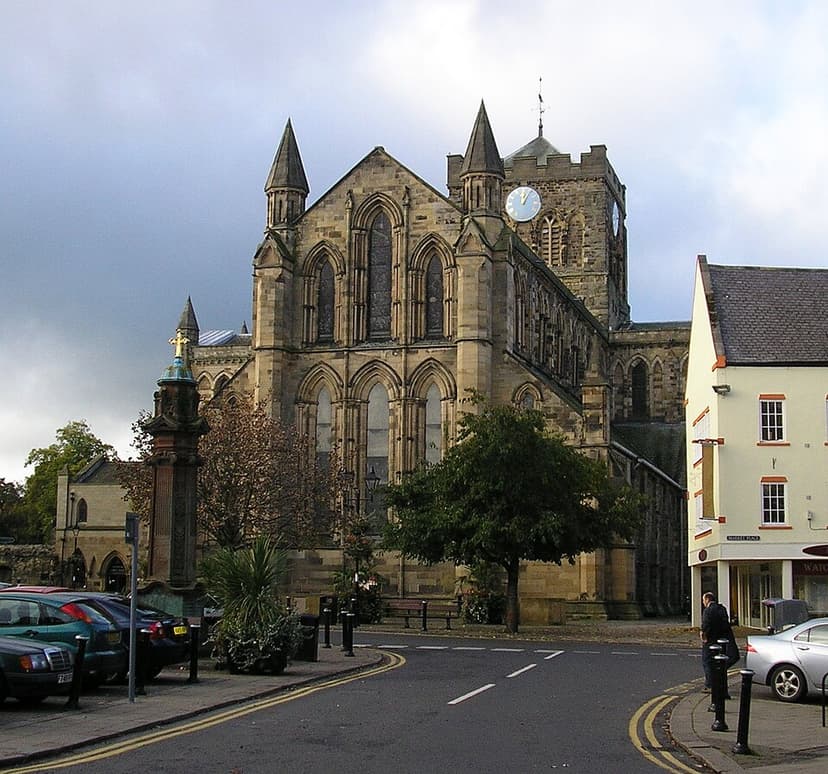
Hexham Abbey
Hexham Abbey is a historic church in Hexham, Northumberland, England, with a history stretching back over 1300 years. Originally founded as a Benedictine abbey in AD 674, it was rebuilt as an Augustinian priory in 1113, and its current structure largely dates from the 12th to 13th centuries. Since the dissolution of the monasteries in 1537, it has served as the parish church for Hexham.

Belmont Abbey, Herefordshire
Belmont Abbey, located in Herefordshire, England, is a Catholic Benedictine monastery that also functions as a parish church. Founded in the mid-19th century by Francis Wegg-Prosser, it became a significant center for the English Benedictine Congregation, serving as a pro-cathedral and the common novitiate and house of studies.