
Belmont Abbey, Herefordshire
Belmont Abbey, located in Herefordshire, England, is a Catholic Benedictine monastery that also functions as a parish church. Founded in the mid-19th century by Francis Wegg-Prosser, it became a significant center for the English Benedictine Congregation, serving as a pro-cathedral and the common novitiate and house of studies.
Key Facts
- ›Founded in 1854 by Francis Wegg-Prosser as a church on his estate, later becoming a Benedictine priory in 1859.
- ›Served as a pro-cathedral for the Diocese of Newport and Menevia before the Diocese of Newport became the Archdiocese of Cardiff.
- ›Raised to the rank of an Abbey by papal bull in 1920.
- ›The Abbey Church, designed by Edward Welby Pugin, is a Grade II* listed building consecrated in 1860.
- ›Known for its sculpture, stained glass windows depicting English Martyrs and angels, and an angel reredos.
- ›The monastic community maintains a foundation in Lurín, Peru, and supports itself through sacred art, hospitality, and cottage industries.

Decorated, Early English
- Grade Ii* Listed Abbey Church
- Sculpture and Stained Glass
- Angel Reredos
- Victorian Glass Window Depicting Archangels and Choirs of Angels
- Monastic Choir
- St Benedict's Chapel
- Commonwealth War Graves
- Commemoration of St Guthlac In West Door Window
19th Century, 20th Century
Edward Welby Pugin
About Belmont Abbey, Herefordshire
Belmont Abbey, situated in Herefordshire, England, is a significant Catholic Benedictine monastery and an active place of worship. It also serves as the parish church for the Parish of St Michael and All Angels.
History and Foundation
The origins of Belmont Abbey trace back to 1854 when Francis Wegg-Prosser, a convert to Catholicism and resident of nearby Belmont House, decided to build a church on his estate. He subsequently invited the Benedictines to establish a permanent Catholic presence in the area. They arrived in 1859, and the foundation initially became a priory. It held a unique position as the Common Novitiate and House of Studies for the English Benedictine Congregation, and also served as a pro-cathedral for the Diocese of Newport and Menevia. The monastic chapter was of the medieval type, where monks formed the cathedral canons.
Belmont was raised to the rank of an Abbey by papal bull in 1920. Its role as a pro-cathedral concluded in 1920 when St David's Church in Cardiff officially became the cathedral for the Archdiocese of Cardiff. In March 2025, it was announced that the Community of St Gregory the Great from Downside Abbey would move to Belmont Abbey for an experimental period.
The Abbey Church
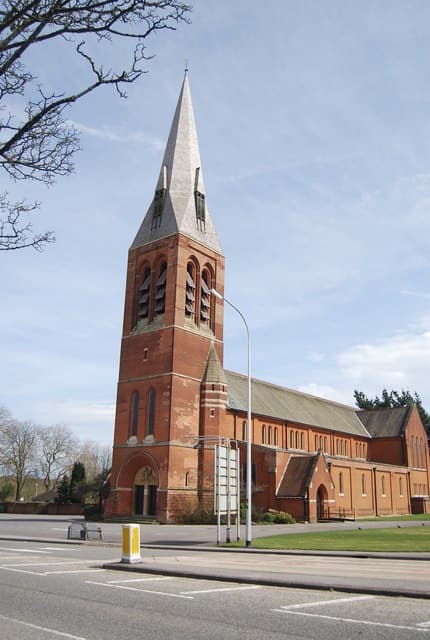
The Abbey Church itself is a Grade II* listed building, with construction commencing in 1857 and consecration taking place on 4 September 1860. The church was designed by Edward Welby Pugin, embodying the resurgent optimism of the restored Catholic faith in the decorated, early English style. The exterior is constructed from local pink sandstone, presenting a simple and unadorned façade reminiscent of 14th-century monastic designs. The interior is faced with warm Bath stone and is characterized by four steeply pointed arches supporting the central tower, where the altar is now situated.
The church is recognized for its high-quality sculpture and stained glass. Notable features include windows depicting angels and English Martyrs, an angel reredos at the east end, and a Victorian glass window illustrating the archangels Michael, Raphael, and Gabriel, alongside the nine choirs of angels. Within the church are the monastic choir, dedicated to the Divine Office and Mass, and side altars. St Benedict's chapel, completed in 1875, features the monastic founder in its central reredos.
Monastic Life and Outreach
The monastic community adheres to the Rule of St Benedict, dedicating its life to the Divine Office and Mass. Historically, the monks have been involved in educational and pastoral work, founding Belmont Abbey School and preparatory schools, though the school at Belmont closed in 1994. Today, the monks provide pastoral care in Herefordshire, Worcestershire, and South Wales. They also maintain a foundation in Peru, the Monastery of the Holy Trinity in Lurín, and operate Hedley Lodge, a retreat, guesthouse, and conference center. The Abbey Church has also been the subject of television documentaries, highlighting the daily activities of its monks.
Source: Wikipedia ↗
Frequently Asked Questions
When was Belmont Abbey founded?
Belmont Abbey was founded in 1854 by Francis Wegg-Prosser. The Benedictines arrived in 1859, and it became a priory.
What is the architectural style of Belmont Abbey Church?
The Abbey Church was built in the decorated, early English style. Its exterior is described as simple and unadorned, reminiscent of classical monastic facades, while the interior is faced with Bath stone.
What significant historical roles has Belmont Abbey played?
Belmont Abbey served as the Common Novitiate and House of Studies for the English Benedictine Congregation and was a pro-cathedral for the Diocese of Newport and Menevia. It was also unique in England for having a monastic cathedral chapter.
What are some notable features of the Abbey Church?
The church is noted for its quality sculpture and stained glass, including windows depicting English Martyrs and angels. It also features an angel reredos at the east end and a central tower supported by four elegant arches.
What is the current status of Belmont Abbey?
Belmont Abbey is an active Catholic Benedictine monastery and also serves as the parish church for the Parish of St Michael and All Angels. The monastic community continues its works, including pastoral care and hospitality.
Related Cathedrals

Salford Cathedral
Salford Cathedral, officially the Cathedral Church of St. John the Evangelist, is a Catholic cathedral located in Salford, Greater Manchester, England. Built between 1844 and 1848, it was designed by Matthew Ellison Hadfield and served as one of the first cruciform Catholic churches built in England since the Reformation. It is the seat of the Bishop of Salford and the mother church of the Diocese of Salford.
Belfast Cathedral
Saint Peter's Cathedral, also known as Belfast Cathedral, is the Catholic cathedral church for the Diocese of Down and Connor, serving as the episcopal seat for its bishop. Construction began in the 1860s, and it was formally designated as the cathedral in 1986. The cathedral is a Grade A listed building and a significant place of worship in Belfast.
Aldershot Cathedral
The Cathedral Church of St Michael and St George is the Roman Catholic cathedral for the Bishopric of the Forces, located in Aldershot, England. Originally built as an Anglican church for the British Army, it was consecrated in 1893 and later repurposed in 1973 to become the seat of the Roman Catholic Bishop of the Forces. It is a significant landmark due to its Gothic Revival architecture and its close association with military history.