
Salford Cathedral
Salford Cathedral, officially the Cathedral Church of St. John the Evangelist, is a Catholic cathedral located in Salford, Greater Manchester, England. Built between 1844 and 1848, it was designed by Matthew Ellison Hadfield and served as one of the first cruciform Catholic churches built in England since the Reformation. It is the seat of the Bishop of Salford and the mother church of the Diocese of Salford.
Key Facts
- ›Designed by Matthew Ellison Hadfield, it was the first cruciform Catholic church built in England after the Reformation.
- ›Its architectural elements are inspired by medieval churches such as Howden Minster, Selby Abbey, and St. Mary Magdalene, Newark-on-Trent.
- ›The spire, at 240 feet (73.2 M), was once the tallest in Lancashire.
- ›It was elevated to cathedral status in 1852 following the establishment of the Diocese of Salford.
- ›The cathedral has undergone significant restoration and re-ordering, notably in the 1970s and a major multi-million-pound project announced in 2021.

Gothic Revival
- Spire
- Stained-Glass Windows
- Chantries Commemorating Benefactors Daniel Lee and John Leeming
- Chapel of the Blessed Sacrament
- War Memorial Chapel
19th Century
Matthew Ellison Hadfield, Charles M. Hadfield
About Salford Cathedral
The Cathedral Church of St. John the Evangelist, commonly known as Salford Cathedral, stands as a significant landmark in Salford, Greater Manchester, England. It serves as the mother church for the Diocese of Salford and the seat of the Bishop of Salford.
History and Construction
Construction of St. John's Church, the precursor to the cathedral, began in 1844 and concluded in 1848. The architectural design was the work of Matthew Ellison Hadfield, a prominent architect from Sheffield. Notably, Hadfield's design for St. John's was the first cruciform Catholic church to be erected in England following the Reformation. The design drew inspiration from various medieval ecclesiastical structures, including Howden Minster for its west front and nave, Selby Abbey for its choir and sanctuary, and the church of St Jacques in Liège for its rib vault decorations. The tower and spire were derived from the design of the church of St Mary Magdalene in Newark-on-Trent, with the spire becoming the tallest in Lancashire at the time of its completion.
Financial contributions towards the church's construction and furnishings came from local businessmen Daniel Lee and John Leeming, each donating £1,000. These benefactors are memorialized in chantries located at the liturgical east end of the choir. The total cost for building the cathedral amounted to £18,000.
Elevation to Cathedral Status and Later Developments
The foundation stone was laid in 1844 by Bishop James Sharples. The church was officially opened on August 9, 1848. In 1852, St. John's was elevated to cathedral status, marking a significant moment as it became one of the earliest Catholic cathedrals established in England and Wales since the English Reformation. This followed the establishment of the Diocese of Salford in September 1850.
Over the years, Salford Cathedral has undergone several phases of repair, restoration, and re-ordering. A violent storm in October 1881 damaged the spire, leading to fundraising efforts for its repair and general refurbishment. In the 1880s, a new chapel of the blessed sacrament was furnished. By 1890, the original debt for the building was settled, leading to the cathedral's consecration that same year.
In the early 20th century, structural issues with the turrets on the west front led to their dismantling and rebuilding. The War Memorial Chapel was opened in 1924 to commemorate those lost in World War I. Concerns about the spire's stability led to a portion being removed in the 1930s, with repairs completed by 1938. Post-World War II, restoration work addressed damage sustained during the war.
Further re-ordering took place in the 1970s and 1980s, including the installation of a new free-standing altar and changes to the choir area, which involved the removal of the original high altar and reredos. A new stained-glass west window was installed in 1994 to commemorate the cathedral's 150th anniversary.
More recently, external stonework restoration was undertaken in 2007, followed by major roof and masonry repairs in 2018. In November 2021, a multi-million-pound restoration project was announced, which is set to include the reinstallation of some of the cathedral's Victorian heritage and a new roof, with the closure expected to last until 2024.
Architectural Style and Features
Salford Cathedral is primarily an example of Gothic Revival architecture, with elements inspired by medieval precedents. Its notable features include the substantial spire, the stained-glass windows depicting religious and historical narratives, and dedicated chapels.
Source: Wikipedia ↗
Frequently Asked Questions
When was Salford Cathedral built?
Salford Cathedral was built between 1844 and 1848. The foundation stone was laid in 1844, and the church was opened on August 9, 1848.
Who designed Salford Cathedral?
The cathedral was designed by Matthew Ellison Hadfield of Weightman and Hadfield. His design was influenced by several noted medieval churches.
What is the significance of Salford Cathedral?
Salford Cathedral became one of the first Catholic cathedrals in England and Wales since the English Reformation. It is the seat of the Bishop of Salford and the mother church of the Diocese of Salford.
Has Salford Cathedral always been a cathedral?
No, Salford Cathedral was originally built as St. John's Church and was elevated to cathedral status in 1852 after the Diocese of Salford was established. The first Bishop of Salford was consecrated there in 1851.
What notable architectural features does Salford Cathedral have?
The cathedral features a spire that was once the tallest in Lancashire, and its design draws inspiration from medieval English and Belgian churches. It also has stained-glass windows, including a west window installed in 1994.
Related Cathedrals

Belmont Abbey, Herefordshire
Belmont Abbey, located in Herefordshire, England, is a Catholic Benedictine monastery that also functions as a parish church. Founded in the mid-19th century by Francis Wegg-Prosser, it became a significant center for the English Benedictine Congregation, serving as a pro-cathedral and the common novitiate and house of studies.
Belfast Cathedral
Saint Peter's Cathedral, also known as Belfast Cathedral, is the Catholic cathedral church for the Diocese of Down and Connor, serving as the episcopal seat for its bishop. Construction began in the 1860s, and it was formally designated as the cathedral in 1986. The cathedral is a Grade A listed building and a significant place of worship in Belfast.
Aldershot Cathedral
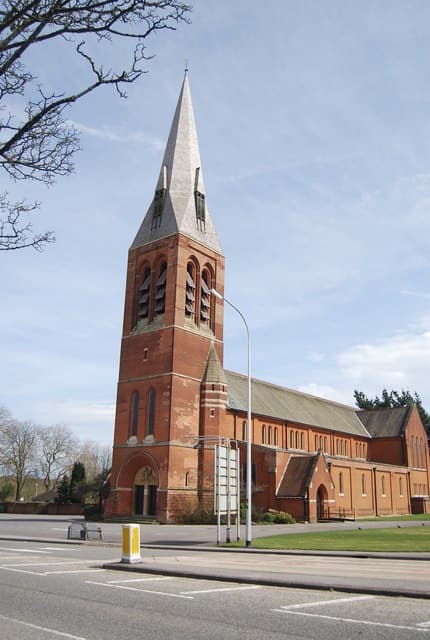
The Cathedral Church of St Michael and St George is the Roman Catholic cathedral for the Bishopric of the Forces, located in Aldershot, England. Originally built as an Anglican church for the British Army, it was consecrated in 1893 and later repurposed in 1973 to become the seat of the Roman Catholic Bishop of the Forces. It is a significant landmark due to its Gothic Revival architecture and its close association with military history.