
Monte Cassino
The Abbey of Monte Cassino is a historic Benedictine monastery located on a rocky hill in Italy, founded by Saint Benedict of Nursia around 529 AD. It is renowned as the first house of the Benedictine Order and the place where the Rule of Saint Benedict was composed, making it a foundational site for Western monasticism. Throughout its long and often tumultuous history, Monte Cassino has been a significant center of religion, culture, and learning, despite suffering numerous destructions and reconstructions.
Key Facts
- ›Founded by Saint Benedict of Nursia around 529 AD, making it the first Benedictine monastery.
- ›The Rule of Saint Benedict, a foundational text for Western monasticism, was composed for the community here.
- ›The abbey has been destroyed and rebuilt multiple times, including by Lombards, Saracens, French troops, and Allied bombing in World War II.
- ›It was a major cultural and educational center in the Middle Ages, boasting one of Europe's richest libraries.
- ›The abbey was elevated to a bishopric in 1322, though this was later suppressed.
- ›In 2014, its territorial jurisdiction was significantly reduced, with most of its parishes transferred to the Diocese of Sora-Cassino-Aquino-Pontecorvo.

the Site of the First Benedictine Monastery., the Birthplace of the Benedictine Rule., Site of the Battle of Monte Cassino., Historical Library and Scriptorium., Reconstructed Basilica.
6th Century, 8th Century, 11th Century, 14th Century, Post-Wwii
About Monte Cassino
The Abbey of Monte Cassino is a renowned Benedictine monastery situated on a prominent rocky hill overlooking the town of Cassino in Italy. Founded by Saint Benedict of Nursia himself around 529 AD, it holds the distinction of being the very first house of the Benedictine Order. It was within these walls that the seminal "Rule of Saint Benedict" was composed, a text that would profoundly shape Western monasticism and influence the course of European civilization.
History and Significance
Monte Cassino's history is marked by its enduring spiritual importance and its vulnerability to conflict. The original monastery was constructed on the site of an ancient Roman temple dedicated to Apollo, with Benedict repurposing the pagan structures for Christian worship. Over the centuries, the abbey has faced numerous destructions and reconstructions, beginning with sacks by Lombards in 580 and Saracens in 884. A significant period of flourishing occurred in the 11th and 12th centuries under Abbot Desiderius, during which the abbey became a leading center of culture, learning, and art, amassing a vast library and employing skilled artisans, including Byzantine mosaicists.
The abbey's strategic location meant it was also embroiled in secular conflicts. Emperor Frederick II garrisoned troops there in 1239, and the buildings were severely damaged by an earthquake in 1349, necessitating extensive rebuilding. In modern times, Monte Cassino became a focal point during World War II, serving as the site of the brutal Battle of Monte Cassino. On February 15, 1944, the abbey was almost completely destroyed by Allied bombing, a devastating event that killed 230 Italian civilians seeking refuge. Despite this, the abbey was meticulously rebuilt after the war and consecrated in 1964.
Cultural and Spiritual Legacy
Monte Cassino's legacy extends far beyond its religious function. It was a vital hub for the preservation and dissemination of knowledge during the Middle Ages, with its scriptorium producing invaluable manuscripts. Monks at Monte Cassino were also instrumental in developing medical knowledge, with the monastery hospital considered one of the first of its kind in Europe. While its territorial jurisdiction was significantly reduced in 2014, Monte Cassino continues to operate as an active territorial abbey, maintaining its status as a cornerstone of Benedictine tradition and a symbol of resilience.
Source: Wikipedia ↗
Frequently Asked Questions
When was Monte Cassino founded?
Monte Cassino was established by Saint Benedict of Nursia around 529 AD. This marked the beginning of the Benedictine Order and the creation of its foundational Rule.
What is the significance of Monte Cassino?
It is the first monastery of the Benedictine Order and the place where the Rule of Saint Benedict was written. This makes it a pivotal site for the development of Western monasticism and European culture.
Has Monte Cassino always been a peaceful place?
No, Monte Cassino has a history of significant destruction. It was sacked by Lombards, Saracens, and French troops, and heavily damaged by Allied bombing during World War II.
What role did Monte Cassino play in medieval learning?
During its golden age in the 11th and 12th centuries, Monte Cassino was a major cultural and educational center. It housed one of Europe's richest libraries and was renowned for its scriptorium and manuscript illuminators.
Is Monte Cassino still an active monastery?
Yes, Monte Cassino remains an active Benedictine monastery. While its territorial jurisdiction was reduced in 2014, it continues to function as a monastic community and spiritual center.
What happened to Monte Cassino during World War II?
During the Battle of Monte Cassino in 1944, the abbey was heavily damaged by Allied bombing. Tragically, this bombing killed 230 Italian civilians seeking refuge within its walls, though German troops were not present at the time of the raid.
Related Cathedrals

Aquino Cathedral
Aquino Cathedral, officially the Co-cathedral of Saints Constantius Bishop and Thomas Aquinas, is a Roman Catholic cathedral located in Aquino, Lazio, Italy. It is dedicated to Saints Constantius of Aquino and Thomas Aquinas, a prominent theologian and philosopher. The cathedral holds significance as a former episcopal seat and currently serves as a co-cathedral within its diocese, housing relics of Saint Thomas Aquinas.

Lucca Cathedral
Lucca Cathedral, officially dedicated to Saint Martin of Tours, is a Roman Catholic cathedral and the seat of the Archbishop of Lucca, Italy. Its history spans from the 6th century, with the current structure initiated in 1060 and consecrated in 1070. It is renowned for its Romanesque and Gothic architecture, housing significant relics like the Holy Face of Lucca and notable artworks.
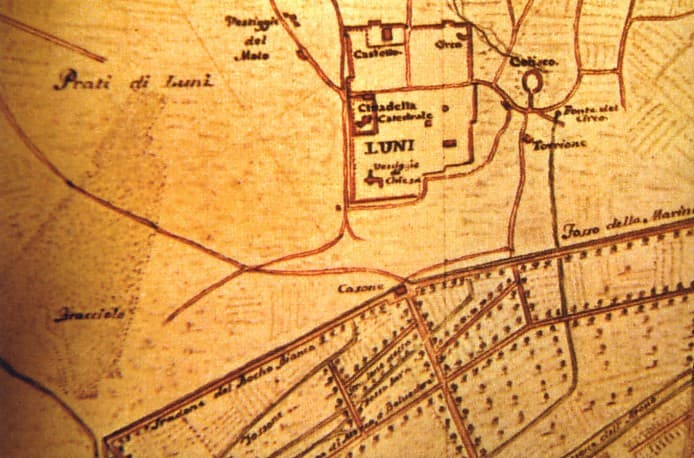
Luni Cathedral
Luni Cathedral, formerly the Pieve of Santa Maria, was a significant religious center located in the ancient Roman city of Luni, Liguria, Italy. Originally built by Romans in the late 4th and early 5th centuries, it served as the seat of the Diocese of Luni and was considered the "mother" church for the region. Despite its eventual abandonment and ruin as the city declined, it remained a site of annual liturgical observance until the early 14th century.