
Mantua Cathedral
Mantua Cathedral, officially the Cathedral of Saint Peter the Apostle, is the principal Roman Catholic church and seat of the Bishop of Mantua in Lombardy, northern Italy. Its history spans centuries, with significant rebuilding and renovations reflecting Romanesque, Gothic, Renaissance, and Baroque architectural influences, making it a layered testament to artistic and religious evolution.
Key Facts
- ›The cathedral's site has held religious structures since the Early Christian era, with a building destroyed by fire in 894 being quickly re-erected.
- ›The current church incorporates elements of an earlier Romanesque church, including some wall structures and the bell tower.
- ›Significant rebuilding phases occurred in the 12th century (Romanesque), the late 14th century (Gothic facade), and the MID-16th century (Renaissance interior renovation by Giulio Romano).
- ›The present-day facade, constructed between 1756 and 1761, is in a late Baroque style and made of Carrara marble.
- ›The cathedral houses the relics associated with the cult of the blood of Christ.
- ›Numerous notable figures, including members of the Gonzaga dynasty and bishops, are buried within the cathedral.

- Romanesque bell tower
- Gothic west front elements
- Renaissance interior alterations by Giulio Romano
- Late Baroque facade
- Chapel of the Blessed Sacrament linked to the Relic of the Blood of Christ
Giulio Romano, Giovan Battista Bertani, Nicolò Baschiera, Jacobello Dalle Masegne, Pierpaolo Dalle Masegne
About Mantua Cathedral
Mantua Cathedral, officially the Cathedral of Saint Peter the Apostle (Italian: Cattedrale di San Pietro apostolo; Duomo di Mantova), is the principal Roman Catholic cathedral and the seat of the Bishop of Mantua, located in the city of Mantua, Lombardy, northern Italy.
History and Architecture
The history of religious structures on the site of Mantua Cathedral stretches back to the Early Christian era. A building that existed on the site was destroyed by fire in 894 and was subsequently rebuilt in the Protoromanesque style. The church underwent significant rebuilding beginning in 1132 under Bishop Manfredo, initially in the Romanesque style; its bell tower was completed before 1150. The current church incorporates elements of this Romanesque predecessor, including some of its wall structures and the bell tower.
In 1395, Francesco I Gonzaga commissioned a new facade in the Gothic style, executed by the Venetian brothers Jacobello and Pierpaolo dalle Masegne. While only the right flank of this Gothic work survives, it featured a prothyrum and rose windows. Following another fire in 1545, Cardinal Ercole Gonzaga engaged Giulio Romano to renovate the church's interior. Romano preserved the facade and perimeter walls but transformed the interior into a design reminiscent of early Christian basilicas, particularly Old St. Peter's Basilica in Rome. This Renaissance transformation was continued after Romano's death by Giovan Battista Bertani.
The cathedral presents a striking architectural layering: a late Baroque facade, a Gothic left flank, and a Romanesque bell tower. The present facade, constructed of Carrara marble between 1756 and 1761, was designed by Nicolò Baschiera and features statues by Giovanni Angelo Finali and Giuseppe Tivani. The interior is laid out in a Latin cross plan with five aisles separated by Corinthian columns, featuring a flat coffered ceiling in the nave and outer aisles, and barrel vaults in the inner aisles. The dome has an octagonal drum.
Notable Features and Contents
Notable artistic contributions include frescoes in the apse by Antonio Maria Viani and paintings by various artists of the Mannerist school of Mantua in the side chapels. Historically, the cathedral housed significant altarpieces commissioned from artists like Paolo Veronese and Giulio Campi, though some of these were lost during the Napoleonic occupation. The organ, built by Benzi-Franceschini in 1915, features a neoclassical case designed by Giambattista Marconi.
The cathedral is also a significant burial site, containing the tombs of numerous historical figures. These include members of the influential Gonzaga dynasty, such as Ludovico I and Ludovico III Gonzaga, as well as their consorts like Barbara of Brandenburg. Bishops of Mantua and other notable individuals, including Boniface of Canossa and Anselm of Lucca, are also interred within its walls. The Chapel of the Blessed Sacrament is associated with the cult of the relic of the blood of Christ.
Source: Wikipedia ↗
Frequently Asked Questions
What is the history of Mantua Cathedral?
The site has a history of religious structures dating back to the Early Christian era. Following a fire in 894, it was rebuilt in the Protoromanesque style. Major rebuilding occurred in the 12th century in the Romanesque style, with further Gothic additions in the late 14th century and a significant Renaissance interior renovation in the 16th century. The current Baroque facade was added in the mid-18th century.
What architectural styles are present in Mantua Cathedral?
Mantua Cathedral displays an overlay of architectural styles. These include Romanesque elements from an earlier church, Gothic features on the left flank and original west front, Renaissance alterations to the interior, and a late Baroque facade.
Who is buried in Mantua Cathedral?
The cathedral serves as the burial site for several significant historical figures. This includes members of the ruling Gonzaga dynasty, such as Ludovico I and Ludovico III Gonzaga, as well as their relatives. It also contains the tombs of various bishops of Mantua and other notable individuals like Boniface of Canossa and Blessed Giacomo Benefatti.
Are there any notable artworks in Mantua Cathedral?
While some important works by artists like Paolo Veronese and Giulio Campi are no longer present due to historical spoliation, the cathedral's interior houses various artworks. These include paintings by artists of the Mantuan Mannerist school, frescoes by Ippolito Andreasi and Teodoro Ghisi, and sculptures on the facade.
What is the significance of the relic of the blood of Christ at Mantua Cathedral?
The Chapel of the Blessed Sacrament, located in the left arm of the transept, is linked to the cult of the relic of the blood of Christ. This relic has been a focus of devotion, contributing to the spiritual importance of this part of the cathedral.
What is the architectural style of the current facade?
The present facade of Mantua Cathedral, built between 1756 and 1761, is in the late Baroque style. It is constructed entirely of Carrara marble and features Corinthian pilasters and a triangular pediment, with statues adorning its various sections.
Related Cathedrals
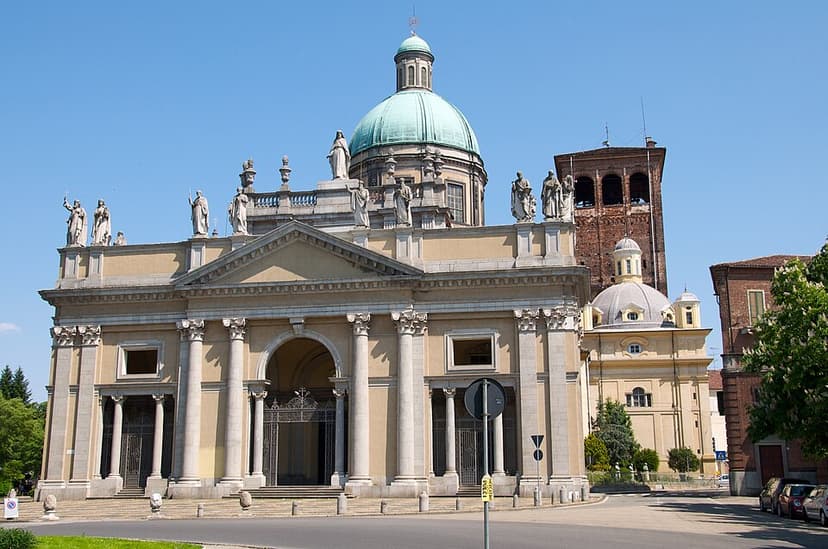
Vercelli Cathedral
Vercelli Cathedral, officially the Duomo di Vercelli or Cattedrale di Sant'Eusebio, is the principal church of Vercelli, Italy, and serves as the cathedral for the Archdiocese of Vercelli. It is dedicated to Saint Eusebius, its first bishop, and stands on a site with a history of earlier ecclesiastical structures dating back to the 4th century.

Amalfi Cathedral
Amalfi Cathedral, officially the Cathedral of Saint Andrew, is a medieval Roman Catholic cathedral located in Amalfi, Italy. It is renowned for its elaborate architecture, a blend of various historical styles, and for housing the relics of the Apostle Saint Andrew. The cathedral has been an important religious center and a significant landmark of the Amalfi Coast for centuries.

Volterra Cathedral
Volterra Cathedral, officially the Cattedrale di Santa Maria Assunta, is a Roman Catholic cathedral in Volterra, Italy, serving as the episcopal seat for the Diocese of Volterra. Originally dedicated to Saint Mary in the 9th century, the present structure was largely rebuilt following a devastating earthquake in 1117 and consecrated in 1120. It holds significant historical and artistic importance, showcasing Romanesque, Gothic, and Renaissance elements, and houses numerous artworks by notable Italian artists.