
Crema Cathedral
Crema Cathedral, officially the Cattedrale di Santa Maria Assunta, is the principal and oldest place of Catholic worship in Crema, Italy, and serves as the seat of the Diocese of Crema. Its construction history spans centuries, with significant rebuilding and renovations reflecting various architectural styles and historical periods, making it a key landmark in the city's religious and cultural heritage.
Key Facts
- ›The cathedral's origins are uncertain, with possible pre-1000 AD pagan temple or early Christian church sites suggested by artifacts and location.
- ›A large Romanesque church existed in the 11th century, with remains found beneath the current structure.
- ›Following destruction in the 12th century, reconstruction began in 1185 under Frederick Barbarossa and continued with interruptions until the 14th century.
- ›The cathedral underwent a significant Baroque renovation between 1776 and 1780, which was later partially reversed by 20th-century restorations.
- ›The bell tower, integrated into the church, was built between the 13th and 14th centuries and stands 58 meters tall.
- ›Notable artworks within the cathedral include a 13th-century French-made wooden Crucifix and a 1518 panel by Vincenzo Civerchio.

- 13th-Century French Wooden Crucifix
- Vincenzo Civerchio's 'Saint Sebastian Between Saints Christopher and Roch'
- Romanesque Facade Elements
- Gothic Rose Window
- 58-Meter Tall Bell Tower
- Remains of 11th-Century Church
Giacomo Zaninelli, Ermenegildo Pini, Orlando Bencetti, Cecilio Arpesani, Emilio Gussalli, Amos Edallo, Corrado Verga
About Crema Cathedral
Crema Cathedral, officially known as the Cattedrale di Santa Maria Assunta, stands as the primary and oldest place of Catholic worship in the city of Crema, Italy. It holds significant historical and religious importance as the episcopal seat of the Diocese of Crema.
History and Architecture
The precise origins of Crema Cathedral are shrouded in the distant past, with no definitive historical records available before the year 1000. Archaeological findings, such as Roman artifacts unearthed during restorations, hint at the possibility of an ancient pagan temple or an early Christian church occupying the site. Tradition suggests a small church dedicated to Santa Maria della Mosa existed in the area prior to Crema's founding, dating back to early Christian times. This location, situated on a defensible ridge, would have been ideal for sheltering refugees.
By the 11th century, a substantial church, nearly the size of the current structure, is documented. Remains of this Romanesque building, featuring three naves and semicircular apses, have been identified beneath the present cathedral. The current edifice owes much of its form to reconstructions initiated after the historic siege of 1159–1160. Reconstruction efforts began in 1185 under Frederick Barbarossa, focusing on the apse and triumphal arch, and continued with various interruptions due to political conflicts and diocesan shifts until the 14th century. The bell tower, a prominent feature integrated into the church, was erected between the 13th and 14th centuries.
Over the centuries, Crema Cathedral has undergone numerous transformations. A radical Baroque renovation between 1776 and 1780 significantly altered the interior's appearance, a style that was later partially reversed by extensive restoration campaigns in the mid-20th century. These modern interventions aimed to remove the 18th-century additions and reinstate earlier architectural elements, balancing conservation with stylistic reconstruction. The facade displays a blend of Romanesque elements, such as round arches and capitals, alongside a distinctly Gothic central rose window. The cathedral's interior features a three-nave layout with groin vaults and semi-columns supporting pointed arches.
Artistry and Significance
Despite the substantial destruction of earlier decorative schemes during the Baroque renovations, Crema Cathedral preserves a significant collection of artworks. Among its most venerated treasures is a large, wooden Crucifix, carved between 1250 and 1275, likely in France, which displays an intense and painful expression. Other notable artworks include a 1518 panel by Vincenzo Civerchio depicting Saint Sebastian, and various frescoes and paintings from different eras.
In 1580, Crema was elevated to an episcopal seat, formally making the cathedral the center of the Diocese of Crema. The bell tower, standing 58 meters tall, is a significant architectural element, housing an original clock mechanism from the 18th century. The cathedral has also hosted important religious figures, including Pope John Paul II in 1992, an event commemorated by a plaque on its wall. Today, Crema Cathedral remains an active place of worship and a vital monument to the city's enduring history and faith.
Source: Wikipedia ↗
Frequently Asked Questions
What is the history of Crema Cathedral before the 11th century?
Historical documents are absent for construction history before the year 1000, making it impossible to determine. Artifacts suggest a possibility of an ancient pagan temple or an early Christian church on the site.
When was Crema Cathedral significantly rebuilt?
Following destruction in the 12th century, reconstruction began in 1185. The process was lengthy and interrupted, with further significant renovations occurring in the late 18th century in Baroque style, and major restorative work in the mid-20th century.
What architectural styles are present in Crema Cathedral?
The cathedral exhibits Romanesque elements in its facade and structure, Gothic features in its rose window, and underwent substantial Baroque modifications in the interior. Modern restorations have aimed to reveal earlier architectural phases.
What are some notable artworks inside Crema Cathedral?
Key artworks include a venerated wooden Crucifix carved between 1250 and 1275, a 1518 panel by Vincenzo Civerchio depicting Saint Sebastian, and various frescoes and paintings from different periods.
What is the significance of the bell tower at Crema Cathedral?
The bell tower, built between the 13th and 14th centuries, is an integrated yet distinct architectural element. Standing 58 meters tall, it features multiple levels with windows, a clock, and a lantern crowning its octagonal structure.
When did Crema Cathedral become an episcopal seat?
In 1580, Pope Gregory XIII elevated Crema to a diocesan seat, officially making the cathedral the episcopal seat. Until then, it had been under the jurisdiction of the Diocese of Piacenza.
Related Cathedrals

Pistoia Cathedral
Pistoia Cathedral, officially the Cathedral of Saint Zeno, is the principal religious edifice in Pistoia, Tuscany, central Italy. Located in the Piazza del Duomo, it serves as the seat of the Bishop of Pistoia and is dedicated to Saint Zeno of Verona. Its history spans from likely origins in the 10th century, with significant architectural modifications over subsequent centuries, including Romanesque, Gothic, and Baroque influences, culminating in a major restoration in the late 20th century.

Angers Cathedral
Angers Cathedral, officially Cathédrale Saint-Maurice d'Angers, is a Catholic cathedral in Angers, France, serving as the seat of the Bishops of Angers. Renowned for its blend of Romanesque and Gothic architectural styles, it also features significant Baroque elements and an exceptional collection of stained-glass windows, some dating back to the late 12th century.
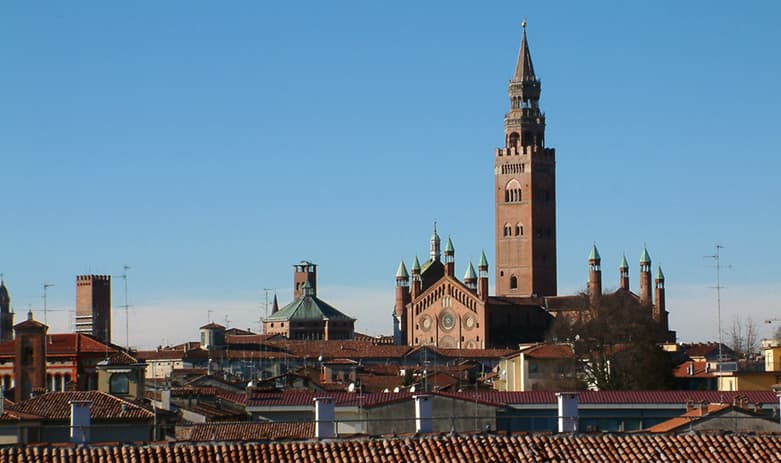
Cremona Cathedral
Cremona Cathedral, officially the Cathedral of Santa Maria Assunta, is a significant Romanesque-Gothic cathedral in Cremona, Lombardy, Italy, serving as the seat of the Bishop of Cremona. Its construction began in the early 12th century and, despite interruptions, evolved over centuries to incorporate Gothic, Renaissance, and Baroque elements, making it a notable monument of medieval European art.