
Cathedral of St. Paul
Catholic Diocese of Birmingham in Alabama·Catholic·United States
The Cathedral of Saint Paul, also known as Saint Paul's Cathedral, is the mother church of the Catholic Diocese of Birmingham in Alabama. Originally built as a parish church in 1893, it was elevated to cathedral status in 1969 following the creation of the Diocese of Birmingham. The cathedral is a significant example of Victorian Gothic architecture and has undergone several renovations and additions throughout its history.
Key Facts
- ›Designed by Chicago architect Adolphus Druiding, the building was completed in 1893 as a parish church.
- ›It was designated as the Co-Cathedral of Saint Paul in 1954 when the Diocese of Mobile-Birmingham was established.
- ›The church officially became the Cathedral of St. Paul in 1969 with the erection of the Diocese of Birmingham in Alabama.
- ›The cathedral and its school were added to the National Register of Historic Places in 1982.
- ›The exterior features Neo-Gothic style with red brick and white limestone walls.
- ›The sanctuary altar is made of carrara marble with Mexican onyx accents and contains the relics of three martyrs.
- Victorian Gothic Architecture
- Stained-Glass Windows By G. C. Riordan & Company
- Carrara Marble Altar With Mexican Onyx Accents
- Reliquary With Relics of Three Martyrs
- Anna Catharine Grace Memorial Pipe Organ
- Large Window of St. Paul Over the Entrance
Adolphus Druiding
About Cathedral of St. Paul
Cathedral of Saint Paul
The Cathedral of Saint Paul, often referred to informally as Saint Paul's Cathedral, serves as the principal church for the Roman Catholic Diocese of Birmingham in Alabama. Its origins trace back to 1872 with the establishment of a parish and the construction of a small wood-framed church. The current edifice, a striking example of Victorian Gothic architecture, was designed by Chicago architect Adolphus Druiding and completed as a parish church in 1893.
History and Development
Catholic presence in Birmingham was initially under the Diocese of Mobile. The first resident pastor of St. Paul's Church, John Browne, was appointed in 1880. Under his successor, Patrick O’Reilly, the cornerstone for the new church was laid in 1890. This new structure was dedicated on November 30, 1893, at a cost of approximately $90,000. During the early 20th century, pastor James Coyle navigated anti-Catholic sentiments, tragically losing his life in 1921.
The church's status evolved over time. In 1954, Pope Pius XII designated St. Paul's Church as the Co-Cathedral of Saint Paul when the Diocese of Mobile was replaced by the Diocese of Mobile-Birmingham. The co-cathedral underwent its first renovation that same year. A significant shift occurred in 1969 when Pope Paul VI divided the diocese, establishing the Archdiocese of Mobile and the Diocese of Birmingham in Alabama. At this point, the Co-Cathedral of St. Paul officially became the Cathedral of St. Paul.
Further structural repairs and sanctuary modifications were made in 1972, including the installation of a large window of St. Paul. The cathedral and its school were recognized for their historical importance by being added to the National Register of Historic Places in 1982. Subsequent renovations have addressed the roof, electrical systems, flooring, pews, and the pipe organ, with a major renovation of the rectory commencing in 2023.
Architecture and Features
The Cathedral of Saint Paul is characterized by its Neo-Gothic style, constructed with red brick and white limestone. The interior includes a nave supported by ten solid granite columns, adorned with 14 Stations of the Cross and various statues, including those of the Blessed Mother, St. Joseph, John Vianney, Apostle Paul, and Anthony of Padua. The stained-glass windows in the aisles are the work of G. C. Riordan & Company.
The sanctuary features an altar crafted from carrara marble, accented with Mexican onyx columns, and displays a bas-relief of the Lamb of God. Within this altar is a reliquary holding the relics of three ancient martyrs: Placidus, Theodorus, and Tarcisius. The cathedral is also home to the Anna Catharine Grace Memorial Pipe Organ, manufactured by the Noack Organ Company and installed in 2022.
The cathedral courtyard includes an outdoor altar depicting the death of St. Joseph. The building's historical and architectural significance has been preserved through numerous updates and its inclusion on the National Register of Historic Places.
Source: Wikipedia ↗
Frequently Asked Questions
When was the Cathedral of St. Paul built?
The new St. Paul's Church, which would later become the Cathedral, was dedicated on November 30, 1893. It was constructed as a parish church and later elevated to cathedral status.
Who designed the Cathedral of St. Paul?
The cathedral was designed by Chicago architect Adolphus Druiding. He designed the Victorian Gothic-style brick building.
What is the architectural style of the Cathedral of St. Paul?
The Cathedral of St. Paul is designed in the Victorian Gothic style. Its exterior features red brick and white limestone walls.
What is the significance of the reliquary in the sanctuary?
The reliquary inside the sanctuary altar contains the relics of three martyrs: Placidus, Theodorus, and Tarcisius. These martyrs lived in the 3rd and 4th centuries CE.
Has the Cathedral of St. Paul undergone renovations?
Yes, the cathedral has undergone several renovations. Notable ones include additions and repairs in 1954, structural repairs and sanctuary changes in 1972, a roof replacement and system upgrades completed in 2014, and floor refinishing and pew replacement in 2019.
Is the Cathedral of St. Paul a historic landmark?
Yes, in 1982, the Cathedral of St. Paul and its school building were added to the National Register of Historic Places, recognizing its historical and architectural significance.
Related Cathedrals

Cathedral of St. Sava
The Saint Sava Serbian Orthodox Church, originally built as Trinity Chapel, is a historic Eastern Orthodox church located in Manhattan, New York City. Designed by Richard Upjohn in the English Gothic Revival style, it served as an uptown chapel for Trinity Church parish before being sold to a Serbian Orthodox congregation in 1942. The church is notable for its architectural significance, its role as a spiritual center for the Serbian community, and its resilience following a devastating fire in 2016.

Bangor Cathedral
Bangor Cathedral, the cathedral church of Bangor, Gwynedd, Wales, is dedicated to its founder, Saint Deiniol. The site has been a place of Christian worship since the sixth century, with the present building undergoing extensive reconstruction and restoration over centuries, notably in the 19th century under George Gilbert Scott. It holds significant historical and architectural importance within Wales.
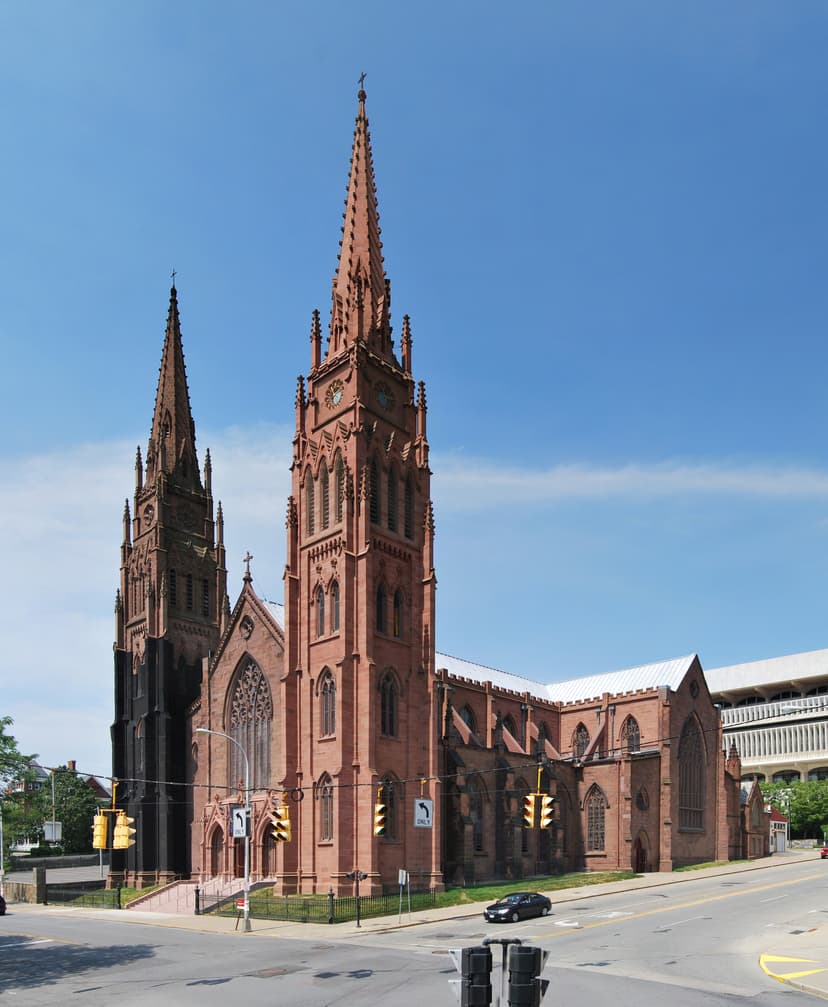
Cathedral of the Immaculate Conception
The Cathedral of the Immaculate Conception in Albany, New York, is a significant Catholic church and the mother church of the Diocese of Albany. Designed by Patrick Keely in the Neo-Gothic style, it was the first American Catholic cathedral of its kind and, upon completion, was the tallest building in Albany. It holds historical importance for its role in accommodating Catholic immigrants and for hosting interfaith events.