
Cathedral Basilica of St. Augustine
Catholic Diocese of St. Augustine·Catholic·United States
The Cathedral Basilica of St. Augustine is a historic Catholic cathedral in St. Augustine, Florida, serving as the seat of the Catholic Bishop of St. Augustine. Established in 1565, its congregation is the oldest Christian congregation in the contiguous United States, and the current structure was constructed between 1793 and 1797, later undergoing significant rebuilding in the late 19th century.
Key Facts
- ›The congregation was established in 1565, making it the oldest Christian congregation in the contiguous United States.
- ›The current cathedral was constructed between 1793 and 1797, following several earlier churches that were destroyed by fire or deterioration.
- ›The cathedral was designated a U.S. National Historic Landmark on April 15, 1970.
- ›Its facade exhibits an eclectic MIX of Spanish mission and Neoclassical architectural styles.
- ›After a fire in 1887, the cathedral was rebuilt and enlarged by architect James Renwick Jr., featuring a cruciform layout and a Spanish Renaissance-style bell tower.
- ›The cathedral became a full cathedral in 1870 and was elevated to the status of a minor basilica in 1976.

Spanish Mission, Neoclassical, Spanish Renaissance
- Eclectic Facade Combining Spanish Mission and Neoclassical Elements
- Coquina Stone Walls
- Spanish Renaissance-Style Bell Tower
- Exposed Decorated Timbers In Roof Truss System
- Bell Dated 1682 Salvaged From A Previous Church
James Renwick Jr.
About Cathedral Basilica of St. Augustine
The Cathedral Basilica of St. Augustine
The Cathedral Basilica of St. Augustine, located in St. Augustine, Florida, is a significant historical and religious landmark, serving as the seat of the Catholic Bishop of St. Augustine. Its congregation traces its origins back to 1565, making it the oldest Christian congregation within the contiguous United States. The current cathedral structure was constructed between 1793 and 1797, with substantial rebuilding and expansion undertaken in the late 19th century.
History and Development
The history of Catholic worship in St. Augustine dates back to the mid-1560s with the founding of the Spanish colony. The earliest churches were simple structures, vulnerable to the elements and conflict. A notable attack in 1586 by Sir Francis Drake led to the destruction of the first church. Subsequent structures also met unfortunate ends; one built of straw and palmetto deteriorated quickly and burned down in 1599, while a more permanent timber church built in 1605 was destroyed by fire in 1702 during an English attempt on the city. Reconstruction efforts were hampered by misspent funds and the period of British rule from 1763 to 1784. After Spain regained control of Florida in 1784, a renewed civic pride spurred the construction of the present church from 1793 to 1797. The building officially became a cathedral in 1870 and was granted the status of a minor basilica in 1976.
Architectural Significance
The cathedral's facade presents an eclectic blend of Spanish mission and Neoclassical architectural styles. Characteristic Spanish mission elements include curved bell gables, limited window openings, clay roof tiles, a semicircular tympanum, and relatively unadorned walls, accented by a prominent statuary niche. Neoclassical details are visible around the entrance, featuring an entablature with triglyphs, a broken pediment, and Doric columns.
Following a significant fire on April 12, 1887, the exterior coquina blocks and cement masonry proved salvageable. Reconstruction efforts, supported by donations from Henry Flagler and national appeals, were led by New York City architect James Renwick Jr. He redesigned the church with a rectangular-cruciform layout and introduced a European-style transept. Renwick also developed an intricate roof truss system that exposed decorated timbers and added a Spanish Renaissance-style bell tower. The tower houses four bells, including one salvaged from a prior church, inscribed "Sancte Joseph. Ora Pro Nobis. D 1682."
The use of coquina stone, a sedimentary rock composed of seashell deposits, was inspired by Native American building techniques. This material, quarried and transported cheaply, could be worked while soft but hardened when exposed to air. However, the later construction of the walls and bell tower utilized modern cast-in-place concrete.
The Cathedral Basilica of St. Augustine was designated a U.S. National Historic Landmark on April 15, 1970, acknowledging its deep historical roots and enduring architectural importance.
Source: Wikipedia ↗
Frequently Asked Questions
When was the Cathedral Basilica of St. Augustine founded?
The congregation of the Cathedral Basilica of St. Augustine was established in 1565. This makes it the oldest Christian congregation in the contiguous United States.
When was the current cathedral structure built?
The current church structure was constructed over a five-year period, from 1793 to 1797. It was built after previous churches on the site were destroyed.
What architectural styles are present at the Cathedral Basilica of St. Augustine?
The cathedral's facade is characterized by an eclectic combination of Spanish mission and Neoclassical styles. Later additions by James Renwick Jr. also incorporated Spanish Renaissance elements in the bell tower.
What is the significance of the coquina stone used in the cathedral?
The original coquina stone walls, salvaged after an 1887 fire, were made of a sedimentary rock formed from seashell deposits. This material was readily available and hardened upon exposure to air, making it a convenient building material.
Who designed the late 19th-century additions to the cathedral?
Following a fire in 1887, the New York City architect James Renwick Jr. was hired to rebuild and enlarge the church. He was responsible for the rectangular-cruciform layout and the Spanish Renaissance-style bell tower.
Is the Cathedral Basilica of St. Augustine a National Historic Landmark?
Yes, the Cathedral Basilica of St. Augustine was designated a U.S. National Historic Landmark on April 15, 1970. This designation recognizes its historical and architectural significance.
Related Cathedrals

Basilica of the National Shrine of the Assumption of the Blessed Virgin Mary
The Basilica of the National Shrine of the Assumption of the Blessed Virgin Mary, also known as the Baltimore Basilica, is a significant Catholic cathedral in Baltimore, Maryland. It holds the distinction of being the first Catholic cathedral built in the United States after the nation's founding and was among the earliest major religious structures erected following the adoption of the U.S. Constitution. It serves as a co-cathedral for the Archdiocese of Baltimore, a parish church, and a national shrine, recognized for its architectural brilliance and historical importance in shaping American Catholicism.

Arras Cathedral
Arras Cathedral, officially named Cathédrale Notre-Dame-et-Saint-Vaast d'Arras, serves as the principal church and seat of the Bishops of Arras in France. The current structure is built upon the site of the former Abbey Church of Saint-Vaast, which was consecrated in 1834 after a significant rebuilding in neoclassical style following the French Revolution.
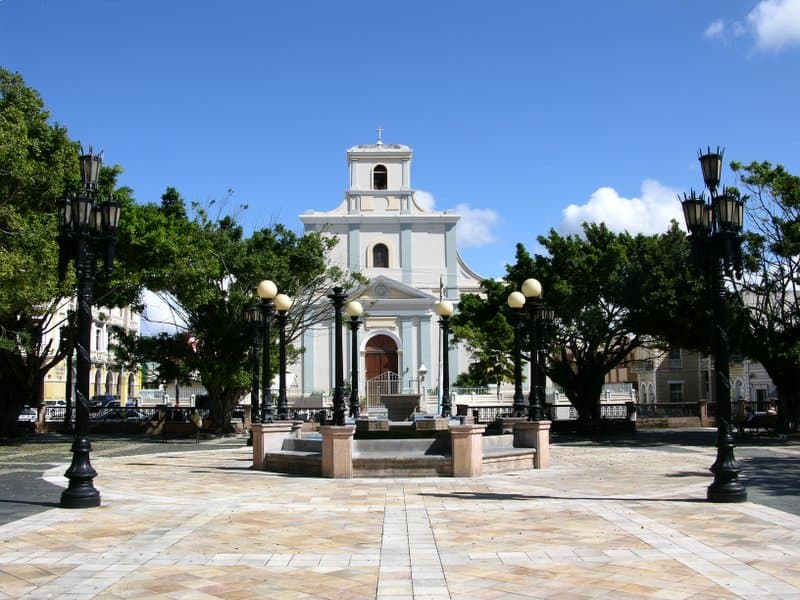
Catedral de San Felipe Apóstol
The Catedral de San Felipe Apóstol, located in Arecibo, Puerto Rico, serves as the seat of the Diocese of Arecibo. It is the second-largest church in Puerto Rico and features a distinctive architectural style with neoclassical and less traditional elements, along with Renaissance-style windows.