
Catedral de San Felipe Apóstol
Diocese of Arecibo·Catholic·Puerto Rico
The Catedral de San Felipe Apóstol, located in Arecibo, Puerto Rico, serves as the seat of the Diocese of Arecibo. It is the second-largest church in Puerto Rico and features a distinctive architectural style with neoclassical and less traditional elements, along with Renaissance-style windows.
Key Facts
- ›The cathedral was established as the seat of the Diocese of Arecibo in 1960.
- ›Its construction spanned various stages from the late 18th century until 1846, with significant damage and repairs due to earthquakes and hurricanes.
- ›The building has a rectangular plan with three naves and semicircular apse covered by an unusual half-dome.
- ›The facade is a three-stage triangular composition, with the top central tower being a later addition.
- ›It is listed on the Puerto Rico Register of Historic Sites and Zones as part of the Historic Churches of Puerto Rico multiple property submission.
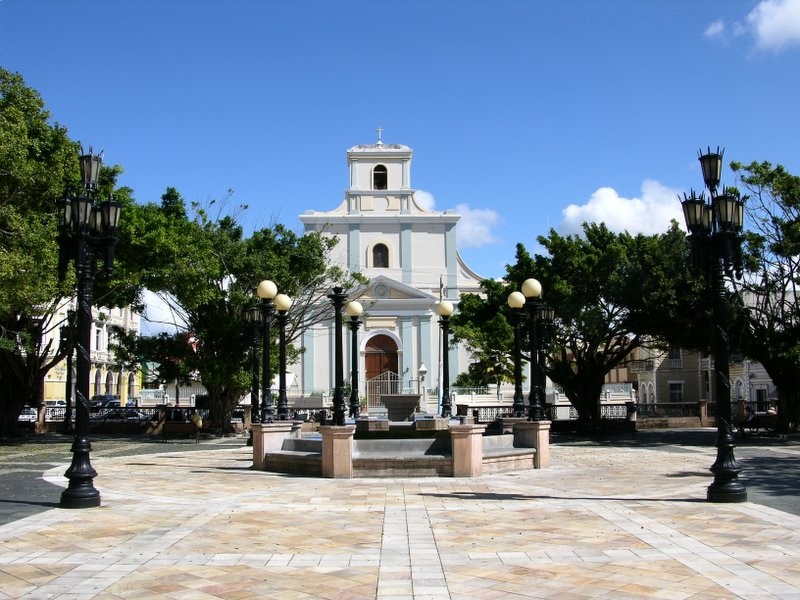
Rectangular Plan With Three Naves, Semicircular Apse With A Half-Dome, Three-Stage Triangular Facade, Renaissance-Style Windows, Central Tower Over the Entrance
About Catedral de San Felipe Apóstol
The Catedral de San Felipe Apóstol, situated in Arecibo, Puerto Rico, stands as the principal church of the Catholic Diocese of Arecibo. Its designation as a cathedral dates from April 30, 1960, when the diocese was officially established.
History and Construction
The origins of a church on this site trace back to the Spanish settlement of Arecibo, with the first parish church constructed in the mid-17th century. This early structure was unfortunately destroyed by an earthquake in 1787. The construction of the current cathedral building, dedicated to Saint Philip the Apostle, was a protracted process, spanning several stages from the late 18th century until its official dedication in 1846. Its edification was frequently interrupted and impacted by natural disasters, including hurricanes and earthquakes. Just four days after its 1846 dedication, the building sustained severe damage from another earthquake. Subsequent repairs were not completed until 1882, following further damage from an 1875 earthquake. A significant earthquake in 1918 badly damaged the vault, leading to its replacement with a flat concrete roof, and a vaulted ceiling of composition board was installed internally.
Architectural Features
The cathedral presents a rectangular plan featuring three naves, with the side naves being shorter to accommodate large flanking chapels that extend nearly half the church's length. The apse is semicircular and topped with an uncommon half-dome. The facade is characterized by a triangular composition divided into three stages. While the lowest stage exhibits neoclassical ornamentation in an academic style, the upper two stages employ a less traditional approach with bands and pilasters. Renaissance-style windows are incorporated, a feature rarely seen in Puerto Rican churches. The central tower positioned over the entrance is a common architectural motif found across the island.
Significance and Recognition
As the seat of the Diocese of Arecibo, the cathedral is a focal point for Catholic life in the region. It is recognized as Puerto Rico's second-largest church, following the Metropolitan Cathedral Basilica of San Juan. Although not individually listed on the federal historic register, the Catedral de San Felipe Apóstol is included in the Puerto Rico Register of Historic Sites and Zones. It was also part of the Historic Churches of Puerto Rico multiple property submission, highlighting its importance within the island's architectural and religious heritage.
Source: Wikipedia ↗
Frequently Asked Questions
What is the history of the Catedral de San Felipe Apóstol?
The first church on the site was established between 1556 and 1616. The current building's construction began in the late 18th century and was largely completed by 1846, though it suffered significant damage from earthquakes and hurricanes throughout its history, requiring extensive repairs.
What are the architectural features of the cathedral?
The cathedral has a rectangular plan with three naves and a semicircular apse covered by a half-dome. Its facade is a three-stage triangular composition with neoclassical ornamentation on the lowest stage and a less traditional use of bands and pilasters on the upper stages. Renaissance-style windows are a notable, though uncommon, feature.
When did the Catedral de San Felipe Apóstol become a cathedral?
The parish church became a cathedral on April 30, 1960, upon the establishment of the Diocese of Arecibo.
Has the cathedral been damaged by natural disasters?
Yes, the cathedral has been severely impacted by natural disasters. It was destroyed by an earthquake in 1787 and later seriously damaged by earthquakes in 1846, 1875, and 1918, necessitating ongoing repairs and modifications.
What is the size of the cathedral compared to other churches in Puerto Rico?
The Catedral de San Felipe Apóstol is Puerto Rico's second-largest church, surpassed only by the Metropolitan Cathedral Basilica of San Juan.
Related Cathedrals

Catedral de Nuestra Señora de la Guadalupe
The Catedral de Nuestra Señora de la Guadalupe, also known as Ponce Cathedral, is the principal church of the Roman Catholic Diocese of Ponce in Puerto Rico. Situated in the heart of Ponce's Plaza Las Delicias, it has a history stretching back to 1670 and is noted for its intricate neoclassical architecture and its significance as a historic landmark.

Catedral Metropolitana Basílica de San Juan Bautista
The Catedral Metropolitana Basílica de San Juan Bautista, located in Old San Juan, Puerto Rico, is a significant historical and religious landmark. It is one of the oldest cathedrals in the Americas and holds the tomb of explorer Juan Ponce de León, alongside national shrines and relics of important figures.

Catedral Santiago Apóstol
The Catedral Santiago Apóstol, also known as the Cathedral of St. James the Apostle, is a Catholic cathedral serving as a co-seat for the Diocese of Fajardo-Humacao in Fajardo, Puerto Rico. Originally established as a parish church in 1766, the current structure was built following an earthquake in 1867, and it achieved cathedral status in 2008.