
Catedral de Nuestra Señora de la Guadalupe
Roman Catholic Diocese of Ponce·Roman Catholic·Puerto Rico
The Catedral de Nuestra Señora de la Guadalupe, also known as Ponce Cathedral, is the principal church of the Roman Catholic Diocese of Ponce in Puerto Rico. Situated in the heart of Ponce's Plaza Las Delicias, it has a history stretching back to 1670 and is noted for its intricate neoclassical architecture and its significance as a historic landmark.
Key Facts
- ›Founded as a chapel in 1670, it was designated a parish church by the King of Spain in 1692.
- ›The current structure incorporates much of the 1839 building, which was declared a cathedral in 1924.
- ›Architecturally, it features a neoclassical exterior with a cruciform plan and a large dome at the crossing.
- ›The cathedral was significantly reconstructed between 1931 and 1937 under architect Francisco Porrata Doria.
- ›It houses a large pipe organ that was once played by renowned composer Juan Morel Campos.
- ›The building was listed on the National Register of Historic Places in 1984 for its historic significance.

Neoclassical, French Neoclassical
Large Pipe Organ, Cruciform Plan With A Large Dome, Two Three-Story Square Towers, Alabaster Main Altar, Stained Glass Windows
Francisco Porrata Doria
About Catedral de Nuestra Señora de la Guadalupe
The Catedral de Nuestra Señora de la Guadalupe, commonly known as Ponce Cathedral, stands as the principal church of the Roman Catholic Diocese of Ponce in Puerto Rico. Its historical roots trace back to 1670, when a modest chapel was first established on the site of the present cathedral in the colonial settlement of Ponce. This chapel was officially designated a parish church by a Royal Permit from King Carlos II of Spain on September 17, 1692.
History and Development
The current structure incorporates much of the church completed in 1839, which was built after the demolition of the original parish church. This 1839 edifice featured two octagonal towers and served as the core for subsequent renovations. The building has endured damage from numerous fires and earthquakes throughout the 19th and 20th centuries, including significant destruction from the 1918 San Fermín earthquake that necessitated the reconstruction of its towers. In 1924, Pope Pius XI officially declared the church a cathedral, with Edwin Byrne becoming its first bishop in 1925.
Architectural Transformation
Between 1931 and 1937, the cathedral underwent a major reconstruction designed by architect Francisco Porrata Doria. This period saw the addition of new chapels, a revised roof, and the remodeling of the upper facade, resulting in the current French neoclassical style. The exterior is painted in pale blue and gray, while the interior features blue and beige tones. Architecturally, it follows a cruciform plan, marked by a large dome at the crossing of the transept and nave. The interior is divided by arcades into a main nave and two aisles, with two small chapels.
Notable Features and Significance
Among the cathedral's notable features is a large pipe organ, reportedly played by the esteemed danza master and composer Juan Morel Campos. The interior also boasts a main neoclassical altar of translucent alabaster, a modern replacement for an original wooden gothic altar now housed in a side chapel. The cathedral's floor is finished in a gray and white marble design, except for the side chapel which uses terrazzo. The western front facade is characterized by two three-story square towers, each topped with silver domes and a Christian cross. For its historical importance, the cathedral was listed on the National Register of Historic Places in 1984. It is a significant landmark located in the center of Ponce's Plaza Las Delicias, an area designated for the preservation of the city's colonial character.
Source: Wikipedia ↗
Frequently Asked Questions
What is the history of Ponce Cathedral?
The history of the Catedral de Nuestra Señora de la Guadalupe dates back to 1670 when a small chapel was built on its site. It was designated a parish church in 1692 and the current core of the building was completed in 1839. It was declared a cathedral in 1924 and underwent significant reconstruction in the 1930s.
What is the architectural style of Ponce Cathedral?
The cathedral is primarily designed in the neoclassical style. Its exterior is painted pale blue and gray, and it features a cruciform plan with a large dome at the crossing. The facade has a French neoclassical style, with two richly decorated square towers.
Where is Ponce Cathedral located?
The cathedral is centrally located in Ponce, Puerto Rico, situated in the middle of the town square known as Plaza Las Delicias. It is within the Ponce Historic Zone and faces west.
What are some notable features of the interior?
The interior features a main nave and two aisles separated by arcades, two small chapels, and a large pipe organ. The main altar is made of translucent alabaster, and the floor is a marble design.
Is Ponce Cathedral an active place of worship?
Yes, Catedral de Nuestra Señora de la Guadalupe is an active place of worship and the seat of the Roman Catholic Diocese of Ponce. It hosts regular services and significant annual events like Las Mañanitas.
Has the cathedral suffered damage?
The cathedral has a history of damage from fires and earthquakes, notably the 1918 San Fermín earthquake which destroyed its original towers. It was also temporarily closed due to damage from the 2020 Puerto Rico earthquakes.
Related Cathedrals
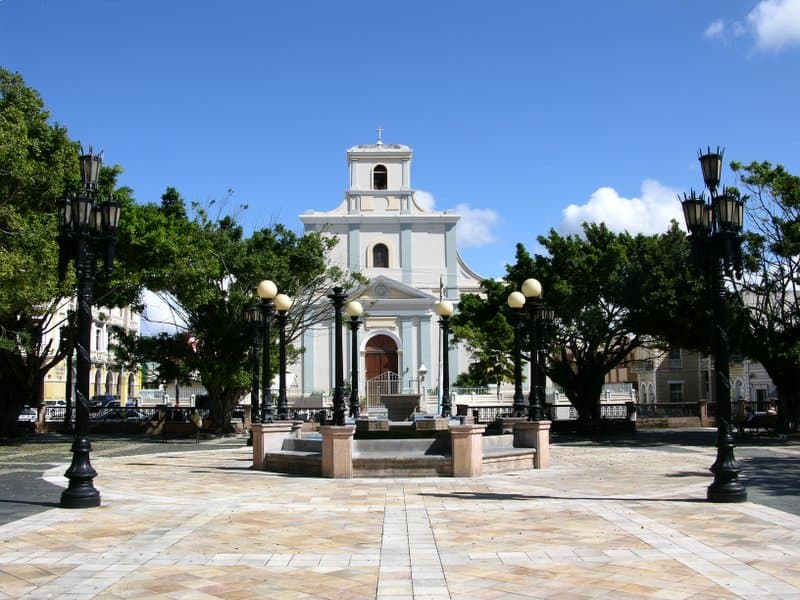
Catedral de San Felipe Apóstol
The Catedral de San Felipe Apóstol, located in Arecibo, Puerto Rico, serves as the seat of the Diocese of Arecibo. It is the second-largest church in Puerto Rico and features a distinctive architectural style with neoclassical and less traditional elements, along with Renaissance-style windows.

Catedral Nuestra Señora de la Candelaria
Catedral Nuestra Señora de la Candelaria is the Roman Catholic cathedral for the Diocese of Mayagüez in Mayagüez, Puerto Rico. Originally a parish church established in the 18th century, it was elevated to cathedral status in 1976. The cathedral is known for its historical significance, including being the site where thousands of enslaved children were baptized and emancipated.

Catedral San Juan Bautista
Catedral San Juan Bautista is an Episcopal cathedral located in the Santurce district of San Juan, Puerto Rico. It serves as the seat of the Diocese of Puerto Rico and was established in the early 20th century, with its current building completed in 1930.