
Camden Town Cathedral
All Saints Cathedral, originally an Anglican church in Camden Town, London, is now the Greek Orthodox Cathedral Church of All Saints. Built between 1822 and 1824 by William and Henry Inwood, it is a Grade I listed building known for its Ionic order architecture, inspired by Greek examples.
Key Facts
- ›Constructed between 1822 and 1824 as a Church of England parish church.
- ›Designed by father-and-son architects William and Henry Inwood.
- ›Features Ionic columns and a tower inspired by the Choragic Monument of Lysicrates.
- ›Became a Greek Orthodox church in 1948 and was elevated to cathedral status in 1991.
- ›A Grade I listed building, reflecting its architectural significance.
- ›Renovations have been undertaken, most recently since 2009, with support from English Heritage and the National Lottery.

Ionic
- Tower Inspired By the Choragic Monument of Lysicrates
- Ionic Columns
- Yellow Stock Brick Construction
- Portland Stone Facing
19th Century
William Inwood, Henry Inwood
About Camden Town Cathedral
All Saints Cathedral
All Saints Cathedral, located in Camden Town, London, is a significant ecclesiastical building with a history rooted in the development of the area. Originally constructed as All Saints Church for the Church of England between 1822 and 1824, it was designed by the notable father-and-son architectural team William and Henry Inwood. The building is characterized by its yellow stock brick construction and Portland stone facings, and it prominently features an Ionic order architectural style.
Architectural Significance
The design of All Saints Cathedral draws inspiration from classical Greek architecture. A key feature is its cylindrical stone tower, which is surrounded by columns and imitates the Choragic Monument of Lysicrates in Athens. The use of Ionic columns is also a defining element, found both externally and in the interior, where they support galleries on three sides. While generally praised for its aesthetic qualities, some architectural critics have noted that the tower may appear disproportionately slender in relation to the main body of the church.
Historical Transition
Camden Town itself developed significantly from the late 1790s onwards, necessitating new places of worship. Following its construction, All Saints became a parish church in its own right in 1852. However, by the 20th century, its congregation had declined. In 1948, the church transitioned to become a Greek Orthodox church, a move that coincided with the growth of a large Greek-speaking community in London after World War II, largely from Cyprus. It officially received the dedication of All Saints in 1920. In recognition of its importance and role within the Greek Orthodox community, it was elevated to the status of a cathedral in 1991. The building is recognized for its historical and architectural merit and is designated as a Grade I listed building.
Present Day
Today, the Greek Orthodox Cathedral Church of All Saints remains an active place of worship, serving its congregation. The church has undergone several renovations throughout its history, with the most recent phase of restoration work commencing in January 2009. This work was overseen by English Heritage and supported by funding from the National Lottery and donations from the Greek Orthodox Community itself.
Source: Wikipedia ↗
Frequently Asked Questions
What is the history of All Saints Cathedral?
Originally built as All Saints Church, Camden Town, between 1822 and 1824, it served the Church of England. In 1948, it became a Greek Orthodox church and was raised to cathedral status in 1991.
Who designed All Saints Cathedral?
The cathedral was designed by the father and son architectural team William and Henry Inwood. They were also responsible for the design of St Pancras New Church.
What architectural style is All Saints Cathedral?
The cathedral exhibits an Ionic order style, with its stone tower being a notable element inspired by the Choragic Monument of Lysicrates in Athens. The primary construction material is yellow stock brick with Portland stone facings.
Is All Saints Cathedral still an active place of worship?
Yes, it is currently an active Greek Orthodox cathedral. It serves a large Greek-speaking community, with worshippers now often coming from the outer suburbs of London.
What is notable about the architecture of All Saints Cathedral?
The cathedral is noted for its Ionic order architecture, particularly the cylindrical stone tower surrounded by columns, which imitates the Choragic Monument of Lysicrates. Its interior features galleries supported by Ionic columns.
Related Cathedrals

Birmingham Orthodox Cathedral
The Birmingham Orthodox Cathedral, officially the Cathedral Church of the Dormition of the Mother of God and St. Andrew, is a Greek Orthodox cathedral located in Birmingham, England. Originally built as a Catholic Apostolic church in 1873, it was inaugurated as the first Greek Orthodox Church in Birmingham in 1958 and later consecrated as a cathedral in 1980. The cathedral serves as a spiritual center for the Greek Orthodox community and also houses a Greek school dedicated to preserving the language and culture.

London Orthodox Cathedral
Saint Sophia Cathedral, consecrated in 1882, is a prominent Greek Orthodox church in London's Bayswater area. It was established to serve the growing Greek community and has since become a significant religious and cultural center, even serving as the cathedral for the Greek government in exile during World War II.
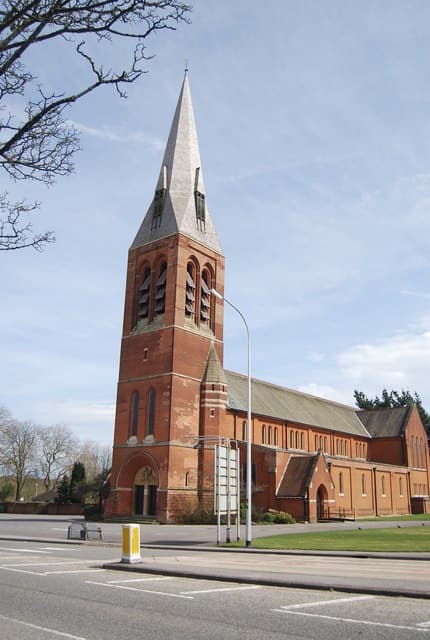
Aldershot Cathedral
The Cathedral Church of St Michael and St George is the Roman Catholic cathedral for the Bishopric of the Forces, located in Aldershot, England. Originally built as an Anglican church for the British Army, it was consecrated in 1893 and later repurposed in 1973 to become the seat of the Roman Catholic Bishop of the Forces. It is a significant landmark due to its Gothic Revival architecture and its close association with military history.