
Assisi Cathedral
Assisi-Nocera Umbra-Gualdo Tadino·Roman Catholic·Italy
Assisi Cathedral, officially the Cathedral of Saint Rufinus, is a significant Romanesque church in Assisi, Italy. It is the third church built on the site to house the relics of Saint Rufinus and holds deep historical importance for the Franciscan Order, having been the site of baptisms for Saint Francis, Saint Clare, and Emperor Frederick II.
Key Facts
- ›Construction began in 1140 based on designs by Giovanni da Gubbio.
- ›Saint Francis of Assisi and Saint Clare were baptized within its walls.
- ›Pope Gregory IX consecrated the high altar in 1228, and Pope Innocent IV inaugurated the completed church in 1253.
- ›The façade is a prime example of Umbrian Romanesque style, featuring a prominent rose window and intricate stone carvings.
- ›The interior, originally Romanesque, was significantly altered in the late Renaissance style by Gian Galeazzo Alessi.
- ›It serves as a co-cathedral for the Roman Catholic Diocese of Assisi-Nocera Umbra-Gualdo Tadino.

- Rose Window On the FaçAde
- Stone Carvings of Griffins and Lions
- Baptismal Font Where Saint Francis and Saint Clare Were Baptized
- Crypt With A Roman Sarcophagus
- Museo Del Duomo With Significant Artworks
Giovanni Da Gubbio, Gian Galeazzo Alessi
About Assisi Cathedral
Assisi Cathedral, known officially as the Cathedral of Saint Rufinus (Cattedrale di San Rufino di Assisi), is a prominent church located in the historic town of Assisi, Italy. It stands as the third church to be constructed on this site, dedicated to Bishop Rufinus, a 3rd-century martyr. The cathedral is a significant example of Umbrian Romanesque architecture.
History and Significance
The construction of the current cathedral commenced in 1140, with designs attributed to Giovanni da Gubbio. Assisi Cathedral holds profound historical importance for the Franciscan Order. It was within these walls that Saint Francis of Assisi, Saint Clare, and Emperor Frederick II were baptized. The church also played a crucial role in the spiritual journey of Saint Clare, who was inspired to recognize her vocation after hearing Saint Francis preach here in 1209. Pope Gregory IX consecrated the high altar in 1228 during his visit for Saint Francis's canonization, and the completed edifice was later inaugurated by Pope Innocent IV in 1253. Since 1986, it has served as a co-cathedral for the Roman Catholic Diocese of Assisi-Nocera Umbra-Gualdo Tadino.
Architecture
The cathedral's façade is a classic example of 12th-century Umbrian Romanesque style, constructed with stone from Monte Subasio. It is characterized by a tripartite division, a prominent rose window in the middle section adorned with symbols of the evangelists and supported by telamones, and a lower level featuring three decorated stone portals with sculpted griffins and lions. The bell tower, partially dating from the 11th century, also displays a 13th-century upper level with a unique liturgical clock indicating the 24 hours of the 'hora italica'. While originally Romanesque, the interior was extensively remodeled in the late Renaissance style by architect Gian Galeazzo Alessi, featuring a central nave, two aisles, an apse, and a dome.
Notable Features and Collections
Key interior elements include the baptismal font, where Saint Francis and Saint Clare were baptized, and chapels such as the Baroque Chapel of the Blessed Sacrament and the Chapel of Our Lady of Consolation, which houses a 15th-century German terracotta sculpture. The Museo del Duomo, opened in 1941, preserves a rich collection of artworks and liturgical objects associated with the cathedral, including detached frescoes, processional banners, reliquaries, and paintings by various masters, offering insights into the region's artistic and religious heritage.
Source: Wikipedia ↗
Frequently Asked Questions
When was Assisi Cathedral built?
Construction of Assisi Cathedral began in 1140. The completed church was inaugurated in 1253, though the high altar was consecrated earlier in 1228.
Who was baptized in Assisi Cathedral?
Key figures baptized in Assisi Cathedral include Saint Francis of Assisi in 1182, Saint Clare in 1193, and Emperor Frederick II. Many of their early followers were also baptized here, as was Saint Gabriel of Our Lady of Sorrows in 1838.
What is the architectural style of Assisi Cathedral?
The cathedral's façade is built in the Romanesque style characteristic of Umbria, while the interior was significantly remodeled in the late Renaissance style.
What is the significance of the façade?
The Romanesque façade is divided into three sections, featuring a central rose window supported by telamones and intricate stone carvings on the portals, including griffins and lions, which are of great iconographic importance.
What is found in the crypt of Assisi Cathedral?
Beneath the cathedral lies a crypt containing a 3rd-century Roman sarcophagus believed to have held the remains of Saint Rufinus, adorned with a bas-relief depicting the myth of Diana and Endymion. The crypt also features a medieval well and ruins of a 10th-century Carolingian cloister.
What artworks are housed in the Museo del Duomo?
The museum exhibits a collection of artworks and liturgical objects, including detached frescoes by Puccio Capanna, a processional banner from 1378, a reliquary with wood from the True Cross, and various paintings by artists like Niccolò Alunno and Dono Doni.
Related Cathedrals
Barletta Cathedral
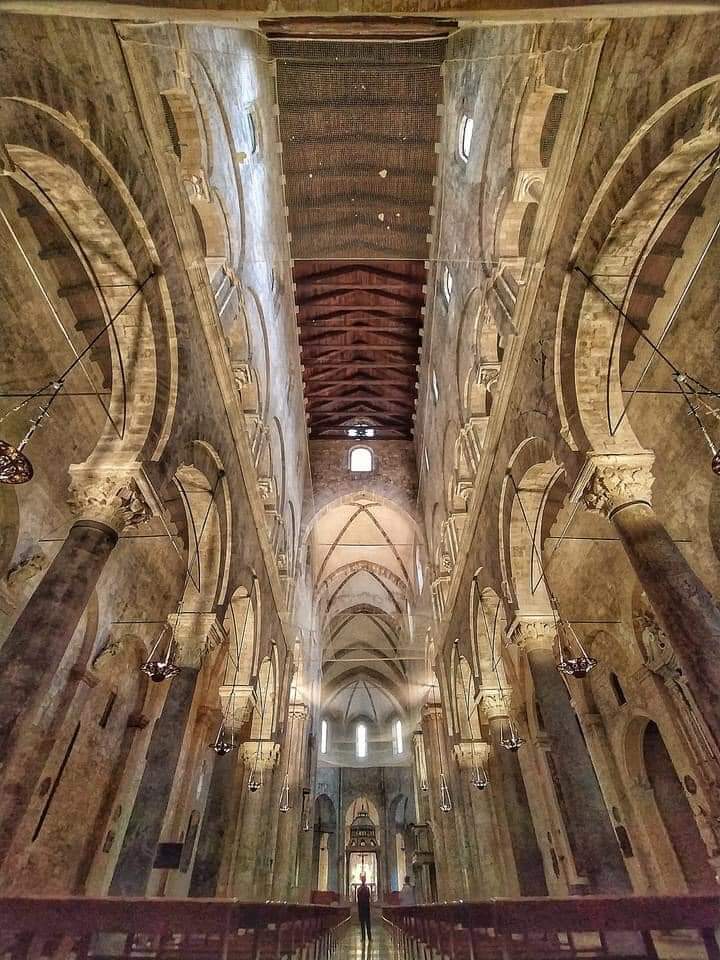
Barletta Cathedral is a Roman Catholic cathedral located in the heart of Apulia, southern Italy. Its construction began in the 12th century, evolving over centuries with Romanesque, Gothic, and Renaissance influences on a site with ancient origins. The cathedral is notable for its rich medieval decorations and its historical significance as a center of worship and architectural development.

Angers Cathedral
Angers Cathedral, officially Cathédrale Saint-Maurice d'Angers, is a Catholic cathedral in Angers, France, serving as the seat of the Bishops of Angers. Renowned for its blend of Romanesque and Gothic architectural styles, it also features significant Baroque elements and an exceptional collection of stained-glass windows, some dating back to the late 12th century.

Bordeaux Cathedral
Bordeaux Cathedral, officially the Primatial Cathedral of St Andrew of Bordeaux, is a Roman Catholic cathedral in Bordeaux, France, serving as the seat of the Archbishop of Bordeaux. It is a significant landmark included in the UNESCO World Heritage Site of the Routes of Santiago de Compostela in France. The cathedral showcases a rich architectural history, evolving from Romanesque to Gothic styles and incorporating Renaissance elements, making it a vital historical and religious site.