
Ascension Cathedral
Greek Orthodox Metropolis of San Francisco·Eastern Orthodox·Usa
The Ascension Greek Orthodox Cathedral in Oakland, California, is a significant center for the Eastern Orthodox faith in the region. Originally established as a community in 1917 and later building its first church in 1921, it was elevated to cathedral status in 1992. It now serves as the largest Greek Orthodox community in its Metropolis, spanning multiple generations of parishioners.
Key Facts
- ›Founded as a community in 1917, with its first church opening in 1921.
- ›Elevated to cathedral status in February 1992.
- ›Houses the largest Orthodox icon of Jesus the Pantocrator in the Americas.
- ›Hosts one of the largest Greek food and culture festivals in the United States annually.
- ›The community has grown to over 1,200 parishioners across six generations.
- ›A new chapel dedicated to the Assumption of the Virgin Mary is under construction.
Icon of Jesus the Pantocrator, Annual Oakland Greek Festival
About Ascension Cathedral
Ascension Greek Orthodox Cathedral
The Ascension Greek Orthodox Cathedral, located at 4700 Lincoln Avenue in Oakland, California, is a prominent Eastern Orthodox church and a significant spiritual center for the Greek Orthodox community in the region. The history of the cathedral's community dates back to 1917, when it was first formed, initially worshiping in rented facilities. By 1921, this community had established its first Greek Orthodox church in the East Bay, the Assumption Greek Orthodox Church, which opened on Brush Street in downtown Oakland.
History and Growth
In 1960, the growing congregation relocated to its present site in the Oakland hills, seeking larger facilities. On December 11, 1960, the church was re-dedicated to the Analypsis, the Ascension of Our Savior. The community continued to flourish, evolving from a predominantly immigrant society into a multi-generational congregation. This growth led to its elevation to the status of a cathedral in February 1992. Today, the Ascension Greek Orthodox Cathedral is recognized as the largest Greek Orthodox community within the Greek Orthodox Metropolis of San Francisco, boasting over 1,200 parishioners spread across six generations.
Notable Features and Events
The cathedral is distinguished by its collection of Orthodox iconography. Most notably, it houses the largest Orthodox icon of Jesus the Pantocrator (Almighty) in the Americas. Reverend Father Thomas J. Paris served as the pastor for nearly four decades, from 1971 until his retirement, with Reverend Father Tom Zaferes currently serving as the pastor and dean.
A new chapel dedicated to the Assumption of the Virgin Mary is currently under construction on the church grounds, indicating the ongoing development and expansion of the cathedral's facilities. The cathedral is also a venue for significant cultural events, most notably its annual Greek food and culture festival. This festival, typically held the weekend after Mother's Day, is one of the largest of its kind in the United States, offering a comprehensive experience of Greek cuisine, cultural exhibitions, traditional dancing, and live music.
Source: Wikipedia ↗
Frequently Asked Questions
When was the Ascension Greek Orthodox Cathedral established?
The community that would become the Ascension Greek Orthodox Cathedral was formed in 1917. Its first church building, the Assumption Greek Orthodox Church, opened on May 21, 1921.
What is the significance of the icon of Jesus the Pantocrator?
The cathedral features a large icon of Jesus the Pantocrator (Almighty). This icon is noted as the largest Orthodox icon of Jesus in the Americas.
What is the Oakland Greek Festival?
The Oakland Greek Festival is an annual event hosted by the cathedral, typically the weekend after Mother's Day. It is one of the largest festivals of its kind in the United States, featuring Greek food, cultural exhibitions, dancing, and live music.
How large is the Greek Orthodox community in Oakland?
The Ascension Greek Orthodox Cathedral is the largest Greek Orthodox community in the Greek Orthodox Metropolis of San Francisco, with over 1,200 parishioners. The community now spans six generations.
When did the church become a cathedral?
The church was elevated to the status of a cathedral in February 1992. Prior to this, it served as a parish church.
Related Cathedrals

All Saints Anglican Cathedral
All Saints Anglican Cathedral, formerly All Saints Episcopal Church, is an active place of worship located in Long Beach, California. Founded in 1923, it became the cathedral of the Anglican Church in North America's Diocese of Western Anglicans in 2017, following its disaffiliation from the Episcopal Church in 2004. The cathedral is known for its blend of high church liturgy, evangelical theology, and charismatic spirituality.

Bryn Athyn Cathedral
Bryn Athyn Cathedral is the episcopal seat of the General Church of the New Jerusalem, a Swedenborgian denomination, located in Bryn Athyn, Pennsylvania. Constructed between 1913 and 1949, its design is primarily Early Gothic, with adjoining structures exhibiting a blend of Gothic and Norman styles, and its exterior evokes Gloucester Cathedral. The cathedral is notable for its revival of medieval stained glass techniques and its unique, intentionally asymmetrical architectural features.
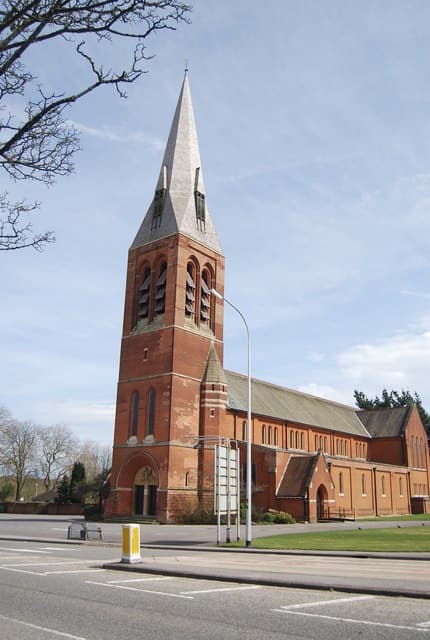
Aldershot Cathedral
The Cathedral Church of St Michael and St George is the Roman Catholic cathedral for the Bishopric of the Forces, located in Aldershot, England. Originally built as an Anglican church for the British Army, it was consecrated in 1893 and later repurposed in 1973 to become the seat of the Roman Catholic Bishop of the Forces. It is a significant landmark due to its Gothic Revival architecture and its close association with military history.