
Armagh Cathedral
Archdiocese of Armagh·Roman Catholic·Northern Ireland
St. Patrick's Cathedral in Armagh, Northern Ireland, serves as the seat of the Catholic Archbishop of Armagh and Primate of All Ireland. Its construction, spanning from 1840 to 1904, was a significant undertaking following the appropriation of the original medieval cathedral by the state church during the Irish Reformation, symbolizing a re-establishment of Catholic presence in the ancient ecclesiastical capital.
Key Facts
- ›Construction began in 1840 under Archbishop William Crolly, with architect Thomas Duff designing an initial Perpendicular Gothic style.
- ›Work halted due to the Irish Famine in 1847 and recommenced in 1854 under Archbishop Joseph Dixon, with James Joseph Mccarthy appointed to oversee completion in a Decorated Gothic style.
- ›The cathedral was dedicated on August 24, 1873, under Archbishop Daniel Mcgettigan, with significant interior work completed later.
- ›Cardinal Michael Logue initiated a major interior beautification project starting in 1899, involving lavish marble work, mosaics, and painted ceilings.
- ›A significant re-ordering of the sanctuary occurred in 1982 under Cardinal Tomás Ó Fiaich, introducing modern granite fittings and removing much of the earlier marble work.
- ›Further restoration and review of the sanctuary took place in 2002-2003 under Cardinal Seán Brady, reintroducing elements reminiscent of the 1904 design.

Perpendicular Gothic, Decorated Gothic, Gothic Revival
Twin Spires, Extensive Mosaic Decoration, Hammer-Beam Roof, Original Caen Stone Reredos, Stained Glass Windows
19th Century, 20th Century
Thomas Duff, James Joseph Mccarthy, William Hague, George Coppinger Ashlin, Liam Mccormick
About Armagh Cathedral
St. Patrick's Cathedral, Armagh
St. Patrick's Cathedral in Armagh, Northern Ireland, is the principal church of the Roman Catholic Archdiocese of Armagh and the seat of the Catholic Archbishop of Armagh, who holds the title of Primate of All Ireland. Its existence is deeply symbolic, marking the re-establishment of a Catholic presence in Armagh, the ancient ecclesiastical capital of Ireland, following the appropriation of the original medieval cathedral by the state church during the Irish Reformation. The current cathedral's construction was a lengthy and complex process, spanning from its initial phase in 1840 through to its completion and dedication in 1904, with further significant reorderings and restorations occurring in the late 20th and early 21st centuries.
History and Construction
The drive to build a Catholic cathedral in Armagh was fueled by historical and political aspirations. Following Catholic emancipation in 1829, there was a growing need for prominent Catholic churches. Archbishop William Crolly, appointed in 1835, was the first Catholic Primate to reside in Armagh since the Reformation and initiated the project. The initial design by Thomas Duff in 1838 was in a romanticized Perpendicular Gothic style, but work was severely hampered by the Irish Famine, leading to a halt in 1847 with only foundations and aisles partially complete.
After a period of abandonment, work recommenced in 1854 under Archbishop Joseph Dixon. The architectural taste had shifted, and James Joseph McCarthy was appointed to oversee the completion, adapting the design to a Decorated Gothic style and building upon Duff's existing walls. McCarthy's ambitious plans included raising the roofline and constructing tall spires, significantly altering the initial vision. The cathedral was dedicated on August 24, 1873, under Archbishop Daniel McGettigan, though much interior work remained.
Later Developments and Refurbishments
In the late 19th and early 20th centuries, Cardinal Michael Logue embarked on a major campaign to beautify the cathedral's interior. This involved extensive marble work, intricate mosaic decorations covering the walls, and painted ceilings, transforming the space into a lavish display of craftsmanship. The cathedral was solemnly rededicated on July 20, 1904, following these extensive works.
The mid-20th century brought significant liturgical changes with the Second Vatican Council. In 1982, under Cardinal Tomás Ó Fiaich, a radical re-ordering of the sanctuary took place, led by architect Liam McCormick. This involved the removal of much of the 1904 marble work, including the rood screen and high altar, and the introduction of new fittings in granite, emphasizing native Irish materials. This renovation was met with considerable controversy.
More recently, between 2002 and 2003, under Cardinal Seán Brady, further restoration and review of the sanctuary occurred. This project aimed to address structural issues and re-evaluated the sanctuary's design, re-flooring the area with Italian porcelain tiles that mimicked the 1904 marble floor and installing new altars and fittings inspired by early Irish crosses. The cathedral continues to be a vibrant center of worship and a significant architectural landmark.
Source: Wikipedia ↗
Frequently Asked Questions
When was St. Patrick's Cathedral in Armagh built?
The construction of St. Patrick's Cathedral in Armagh took place in various phases between 1840 and 1904. The foundation stone was laid in 1838, but work was significantly impacted by the Irish Famine.
Why was a new Catholic cathedral built in Armagh?
A new Catholic cathedral was built because the original medieval Cathedral of St. Patrick had been appropriated by the Church of Ireland during the Irish Reformation. This left Armagh, the ancient ecclesiastical capital and Primatial seat, without a Catholic cathedral for centuries.
Who were the main architects involved in building St. Patrick's Cathedral?
The initial architect was Thomas Duff, who designed the building in a Perpendicular Gothic style. Later, James Joseph McCarthy took over and adapted the design to a Decorated Gothic style. William Hague and George Coppinger Ashlin also made significant contributions to the interior, and Liam McCormick designed the 1982 re-ordering.
What are some notable features of St. Patrick's Cathedral?
The cathedral is known for its impressive twin spires, elaborate mosaic decorations covering much of the interior walls, and a hammer-beam roof painted in an Italianate style. The interior has undergone significant changes, particularly in 1982 and 2003, reflecting evolving liturgical and aesthetic preferences.
Is St. Patrick's Cathedral an active place of worship?
Yes, St. Patrick's Cathedral is an active place of worship. It serves as the seat of the Catholic Archbishop of Armagh and holds daily and Sunday Masses, as well as services for Holy Days.
Related Cathedrals
Belfast Cathedral
Saint Peter's Cathedral, also known as Belfast Cathedral, is the Catholic cathedral church for the Diocese of Down and Connor, serving as the episcopal seat for its bishop. Construction began in the 1860s, and it was formally designated as the cathedral in 1986. The cathedral is a Grade A listed building and a significant place of worship in Belfast.
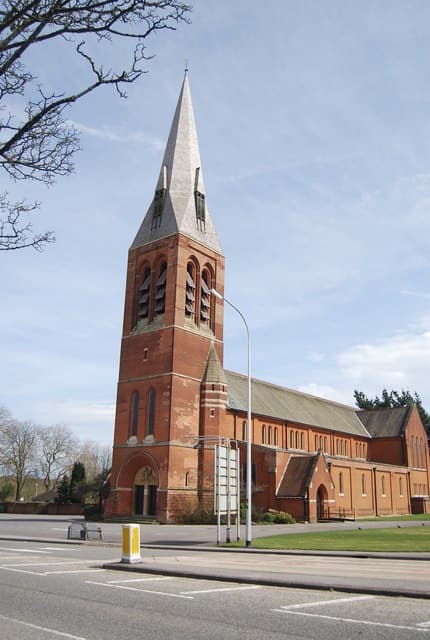
Aldershot Cathedral
The Cathedral Church of St Michael and St George is the Roman Catholic cathedral for the Bishopric of the Forces, located in Aldershot, England. Originally built as an Anglican church for the British Army, it was consecrated in 1893 and later repurposed in 1973 to become the seat of the Roman Catholic Bishop of the Forces. It is a significant landmark due to its Gothic Revival architecture and its close association with military history.

Arundel Cathedral
The Cathedral Church of Our Lady and St Philip Howard in Arundel, West Sussex, England, was dedicated in 1873 as a Catholic parish church and became a cathedral in 1965 with the foundation of the Diocese of Arundel and Brighton. It serves as the seat of the Bishop of Arundel and Brighton and is recognized as a Grade I listed building, notable for its French Gothic Revival architecture.