
Antibes Cathedral
Diocese of Nice·Roman Catholic·France
Antibes Cathedral, officially known as Cathédrale Notre-Dame-de-l'Immaculée-Conception d'Antibes, is a historic Roman Catholic church located in Antibes, France. It has a long and often turbulent history, having been destroyed and rebuilt multiple times due to raids and conflict, with its current facade dating from the 18th century. The cathedral is recognized as a listed and protected historic monument.
Key Facts
- ›The site may have formerly hosted a pagan temple dedicated to Diana and Minerva.
- ›The Bishopric of Antibes was established around 450 AD, with the first cathedral possibly built at that time.
- ›The cathedral was destroyed by Saracen pirates in 1124 and rebuilt, with the choir dating to this period.
- ›The current external facade was largely reconstructed in 1747 following Austrian bombardment during the Siege of Antibes.
- ›Notable artworks include the altarpiece of our Lady of the Rosary by Louis Brea and carved walnut doors by Jacques Dolle.
- ›It was added to the French Ministry of Culture’s List of Historic Monuments in 1945.

Italian
- Altarpiece of Our Lady of the Rosary By Louis Brea
- Carved Walnut Doors Depicting Saint Roch and Saint Sebastian By Jacques Dolle
- Choir
Louis Xv
About Antibes Cathedral
Antibes Cathedral: A Monument of Resilience on the French Riviera
Antibes Cathedral, formally known as Cathédrale Notre-Dame-de-l'Immaculée-Conception d'Antibes, stands as a significant Roman Catholic church in the picturesque town of Antibes on the French Riviera. This historic edifice has witnessed centuries of change, destruction, and reconstruction, solidifying its place as a listed and protected monument.
History and Rebuilding
Local tradition suggests the site of the cathedral was once occupied by a pagan temple dedicated to the Roman goddesses Diana and Minerva. The history of the Christian presence begins around 450 AD with the establishment of the Bishopric of Antibes by Pope Leo I. It is presumed that the first cathedral was built during this era, with evidence suggesting the altar in the Chapel of the Holy Sacrament dates back to the Merovingian period.
The cathedral's existence has been precarious, marked by devastating raids. In 1124, Saracen pirates destroyed the original structure. The subsequent rebuilding, initiated by Berenguer Ramon, Count of Provence, resulted in the choir, which remains the oldest surviving part of the cathedral. Despite further rebuilding efforts in 1250, raids continued, leading the bishops to relocate to Grasse for five centuries. The church suffered further damage in the eighteenth century due to Austrian bombardment during the 1746-7 Siege of Antibes. A royal edict from Louis XV in June 1747 authorized its reconstruction, and the cathedral's present-day external form largely dates from this period. Following the French Revolution, the Bishopric of Grasse was suppressed, and Antibes was assigned to the Diocese of Nice by the Concordat of 1801.
Architecture and Artistry
The cathedral features a layout with three naves and a large organ situated at the rear. The facade, rebuilt in 1747, exhibits an Italian architectural style. Inside, Antibes Cathedral houses several notable works of art. The altarpiece of Our Lady of the Rosary, located in the transept chapel, is a renowned piece from 1515 by the Niçois painter Louis Brea. Equally significant are the cathedral's carved walnut doors, created around 1710 by the local sculptor Jacques Dolle, which depict Saint Roch and Saint Sebastian, the twin patron saints of Antibes.
In recognition of its historical and cultural importance, the Cathedral, along with the adjoining Chapel of the Holy Spirit and the nearby Tour Grimaldi, was officially added to the French Ministry of Culture’s List of Historic Monuments in 1945.
Source: Wikipedia ↗
Frequently Asked Questions
What is the full name of Antibes Cathedral?
Antibes Cathedral is officially named Cathédrale Notre-Dame-de-l'Immaculée-Conception d'Antibes, and is also known as Cathédrale Notre-Dame-de-la-Platea d'Antibes.
When was the Bishopric of Antibes established?
The Bishopric of Antibes was established around 450 AD by Pope Leo I. It is believed the first cathedral was built at this time.
What significant historical events led to the rebuilding of Antibes Cathedral?
The cathedral has been destroyed multiple times, including by Saracen pirates in 1124 and by Austrian bombardment during the 1746-7 Siege of Antibes. These events necessitated significant rebuilding efforts.
What are the most renowned artworks inside Antibes Cathedral?
Among the notable artworks are the altarpiece of Our Lady of the Rosary, created in 1515 by Louis Brea, and carved walnut doors depicting Saints Roch and Sebastian, made around 1710 by Jacques Dolle.
What is the architectural style of the current facade?
The current facade of Antibes Cathedral is in the Italian style. It dates from 1747, when the building was rebuilt after being damaged by Austrian bombardment.
Related Cathedrals
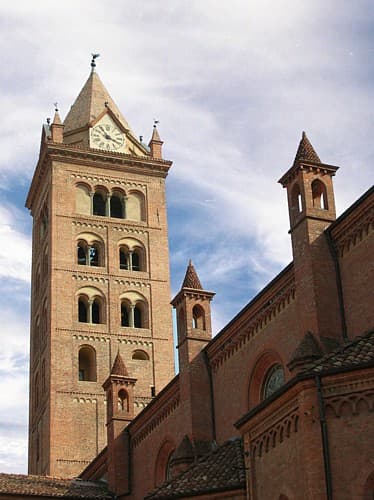
Alba Cathedral
Alba Cathedral, officially the Cattedrale di San Lorenzo, is a Roman Catholic cathedral in Alba, Italy, dedicated to Saint Lawrence and serving as the episcopal seat of the Diocese of Alba. Its current Romanesque structure, largely dating from the 12th century, has undergone significant remodelling throughout its history, most notably in the late Gothic period and extensive renovations in the 19th century.

Albenga Cathedral
Albenga Cathedral, officially the Cathedral of Saint Michael the Archangel, is a Roman Catholic cathedral in Albenga, Italy, serving as the seat of the Diocese of Albenga-Imperia. Occupying a site with a church since the late 4th or early 5th century, its present medieval structure dates primarily from around 1100, with significant rebuilding in the late 12th century and later modifications, notably in 1582. A restoration in the 1970s aimed to restore its medieval appearance, and the bell tower was substantially rebuilt in the late 14th century.

Ardagh
Ardagh is a historic village in County Longford, Ireland, with origins tracing back to pre-Christian worship and a significant Christian settlement established by Saint Patrick. Its development was heavily influenced by the Featherston family in the 18th and 19th centuries, leading to a village layout designed by J. Rawson Carroll, reputedly inspired by a Swiss village aesthetic. The area retains important Early Christian sites, most notably the ruined Cathedral of St. Mel, which has a history marked by destruction and rebuilding.