
Narada Maha Thera
Narada Maha Thera was a prominent Theravada Buddhist monk, scholar, translator, educator, and missionary from Sri Lanka. He is widely recognized for his extensive missionary work, bringing Buddhist teachings to various countries, and for his contributions to popularizing Dhamma talks in Sri Lanka. For many years, he served as the Superior of Vajiraramaya in Colombo.
Key Facts
- ›Born Sumanapala Perera on July 14, 1898, in Kotahena, Colombo, Sri Lanka.
- ›Ordained as a Theravada Buddhist monk at the age of eighteen.
- ›Represented Sri Lanka at the opening of the Mulagandhakuti vihara in Sarnath, India, in 1929.
- ›Undertook significant missionary journeys to countries including Indonesia, Taiwan, Cambodia, Laos, South Vietnam, Japan, Nepal, Australia, the United Kingdom, and the United States.
- ›Contributed to popularizing the 'bana' style Dhamma talk and brought Buddhist teachings to the Westernized middle class in Sri Lanka.
- ›Passed away on October 2, 1983.

Important Relationships
- Vajiraramaya
- the Buddha and His Teachings
- Buddhism In A Nutshell
- the Buddhist Doctrine of Kamma and Rebirth
- Kandaraka Sutta; Potaliya Sutta: Discourses From the Majjhima Nikaya
- Apannaka Sutta, Cula Malunkya Sutta, Upali Sutta: Discourses From the Majjhima Nikaya
- Manual of Abhidhamma
- An Elementary Pali Course
- Life of Venerable Sariputta
- Everyman’S Ethics
- Facts of Life
- Dhammapada, Pali Text and Translation
- the Way To Nibbana
- Mirror of the Dhamma: A Manual of Buddhist Chanting and Devotional Texts
- An Outline of Buddhism
- the Life of Buddha, In His Own Words
Colombo, Sri Lanka, Kotahena, Colombo, Sarnath, India, Borobudur, Indonesia, South Vietnam, United Kingdom, United States
Pali, Sinhala
Bhikkhu
About Narada Maha Thera
Narada Maha Thera, born Sumanapala Perera on July 14, 1898, was a distinguished Theravada Buddhist monk, scholar, translator, educator, and missionary from Sri Lanka. He held the significant position of Superior of Vajiraramaya in Colombo for many years and was a widely respected figure both within Sri Lanka and internationally.
Biography and Missionary Work
Born into a middle-class family in Kotahena, Colombo, Narada Maha Thera received his education at St. Benedict's College and Ceylon University College. He was ordained as a monk at the young age of eighteen. His early significant involvement in Buddhist affairs included representing Sri Lanka at the 1929 opening ceremony of the new Mulagandhakuti vihara in Sarnath, India.
In 1934, Narada Maha Thera made a historically significant visit to Indonesia, becoming the first Theravada monk to do so in over 450 years. During this trip, he consecrated a Bodhi tree on the southeastern side of Borobudur and initiated local laypeople into the roles of upāsakas and upāsikās. His missionary endeavors continued throughout his life, leading him to travel to numerous countries including Taiwan, Cambodia, Laos, South Vietnam, Singapore, Japan, Nepal, and Australia. In 1956, he visited the United Kingdom and the United States, even addressing a large gathering at the Washington Monument. He also played a role in establishing Buddhist presence in South Vietnam, bringing a Bodhi tree to the Thích Ca Phật Đài temple in 1960 and making frequent visits to the country.
Contributions to Buddhist Practice and Scholarship
Alongside other prominent monks like Piyadassi Maha Thera, Narada Maha Thera was instrumental in popularizing the "bana" style Dhamma talk in the 1960s. This approach aimed to bring Buddhist teachings directly into the daily lives of the Westernized middle class in Sri Lanka. His scholarly contributions are evident in his extensive bibliography, which includes works such as "The Buddha and His Teachings," "Manual of Abhidhamma," and "The Life of Buddha, In His Own Words." He also translated Pali texts and provided courses in the Pali language.
Narada Maha Thera passed away on October 2, 1983. His legacy is that of a dedicated monk and a tireless missionary who significantly contributed to the dissemination of Buddhist teachings across the globe and enriched Buddhist scholarship.
Source: Wikipedia ↗
Frequently Asked Questions
Who was Narada Maha Thera?
Narada Maha Thera was a Theravada Buddhist monk, scholar, translator, educator, and missionary from Sri Lanka. He was known for his extensive missionary work and for being the Superior of Vajiraramaya in Colombo for many years.
What was Narada Maha Thera known for?
He was known for his missionary efforts in numerous countries, bringing Buddhist teachings to diverse populations. He also played a role in popularizing Dhamma talks in Sri Lanka and making Buddhist teachings accessible to the Westernized middle class.
When and where was Narada Maha Thera born?
Narada Maha Thera was born Sumanapala Perera on July 14, 1898, in Kotahena, Colombo, Sri Lanka.
What significant missionary work did Narada Maha Thera undertake?
Narada Maha Thera traveled to many countries for missionary work, including Indonesia, Taiwan, Cambodia, Laos, South Vietnam, Japan, Nepal, Australia, the United Kingdom, and the United States. He planted a Bodhi tree at Borobudur and ordained novices in South Vietnam.
What were some of Narada Maha Thera's notable works or contributions?
He authored or contributed to several Buddhist texts, including 'The Buddha and His Teachings,' 'Manual of Abhidhamma,' and 'The Life of Buddha, In His Own Words.' He also helped popularize Dhamma talks in Sri Lanka.
Related Buddhists
Soma Thera
Kotahene Soma Maha Thera was a Theravada Buddhist monk, translator, and missionary born in Sri Lanka. He is known for translating Buddhist texts into English and for his missionary work in Japan, Burma, India, and Germany. His extensive writings contributed to the Buddhist Publication Society's outreach.
Ashin Thittila
Ashin Thittila was a distinguished Burmese Theravada Buddhist monk, scholar, and meditation teacher. He is renowned for being a pioneer in Buddhist missionary work abroad, notably spending extended periods in England. His contributions include translating key Abhidhamma texts into English and lecturing widely on Buddhist philosophy and meditation across multiple continents.
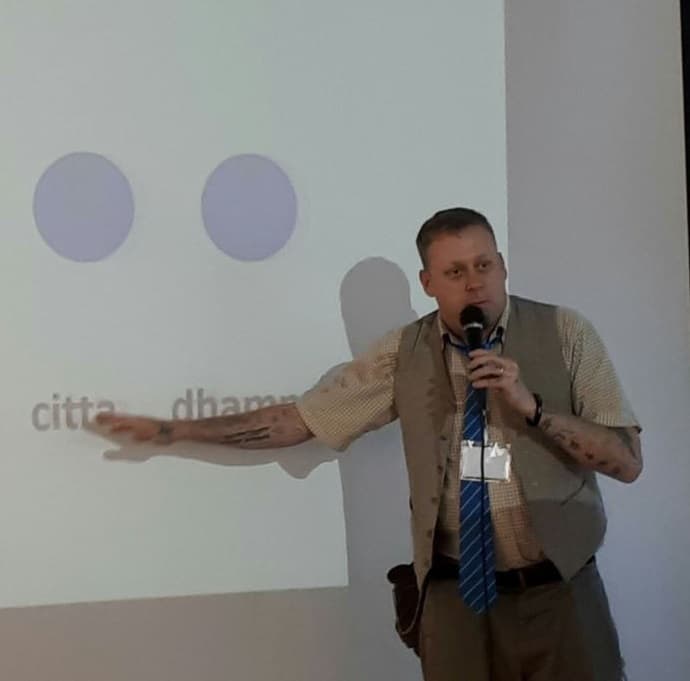
Seth Evans
Seth Evans is a scholar, educator, and musician specializing in the Abhidhamma Pitaka and the Visuddhimagga, known for his work on the phenomenological aspects of Buddhist psychology. He bridges his academic pursuits with his role as a bass player in the punk-rock band The Out of Sorts, having previously been a member of Reno Divorce. Evans advocates for a contextual, hermeneutic interpretation of early Buddhist texts.