
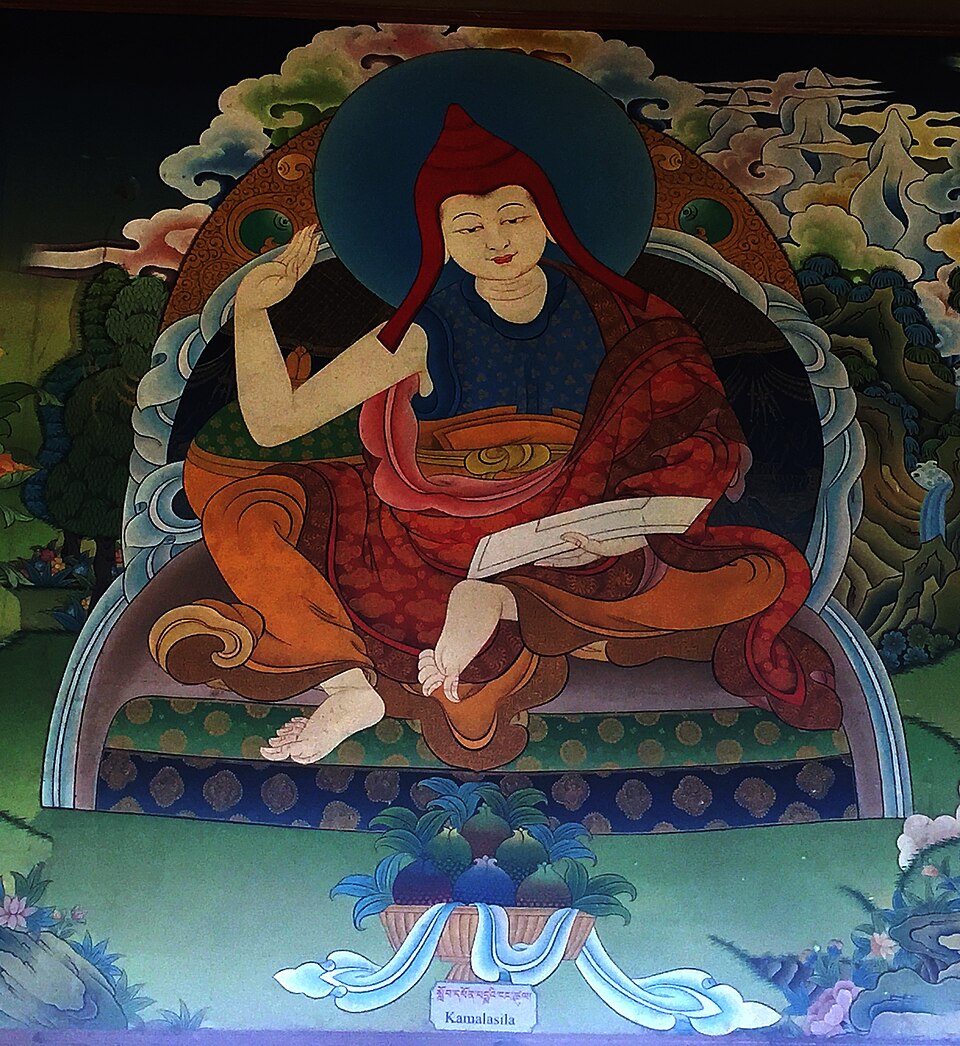
Kamalaśīla
Kamalaśīla was an influential Indian Buddhist monk and philosopher from Nalanda Mahavihara, active around the 8th century CE. He is renowned for his role in the development of Indian Mahayana thought and his significant contributions to Buddhist philosophy. His participation and supposed victory in the Debate of Samye played a crucial role in shaping the direction of Tibetan Buddhism.
Key Facts
- ›Kamalaśīla was an Indian Buddhist monk and philosopher from Nalanda Mahavihara.
- ›He is known for his philosophical works, particularly the "Trilogy of Stages of Meditation" (Bhāvanākrama).
- ›He accompanied Śāntarakṣita to Tibet at the request of King Trisong Detsen.
- ›Kamalaśīla is credited with winning the pivotal Debate of Samye in 793 CE.
- ›His victory in the debate led to the adoption of the Indian Mahayana model over the Chinese Chan Buddhism in Tibet.
- ›His works influenced the Madhyamaka school and traditions associated with Dignāga and Dharmakirti.
Important Relationships
- Śāntarakṣita
- Trisong Detsen
- Moheyan
- Dampa Sangye
- Padampa Sangye
- Machig Labdrön
Trilogy of Stages of Meditation, Commentary On MadhyamāLaṃKāRa
Nalanda Mahavihara, Tibet, Samye
DignāGa, Dharmakirti, NāGāRjuna, Asanga
Sanskrit
About Kamalaśīla
Kamalaśīla was an 8th-century Indian Buddhist monk and philosopher affiliated with Nalanda Mahavihara. He stands as a pivotal figure in the development of Indian Mahayana thought, making original contributions that demonstrated a deep understanding of both Buddhist and non-Buddhist philosophies. His missionary work and his influential role in the Debate of Samye were instrumental in shaping the trajectory of Tibetan Buddhism.
Biography and Historical Context
Much of what is known about Kamalaśīla's life is derived from later Tibetan sources, which are considered comparatively late and thus potentially problematic. Tibetan accounts identify him, along with Śāntarakṣita and Jñānagarbha, as one of the "three eastern Svātantrikas," originating from Eastern India. Little is documented about his life prior to his journey to Tibet, other than that he studied under Śāntarakṣita at Nalanda and arrived in Tibet after 788 CE, following his teacher's death, at the invitation of King Trisong Detsen.
The Debate of Samye
A significant event in Kamalaśīla's life was his participation in the Debate of Samye, which took place in 793 CE. King Trisong Detsen sought to resolve religious differences by sponsoring a debate between Kamalaśīla, representing what Tibetan sources characterize as the "gradual" path of Vajrayana, and Moheyan, who represented the East Mountain Teaching of Chan Buddhism, advocating a "direct" approach to enlightenment. While most Tibetan sources assert Kamalaśīla's victory, Chinese accounts suggest Moheyan prevailed. The traditional Tibetan outcome led to Moheyan's departure from Tibet and the royal decree to suppress sudden-enlightenment texts, thereby establishing the Indian Mahayana model as the dominant form of Buddhism in Tibet.
Major Contributions and Works
Kamalaśīla is most renowned for his "Trilogy of Stages of Meditation" (Bhāvanākrama), a series of three texts that summarize and elaborate on aspects of the Yogacara tradition, particularly concerning meditation and mental cultivation. These works are considered his most influential on meditation practices and are noted for their combination of rational analysis and scriptural citation. He also authored a commentary on the Madhyamaka school's Madhyamālaṃkāra. There is ongoing scholarly discussion regarding whether these works were composed in India or Tibet, with some Tibetan sources claiming their creation in Tibet at the request of Emperor Trisong Detsen.
Legacy
Kamalaśīla's influence extends to his role as a defender of the Madhyamaka school, which is based on the teachings of Nāgārjuna. His advocacy for the "gradual" path to enlightenment, as opposed to the "direct" path advocated by Moheyan, profoundly impacted the institutionalization and philosophical development of Tibetan Buddhism. While the historicity of the Debate of Samye has been questioned by some scholars, its importance in defining Tibetan religious and cultural traditions remains significant.
Source: Wikipedia ↗
Frequently Asked Questions
Who was Kamalaśīla?
Kamalaśīla was an 8th-century Indian Buddhist monk and philosopher from Nalanda Mahavihara. He was a significant figure in Mahayana Buddhism and played a key role in the introduction and development of Buddhism in Tibet.
What is Kamalaśīla most famous for?
Kamalaśīla is most famous for his philosophical writings, particularly his "Trilogy of Stages of Meditation" (Bhāvanākrama), and for his supposed victory in the Debate of Samye. This debate was a critical event in the history of Tibetan Buddhism.
What was the Debate of Samye?
The Debate of Samye, held around 793 CE, was a significant event where Kamalaśīla represented Indian Buddhism and Moheyan represented the East Mountain Teaching of Chan Buddhism. The debate aimed to determine the true dharma for Tibet.
What was the outcome of the Debate of Samye?
Most Tibetan sources claim that Kamalaśīla won the Debate of Samye, leading to the royal decree to destroy sudden-enlightenment texts and the departure of Moheyan from Tibet. This cemented the influence of Indian Buddhism in Tibet.
What are Kamalaśīla's most important works?
Kamalaśīla is renowned for his "Trilogy of Stages of Meditation" (Bhāvanākrama), which summarizes and builds upon aspects of the Yogacara tradition. He also wrote a commentary on the Madhyamaka school's Madhyamālaṃkāra.
Did Kamalaśīla live in Tibet?
Kamalaśīla accompanied Śāntarakṣita to Tibet and was involved in significant philosophical debates there. While some Tibetan sources suggest he composed works in Tibet, there is ongoing scholarly debate about the exact location of his literary output.
Related Buddhists
Lokaksema
Lokaksema was a Kushan Buddhist monk who flourished between 147 and 189 CE. He is historically significant as one of the first known translators of Mahayana Buddhist texts into Chinese during the Han dynasty. His work played a crucial role in the transmission of Buddhism to East Asia.
Prajñā
Prajñā was a 9th-century Buddhist monk born in Kapisa, near modern Kabul, Afghanistan. He is known for his significant contributions to the translation of Sanskrit sutras into Chinese during his visit to Tang China. His work facilitated the understanding of important Buddhist texts and he is also noted for his association with the Japanese monk Kūkai.
Dharmakīrtiśrī
Dharmakīrtiśrī was a significant 10th-century Buddhist teacher, also known as Serlingpa or Kulānta, whose name indicated his origin from a region in Southeast Asia such as Lower Burma, the Malay Peninsula, or Sumatra. He is renowned for being the teacher of several influential Mahayana Buddhist scholars and for authoring a key commentary on the Abhisamayālaṃkāra.