
Dignāga
India·Vātsīputrīya (early), Buddhist Logic and Epistemology (founder)·Male·6th century
Dignāga was an influential Indian Buddhist philosopher and logician active in the 5th-6th centuries CE. He is renowned for founding the first systematic Buddhist logic and epistemology, significantly shaping Indian philosophical thought. His work introduced concepts like "apoha" (exclusion) and established "perception" and "inference" as the sole valid means of knowledge, profoundly impacting subsequent Buddhist and Hindu philosophical traditions.
Key Facts
- ›Founded the first systematic Buddhist logic and epistemology.
- ›Introduced the theory of "apoha" (exclusion) to explain linguistic meaning.
- ›Accepted only "perception" (pratyaksa) and "inference" (anumāṇa) as valid instruments of knowledge.
- ›His magnum opus is the "Pramāṇa-samuccaya" (Compendium of Epistemology).
- ›His philosophical school brought about an Indian "epistemological turn."
- ›Influenced later Buddhist philosophers like Dharmakīrti and Hindu thinkers of the Nyāya school.
Important Relationships
- Dharmakīrti
- Nyāya school
- Xuanzang
- Taranatha
- Richard P. Hayes
- Georges B. Dreyfus
PramāṇA-Samuccaya, Alambana-ParīKṣā, HetucakraḍAmaru, NyāYa-Mukha
Kanchi, Andhra Country, Nalanda
Sautrantika School
Sanskrit
Ordained Monk
Philosopher, Logician, Founder, Teacher
Historical Figure, Influential Thinker
About Dignāga
Dignāga (c. 470/480 – c. 530/540 CE) was a pivotal Indian Buddhist philosopher and logician, widely recognized as a principal founder of Indian logic (hetu vidyā) and atomism. His philosophical system ushered in an 'epistemological turn' in Indian thought, establishing the first comprehensive framework for Buddhist logic and epistemology that became the standard in India and Tibet. Dignāga's intellectual legacy profoundly influenced subsequent Buddhist thinkers, notably Dharmakīrti, as well as Hindu philosophers of the Nyāya school.
Life and Historical Context
Details regarding Dignāga's life are scarce. Tradition suggests he was born into a Brahmin family in the vicinity of Kanchi. At a young age, he was ordained as a monk within the Vātsīputrīya school by a monk named Nāgadatta. Historical accounts indicate that Dignāga was active for a period in the Andhra region and later became associated with the renowned monastic university of Nalanda.
Major Contributions to Philosophy
Dignāga's most significant philosophical work is the Pramāṇa-samuccaya (Compendium of Epistemology). In this treatise, he articulated his epistemology, asserting that only two instruments of knowledge, or valid cognitions (pramāṇa), exist: perception (pratyakṣa) and inference (anumāṇa). Dignāga defined perception as a non-conceptual apprehension of particulars, devoid of conceptualization and naming, which is immediate and sensory. Inference, conversely, is a conceptual and linguistic process that deals with general attributes.
He introduced the theory of 'apoha' (exclusion) to explain linguistic meaning. According to this doctrine, words function by negating other entities; for instance, the word 'cow' signifies an object by excluding all 'non-cows.' This approach challenged prevailing theories of universals and offered a nominalist perspective on language.
Works
While many of Dignāga's original Sanskrit works are lost, they survive through Tibetan and Chinese translations. His magnum opus, the Pramāṇa-samuccaya, is a foundational text in Buddhist logic and epistemology. Other notable works include the Alambana-parīkṣā (Examination of the Object of Cognition), which argues for the primacy of consciousness, and the Hetucakraḍamaru (The Reason Wheel Drum), an early work on formal logic.
Tradition and Influence
Dignāga's intellectual lineage established a distinct tradition of Buddhist epistemology and reasoning, often referred to as the 'School of Dignāga' or, in conjunction with Dharmakīrti, the 'School of Dignāga and Dharmakīrti.' This tradition, known in Tibetan as 'those who follow reasoning,' profoundly shaped the development of philosophical discourse in India and Tibet. His emphasis on rigorous logical argumentation and epistemological validation influenced later Madhyamaka thinkers and non-Buddhist philosophers, who were compelled to defend their views with sophisticated epistemological theories.
Source: Wikipedia ↗
Frequently Asked Questions
Who was Dignāga?
Dignāga was an Indian Buddhist philosopher and logician who lived around the 5th to 6th centuries CE. He is widely recognized as a founder of Indian logic and epistemology, establishing the first comprehensive Buddhist system of these disciplines.
What were Dignāga's main contributions to logic and epistemology?
Dignāga's primary contribution was the development of a systematic Buddhist epistemology and logic. He argued that only perception and inference are valid means of knowledge. He also introduced the influential theory of "apoha" (exclusion) to explain how language derives its meaning.
What is Dignāga's theory of "apoha"?
Dignāga's theory of "apoha" suggests that words signify objects by excluding other objects. For example, the word "cow" means that an object is not a "non-cow." This theory posits that words do not denote inherent reality but rather function through negation and exclusion, which he considered a form of inference.
What were the two valid instruments of knowledge according to Dignāga?
According to Dignāga, the only two valid instruments of knowledge (pramāṇa) are "perception" (pratyakṣa) and "inference" (anumāṇa). He believed these two covered all knowable objects, with perception dealing with particulars and inference with generalities.
What is Dignāga's magnum opus?
Dignāga's most important work is the "Pramāṇa-samuccaya" (Compendium of Epistemology). In this text, he lays out his theories on perception, inference, language, and their relationship to knowledge.
How did Dignāga influence later Indian philosophy?
Dignāga's work initiated an "epistemological turn" in Indian philosophy, requiring philosophers to defend their views with rigorous epistemological theories. His logic and epistemology significantly influenced subsequent Buddhist thinkers like Dharmakīrti and also Hindu philosophers of the Nyāya school.
Related Buddhists

Bhāviveka
Bhāviveka was a sixth-century Indian Buddhist philosopher renowned for his contributions to the Madhyamaka school of Mahayana Buddhism. He is credited with founding the Svatantrika tradition, a distinct approach within Madhyamaka that emphasizes independent syllogistic reasoning. His key works, such as the Madhyamakahrdaya and Prajñāpradīpa, critically engaged with other Indian philosophical systems and developed sophisticated arguments for the Madhyamaka view of emptiness.
Buddhapālita
Buddhapālita was an influential Indian Mahayana Buddhist commentator active in the 5th-6th centuries CE, primarily known for his commentary on Nagarjuna's Mūlamadhyamakakarikā. His work, the Mūlamadhyama-vṛtti, utilized the reductio ad absurdum method to explain Nagarjuna's philosophy, a methodological approach that later became a defining characteristic of the Prasaṅgika school of Madhyamaka philosophy in Tibetan scholasticism. While little is known about his life, his philosophical method significantly shaped later debates and interpretations within Mahayana Buddhism.
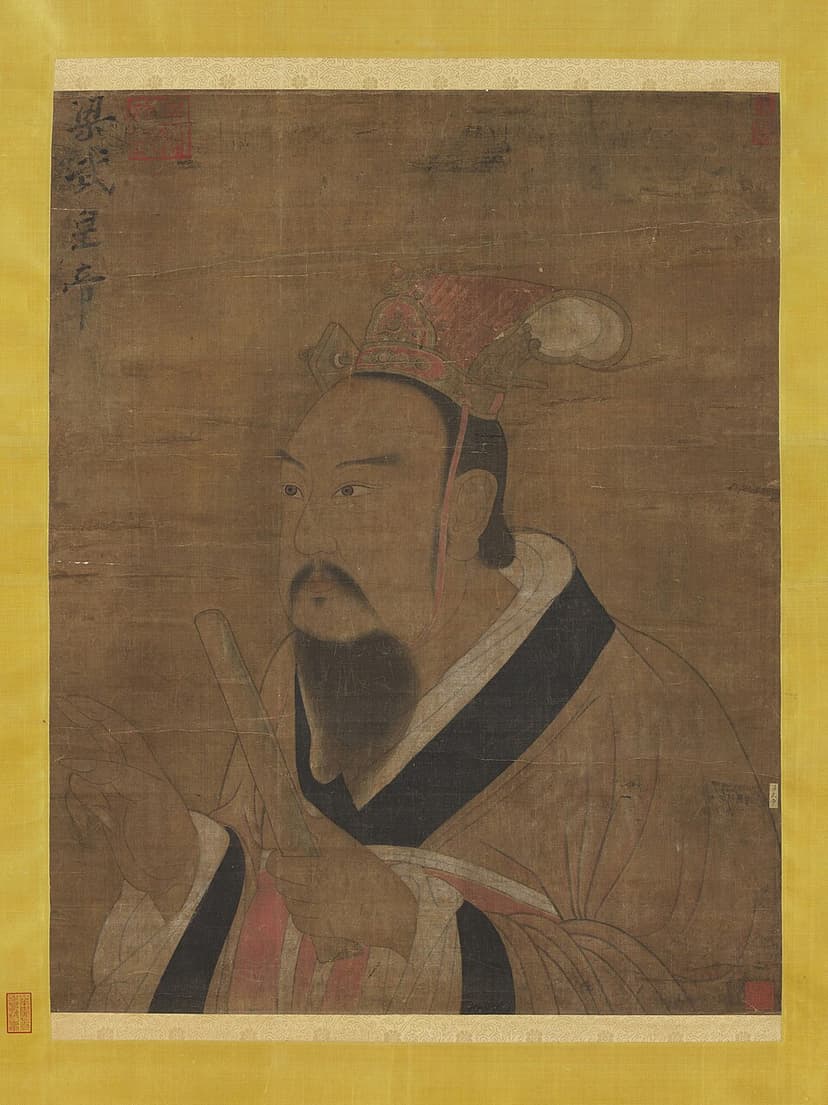
Emperor Wu of Liang
Emperor Wu of Liang, born Xiao Yan, was the founder of the Liang dynasty during China's Northern and Southern dynasties period. His reign, initially marked by stability and prosperity, saw him champion Confucian civil service exams and patronize the arts. He also embraced Buddhism, banning animal sacrifices and earning the nickname "The Bodhisattva Emperor."