
Yongla Goenpa
Yongla Goenpa is a Nyingma Buddhist monastery situated atop a mountain in Pema Gatshel, Bhutan, visible from the national highway. It holds significance for its legendary founding by Kheydrup Jigme Kundel in the 18th century, following instructions from Jigme Lingpa to find a site resembling a ritual dagger, and its annual Phurpai Drubchen festival.
Key Facts
- ›Founded in the 18th century by Kheydrup Jigme Kundel, instructed by Jigme Lingpa.
- ›Named Yongla after the Khandro Dechen Gyalmo's affirmation 'Yong Yong' upon finding the prophesied location.
- ›The current Lhakhang was constructed in the 1980s.
- ›The monastery was renovated after being severely damaged by a 2009 earthquake, with reconstruction completed in 2019.
- ›The annual Yongla Phurpai Drubchen festival, initiated in the 18th century, was reinstated in the 1960s and is held in September.
- ›Has had 16 successive Lams serving as its abbot.
Important Relationships
- Jigme Lingpa
- Kheydrup Jigme Kundel
- Khandro Dechen Gyalmo
- Yongla Lam Dorji
- Lam Sonam Zangpo
- King Jigme Khesar Namgyel Wangchuck
Mountain Top Location, Visible From National Highway, Sacred Relic of Phurpa
- Founding By Kheydrup Jigme Kundel
- Severely Damaged By 2009 Earthquake
- Renovated and Reconstructed Between 2012 and 2019
- Reinstatement of Yongla Phurpai Drubchen Festival In 1960s
About Yongla Goenpa
Yongla Goenpa is a significant Nyingma Buddhist monastery located in Pema Gatshel, Bhutan. Perched atop a mountain, it is a prominent landmark visible from the national highway connecting Samdrup Jongkhar and Pema Gatshel. The monastery is renowned for its legendary founding and its role in preserving Buddhist traditions.
History and Legend
The origins of Yongla Goenpa are steeped in legend, with its establishment attributed to Kheydrup Jigme Kundel in the 18th century. Kundel was purportedly instructed by the revered master Jigme Lingpa to find a sacred destination in Bhutan that mirrored the spiritual significance of Tsari in Tibet, described as resembling a ritual dagger (Phurpa). This quest was part of an effort to propagate Jigme Lingpa's teachings. Accompanied by Khandro Dechen Gyalmo, Kundel journeyed from Tibet through Bumthang until he reached the site of the present-day Yongla. Upon inquiry about the prophesied location, Khandro Dechen Gyalmo's affirmative response, 'Yong Yong,' led to the place being named Yongla. Kheydrup Jigme Kundel then meditated at this auspicious spot, disseminating his teachings and subsequently establishing a meditation center. Due to the growing popularity of Kundel's teachings, a nunnery was also constructed at the same location.
While the original meditation center and nunnery formed the early monastic complex, the Lhakhang that stands today was constructed around the 1980s. Over its history, Yongla Goenpa has been led by 16 successive Lams who have served as its abbot.
Renovation and Festivals
In 2009, Yongla Monastery suffered severe damage due to a 6.1 magnitude earthquake that struck Bhutan. The subsequent restoration efforts were undertaken with royal patronage, notably after King Jigme Khesar Namgyel Wangchuck visited the monastery post-earthquake. Reconstruction commenced in 2012, and the monastery was successfully restored to its former grandeur by 2019.
A significant religious event associated with Yongla Goenpa is the Yongla Phurpai Drubchen. This festival was initially initiated by Kheydrup Jigme Kuendrol in the 18th century but was later revived. In the 1960s, Lam Sonam Zangpo was instrumental in reinstating the festival. The annual Phurpai Drubchen is organized by the Pema Gatshel Rabdey and takes place in September, spanning ten days. The final day of the festival is particularly important, as devotees receive blessings from the sacred relic of Phurpa.
Source: Wikipedia ↗
Frequently Asked Questions
Who founded Yongla Goenpa?
While Yongla Lam Dorji is credited with founding Yongla Goenpa in 1736, the monastery was originally founded by Kheydrup Jigme Kundel in the 18th century. Kundel was guided by Jigme Lingpa to locate a place resembling a ritual dagger (Phurpa).
How did Yongla Goenpa get its name?
The place was named Yongla after Kheydrup Jigme Kundel's companion, Khandro Dechen Gyalmo, responded 'Yong Yong' when asked if it was the prophesied destination. 'Yong Yong' means 'Yes, Yes' in the local dialect.
When was the current structure of Yongla Goenpa built?
The Lhakhang, the main structure seen at Yongla Goenpa today, was built around the 1980s. This followed the original meditation center built by Kheydrup Jigme Kundel and a later nunnery.
What happened to Yongla Goenpa after the 2009 earthquake?
The monastery was severely damaged by a 6.1 magnitude earthquake on September 21, 2009. Following a visit by King Jigme Khesar Namgyel Wangchuck, reconstruction began in 2012 and the monastery was restored to its former glory by 2019.
What is the Yongla Phurpai Drubchen festival?
The Yongla Phurpai Drubchen is an annual festival initiated in the 18th century by Kheydrup Jigme Kuendrol, though it was lost and later reinstated in the 1960s. It is conducted by the Pema Gatshel Rabdey in September, lasting ten days, and culminates with devotees receiving blessings from a sacred relic of Phurpa.
Related Buddhist Temples
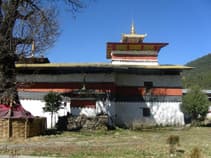
Tamzhing Monastery
Tamzhing Monastery, officially Tamzhing Lhündrup Monastery, is a significant Nyingma gompa located in the Bumthang District of central Bhutan. It is renowned for its direct historical and spiritual connection to the Bhutanese tertön and saint Pema Lingpa, who founded the temple in 1501. The monastery continues to be the seat of Sungtrul Rinpoche, the current speech incarnation of Pema Lingpa, and plays a vital role in preserving Bhutanese Buddhist traditions and sacred dances.

Dubdi Monastery
Dubdi Monastery, also known as Yuksom Monastery, is a significant Buddhist monastery of the Nyingma sect, renowned as the oldest in Sikkim. Established in 1701, it played a crucial role in the founding of the Kingdom of Sikkim and is part of a vital Buddhist pilgrimage circuit.

Chorten Kora
Chorten Kora is a significant stupa located in Trashi Yangtse, East Bhutan, by the Khorlo-Chu River. Constructed in 1740 by Lama Ngawang Lodrö, it was built in memory of his uncle and to subdue a demon believed to inhabit the site. The stupa is modeled after the Boudhanath stupa in Nepal and is a focal point for annual festivals.