
Wat Manorom
Wat Manorom is a significant Buddhist temple and monastery located in Luang Prabang, Laos. Its founding is debated, with theories placing its establishment between 1372 and 1492, and it houses a notable 6-meter-high bronze Buddha statue dating from the 1370s.
Key Facts
- ›Located in Luang Prabang, Laos.
- ›Possible founding dates include 1372, 1375, or around 1492.
- ›The great bronze Buddha in the nave measures 6 meters high.
- ›The bronze Buddha statue dates back to the 1370s.
- ›Associated with Laotian royalty, potentially founded by Samsenthai or during the reign of Laasaenthai Bouvanaat.

Important Relationships
- Samsenthai
- Laasaenthai Bouvanaat
6-Meter-High Bronze Buddha Statue
About Wat Manorom
Wat Manorom is a prominent Buddhist temple and monastery located in the historic city of Luang Prabang, Laos. Its historical significance is underscored by the ongoing scholarly debate surrounding its precise founding date, with theories suggesting origins in either 1372 or 1375 under King Samsenthai, or a later establishment around 1492 during the reign of Laasaenthai Bouvanaat. Regardless of the exact year, the temple is an important religious and cultural landmark in Laos.
Key Features and History
A central and striking element of Wat Manorom is its grand bronze Buddha statue, which stands an impressive 6 meters in height. This magnificent sculpture is believed to date from the 1370s, making it a relic of considerable antiquity and artistic merit. The presence of such an ancient and large Buddha image highlights the temple's long-standing religious importance and its connection to the patronage of Laotian royalty, as indicated by its potential founding figures.
Religious and Cultural Significance
As a major monastery, Wat Manorom continues to serve as an active center for Buddhist practice and monastic life. Its historical ties to royal patronage and its ancient artifacts contribute to its status as a site of cultural heritage. The temple's existence and its surviving artifacts offer valuable insights into the religious history and artistic traditions of Laos, particularly during the periods of its potential foundation and the creation of its notable Buddha image.
Source: Wikipedia ↗
Frequently Asked Questions
Where is Wat Manorom located?
Wat Manorom is situated in Luang Prabang, Laos. It is a major Buddhist temple and monastery in the region.
When was Wat Manorom founded?
There are differing theories regarding the founding date of Wat Manorom. Some suggest it was founded in 1372 or 1375, while other accounts place its origins around 1492 during the reign of Laasaenthai Bouvanaat.
What is the most notable feature at Wat Manorom?
The most notable feature at Wat Manorom is a large bronze Buddha statue. This statue stands 6 meters high and is located in the temple's nave.
What is the age of the bronze Buddha at Wat Manorom?
The significant bronze Buddha statue housed within Wat Manorom dates back to the 1370s. This indicates its considerable historical age.
Related Buddhist Temples

Wat Ong Teu Mahawihan
Wat Ong Teu Mahawihan, meaning "Temple of the Heavy Buddha," is a significant Buddhist monastery in Vientiane, Laos, renowned for housing the largest Buddha image in the city. Originally built by King Setthathirath I in the 16th century, it has undergone several reconstructions after being destroyed by invasions, notably in the 19th century and then restored by the French in the early 20th century, maintaining its role as a center for Theravada Buddhist learning.
Wat Sen
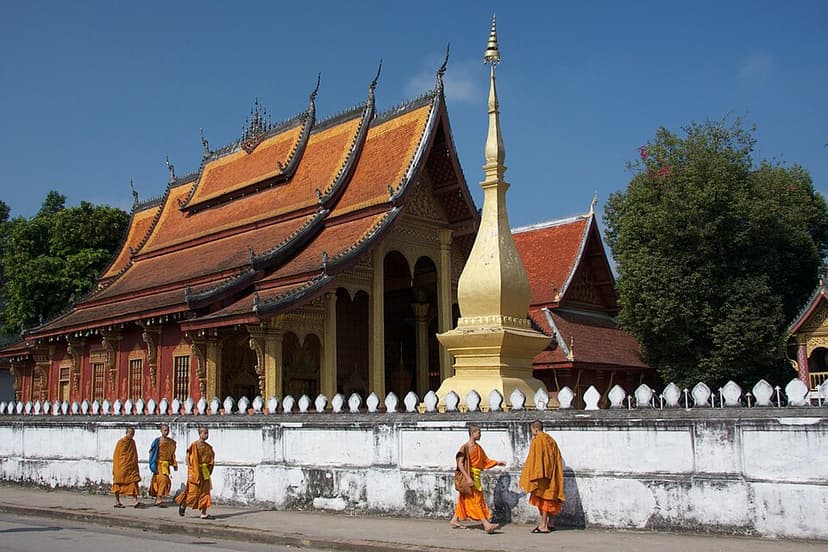
Wat Sen, also known as Wat Sene Souk Haram, is a significant Buddhist temple located in Luang Prabang, Laos. Built in 1718 by King Kitsarath using 100,000 stones from the Mekong River, its name translates to "Temple of 100,000 treasures." The temple underwent restoration in 1957 to commemorate the 2500th anniversary of the Buddha's birth.

Wat Si Saket
Wat Si Saket is a significant Buddhist temple located in Vientiane, Laos, built in 1818 by King Anouvong. It is notable for its unique architectural style and the extensive collection of Buddha images housed within its cloister walls, making it potentially the oldest standing temple in Vientiane.