
Wat Hong Rattanaram
Wat Hong Rattanaram Ratchaworawihan, often shortened to Wat Hong Rattanaram, is an ancient Thai Buddhist temple situated along the Khlong Bangkok Yai canal in Bangkok. Classified as a second-rank royal temple, it holds significant historical importance, having been patronized by King Taksin and later restored by King Nangklao and King Mongkut. The temple is renowned for its sacred Buddha statues and artistic murals.
Key Facts
- ›Founded in the late Ayutthaya period by a wealthy Chinese benefactor named Hong.
- ›Became a place of worship and received royal patronage from King Taksin.
- ›Underwent major restoration during the reign of King Nangklao (Rama III).
- ›Houses the sacred bronze Buddha statue 'Phra Saen' in the Lan Xang art style.
- ›Features murals depicting the Mahanipata Jataka (ten Great Birth Stories of the Buddha) in the ordination hall.
- ›Contains a golden Buddha statue from the late Sukhothai period, discovered in 1957.

Important Relationships
- King Taksin
- King Nangklao (Rama III)
- King Mongkut (Rama IV)
- Prince Pinklao
Phra Saen Buddha Statue, Golden Buddha Statue, Murals of the Mahanipata Jataka, Shrine of King Taksin, Sacred Pool
- Donated Funds For Temple Construction By Benefactor Hong
- King Taksin's Patronage and Worship At the Temple
- Major Restoration During the Reign of King Nangklao
- King Mongkut's Involvement and Enshrinement of Phra Saen
- Discovery of the Golden Buddha Statue
Lan Xang Art Style
About Wat Hong Rattanaram
Wat Hong Rattanaram Ratchaworawihan
Wat Hong Rattanaram Ratchaworawihan, commonly known as Wat Hong Rattanaram, is an ancient Thai Buddhist temple situated along the Khlong Bangkok Yai canal in Bangkok. It holds the distinction of being a second-rank royal temple and is considered a temple associated with Prince Pinklao.
History and Significance
The temple's origins trace back to the late Ayutthaya period, when it was established with funds donated by a wealthy Chinese benefactor named Hong, after whom the temple derives its name. Following the fall of Ayutthaya in 1767, King Taksin chose this area in Thonburi for his new capital and regularly worshipped at Wat Hong Rattanaram, located just 500 meters to the south of his palace. During his reign, the temple received royal support and served as a religious educational center.
Significant restoration efforts took place during the reign of King Nangklao (Rama III). Further royal involvement occurred under King Mongkut (Rama IV). The temple is particularly venerated for its sacred Buddha statues and artistic heritage.
Notable Features
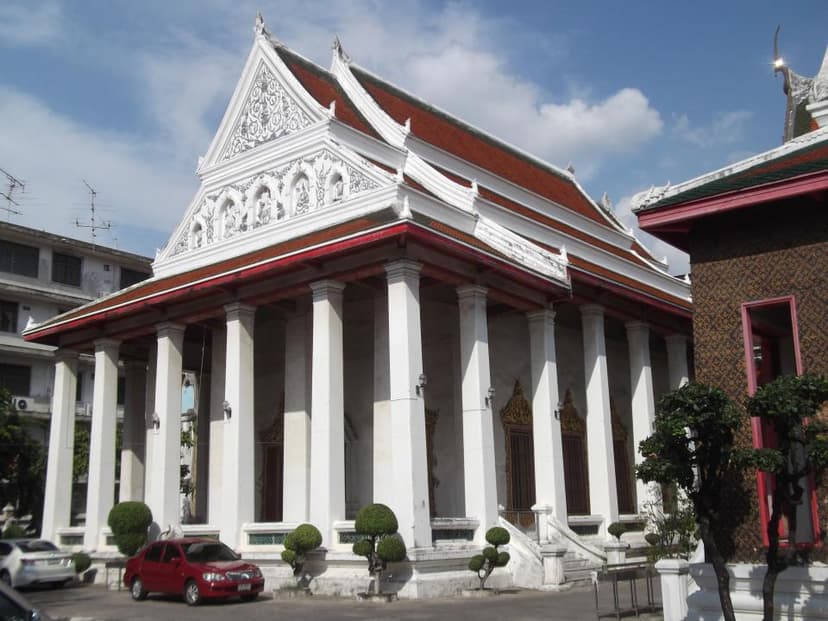
The ordination hall of Wat Hong Rattanaram is architecturally notable, featuring ornate door and window frames and intricately sculptured doors. The interior walls are adorned with murals depicting the Mahanipata Jataka, the Ten Great Birth Stories of the Buddha, illustrating his previous lives. Within this hall is enshrined 'Phra Saen,' a bronze Buddha statue in the Lan Xang art style, which has a history originating from Chiang Taeng (Steung Treng).
In the sermon hall, the main Buddha statue is a golden effigy from the late Sukhothai period. This statue was unexpectedly discovered in 1957 when its cement casing cracked. It is believed to be contemporary with the golden Buddha statue at Wat Traimit in Chinatown.
Additional Sites and Connections
Outside the temple, near the Khlong Bangkok Yai, stands a shrine in honor of King Taksin. This was erected by the local community as an expression of gratitude for the king's role in restoring the temple. Additionally, the temple grounds include a sacred pool, believed by devotees to be a source of holy water for ritualistic use.
Historically, the temple's land also accommodated the Bangkok Yai district office from 1915 until 1988. The presence of the Itsaraphap MRT station, which features golden swan iconography in its design, pays tribute to Wat Hong Rattanaram, as 'Hong' in Thai signifies a mythical swan, a symbol linked to the temple.
Source: Wikipedia ↗
Frequently Asked Questions
When was Wat Hong Rattanaram founded?
Wat Hong Rattanaram was founded in the late Ayutthaya period. It was established by a wealthy Chinese individual named Hong, who donated funds for its construction.
What is significant about the 'Phra Saen' Buddha statue?
'Phra Saen' is a bronze Buddha statue in the Lan Xang art style, enshrined within the ordination hall. Its history is linked to a temple in Chiang Taeng (Steung Treng), and it is considered a very sacred statue.
What is depicted in the murals of the ordination hall?
The murals adorning the four walls inside the ordination hall depict the Mahanipata Jataka, which are the Ten Great Birth Stories of the Buddha. These illustrate the Buddha's ten previous lives.
What is notable about the golden Buddha statue at the temple?
The main Buddha statue in the sermon hall is made of gold and dates from the late Sukhothai period. It was originally encased in cement and revealed to be golden when the cement cracked in 1957.
Are there any shrines or special features at Wat Hong Rattanaram?
Yes, there is a shrine honoring King Taksin located just outside the temple, built by the community in gratitude for his restoration efforts. The temple also features a sacred pool believed to be a source of holy water.
What is the connection between the temple and the Itsaraphap MRT station?
The nearby Itsaraphap MRT station's main theme is the golden swan, a tribute to Wat Hong Rattanaram. The word 'Hong' in Thai means hamsa, a mythical swan, which is symbolically linked to the temple.
Related Buddhist Temples

Wat Paramaiyikawat
Wat Paramaiyikawat, also known as Wat Paramaiyikawat Warawihan, is an ancient Buddhist temple located on Ko Kret island in Nonthaburi Province, Thailand. Classified as a second-rank royal temple, it holds significant historical importance, having been restored and named by King Chulalongkorn in honor of his grandmother, and is recognized for its unique Mon architectural influences, particularly its leaning "Phra Chedi Mutao" pagoda.
Wat Chakkrawat
Wat Chakkrawat, formerly known as Wat Sam Pluem, is a historic Buddhist monastery located in Bangkok's Chinatown. It holds significance as an ancient temple established during the early days of the Rattanakosin Kingdom, predating the development of the Yaowarat road, and was later designated a royal temple.

Wat Molilokkayaram
Wat Molilokkayaram Ratchawarawihan is a significant Buddhist temple in Bangkok, Thailand, renowned as a prominent center for the study of Pali language and Buddhist scriptures. Originally established in the mid-18th century, it has undergone several renovations and name changes under various Thai monarchs, eventually becoming a second-class royal monastery and a vital educational institution for monks.