
Tibet Institute Rikon
The Tibet Institute Rikon is a significant Tibetan Buddhist monastery and cultural center located in Switzerland. Established in 1968, it serves as a spiritual and cultural hub for Tibetan refugees and promotes the understanding of Tibetan culture and Buddhism to a wider audience.
Key Facts
- ›Founded as a non-profit foundation in 1968, with its monastic community established on the advice and patronage of the 14th Dalai Lama.
- ›It is considered the only monastery outside of Asia founded on behalf of the Dalai Lama.
- ›The institute's buildings were designed by architect Ueli Flück, incorporating functional Western style with traditional Tibetan elements.
- ›It houses one of the world's largest Tibetan specialist libraries, with approximately 11,000 titles.
- ›The monastic community represents the four major schools of Tibetan Buddhism: Nyingma, Kagyu, Sakya, and Gelug.
- ›The Tibet Institute Rikon celebrated its 50th anniversary in September 2018, with a visit from the 14th Dalai Lama.

Important Relationships
- 14th Dalai Lama
- Henri Kuhn
- Jacques Kuhn
- Ueli Flück
- Specialist Library With Approximately 11,000 Tibetan-Specific Documents
- Architectural Design By Ueli FlüCk
- Representation of the Four Major Schools of Tibetan Buddhism
- Establishment of the Foundation In 1968
- Consecration of the Monastic Institute In 1968
- First Visit By the 14th Dalai Lama In 1973
- 50th Anniversary Celebration In September 2018
Functional Western Style, Traditional Tibetan Elements
About Tibet Institute Rikon
The Tibet Institute Rikon is a significant Tibetan Buddhist monastery and cultural center situated in Zell-Rikon im Tösstal, Switzerland. Established as a non-profit foundation in 1968, its inception was driven by the need for spiritual and cultural support for Tibetan refugees who began settling in Switzerland in large numbers following events in Tibet in 1959. The institute was founded on the advice and under the patronage of the 14th Dalai Lama, making it the only monastery outside of Asia to be established on his behalf.
History and Establishment
Switzerland was among the first Western nations to welcome Tibetan refugees. The Kuhn family, owners of Metallwarenfabrik AG Heinrich Kuhn (now Kuhn Rikon AG), played a crucial role by offering employment and accommodation to a group of refugees. This support led to the establishment of the monastic Tibet Institute, intended not only for the spiritual and cultural care of the Tibetan diaspora but also for the preservation of Tibetan culture for future generations. The institute was inaugurated on November 9, 1968, under the name "Kloster zum Rad der Lehre" (Monastery for the Wheel of Teaching), though its formal establishment as a monastery was delayed due to Swiss federal laws at the time.
The Dalai Lama, although banned from entering Switzerland for the inauguration, visited the monastery for the first time in 1973. He has visited the institute on numerous occasions since, including in 2010 for the 50th anniversary of Tibetan refugees in Switzerland, and again in 2013, 2015, and 2016. The monastic community in Rikon asserts its status as the sole Tibetan monastery in the West.
Architecture and Facilities
The institute's buildings were designed by architect Ueli Flück. The architectural style is functional and Western, intentionally incorporating traditional Tibetan elements without strictly adhering to sacred Tibetan architectural forms. This approach reflects the evolving role of a Tibetan monastery in a Western context. A key feature of the institute is its publicly accessible special library, which houses approximately 11,000 titles related to Tibet, making it one of the world's largest specialized libraries on the subject.
Cultural and Religious Life
Today, the Tibet Institute Rikon serves as a vital center for the cultural and religious life of Tibetans in Switzerland. It actively promotes the understanding of Tibetan culture and Buddhism through a wide array of cultural activities, public events, and outreach programs. The institute also supports scientific research in Tibetology and fosters dialogue between Buddhist philosophy and Western science. The monastic community, comprising monks representing the four major schools of Tibetan Buddhism, collaborates with the institute's staff to organize these events. The institute is supported by a foundation, patrons, and sponsors, ensuring its continued operation and its role in preserving Tibetan heritage.
Source: Wikipedia ↗
Frequently Asked Questions
When was the Tibet Institute Rikon founded?
The Tibet Institute Rikon was established as a non-profit foundation in 1968. The foundation stone was laid on July 29, 1967, and the monastic institute was consecrated on November 9, 1968.
Why was the Tibet Institute Rikon established in Switzerland?
Switzerland was one of the first Western countries to allow a large number of Tibetan refugees to settle in 1961. The institute was founded to provide spiritual and cultural care for these refugees and to preserve Tibetan culture for future generations.
Who supported the founding of the Tibet Institute Rikon?
Henri and Jacques Kuhn, owners of Kuhn Rikon AG, offered work and accommodations to Tibetan refugees and helped found the institute. Jacques Kuhn supported the monastic community until his death in 2017. The 14th Dalai Lama also provided advice and patronage.
What is the significance of the Tibet Institute Rikon's library?
The institute has a publicly accessible special library containing around 11,000 titles of Tibetan-specific documents. This makes it one of the world's largest Tibetan specialist libraries.
What is the architectural style of the Tibet Institute Rikon?
The institute building was designed by Ueli Flück in a functional Western style that incorporates traditional Tibetan elements. The design deliberately avoided traditional Tibetan sacred architecture to reflect the altered role of a Tibetan monastery in the West.
What role does the Tibet Institute Rikon play in cultural exchange?
The institute is a vital part of the cultural and religious life for Tibetans in Switzerland and serves as an important forum for Westerners interested in Buddhism and Tibet. It organizes public events, maintains a library, issues publications, and promotes understanding of Tibetan culture.
Related Buddhist Temples
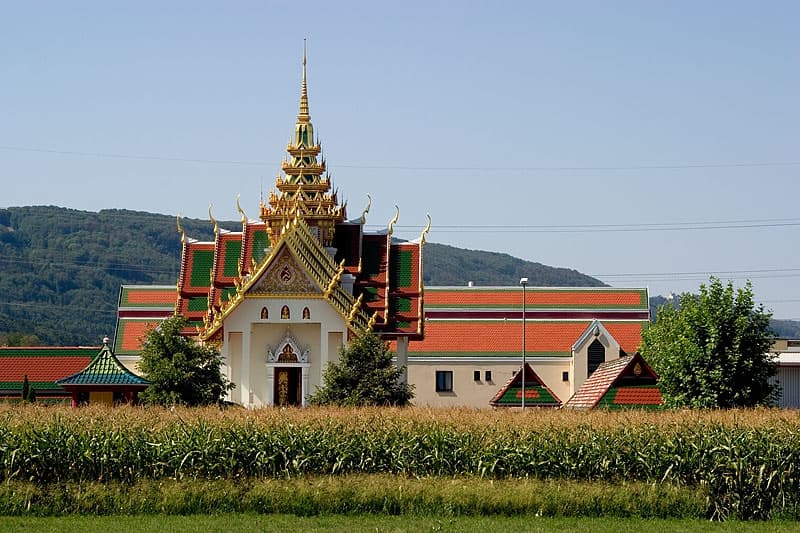
Wat Srinagarindravararam
Wat Srinagarindravararam is a Theravada Buddhist temple located in Gretzenbach, Switzerland. It was named in honor of Princess Srinagarindra, mother of King Rama IX of Thailand, and plays a vital role in serving the spiritual and educational needs of the local Thai, Khmer, Lao, and Swiss Buddhist communities.
Deer Park Buddhist Center and Monastery
Deer Park Buddhist Center and Monastery in Oregon, Wisconsin, is a prominent center for Tibetan Buddhism, founded in 1975 by Geshe Lhundub Sopa. It serves as a monastic and teaching institution, upholding the Dalai Lama's tradition and attracting international students. The center is currently undertaking a significant temple expansion project to house Tibetan art and artifacts, expand educational programs, train new monks, and promote Tibetan freedom.

Lerab Ling
Lerab Ling is a significant Tibetan Buddhist center established in 1992 by Sogyal Rinpoche in Occitanie, France. It is renowned for housing what is likely the largest Tibetan Buddhist temple in Europe, inaugurated by the Dalai Lama in 2008, and serves as a major hub for Buddhist study and practice in the West.