
Pha That Luang
Pha That Luang is a prominent gold-covered Buddhist stupa located in Vientiane, Laos. Originally believed to have been established in the 3rd century AD, it has undergone significant reconstructions throughout its history, most notably in the 1930s. The stupa is a major national symbol and a significant site for religious and cultural events in Laos.
Key Facts
- ›Believed to have been founded in the 3rd century AD, possibly housing a relic of the Buddha.
- ›King Setthathirat ordered its reconstruction in 1566, relocating the capital to Vientiane.
- ›The stupa has been plundered and destroyed multiple times, including by Thai invasions in 1828.
- ›Restored by the French in the 1930s based on 1867 drawings by Louis Delaporte.
- ›Its dimensions include a height of 45 meters and a base of approximately 69 meters per side.
- ›Features encircling walls containing Lao and Khmer sculptures, including one of Jayavarman VII.

Important Relationships
- Emperor Ashoka
- King Setthathirat
- Gerrit van Wuysthoff
- Louis Delaporte
- Jayavarman VII
- Gold-Covered Exterior
- Encircling Walls With Lao and Khmer Sculptures
- Sculpture of Jayavarman Vii
- Establishment In the 3rd Century Ad With A Relic of the Buddha
- Relocation of Capital and Reconstruction Ordered By King Setthathirat In 1566
- Destruction By Thai Invasion In 1828
- Restoration By the French In the 1930s
About Pha That Luang
Pha That Luang, translating to "Great Stupa," is a revered gold-covered Buddhist stupa situated in Vientiane, the capital city of Laos. Its origins are traced back to the 3rd century AD, with historical accounts suggesting that Buddhist missionaries from the Mauryan Empire, sent by Emperor Ashoka, enshrined a relic of the Buddha within it. This early foundation marks it as a site of significant antiquity within Buddhist history.
History and Reconstruction
The stupa's current form owes much to a major reconstruction ordered in 1566 by King Setthathirat, who moved his capital to Vientiane. This significant undertaking established the stupa at its current location, approximately 4 km from the city center. Over the centuries, Pha That Luang endured multiple destructions and plunderings by various invading forces, including the Burmese, Siamese, and Chinese. A particularly destructive event was its destruction by a Thai invasion in 1828. The French later undertook restoration efforts, with a significant reconstruction occurring in the 1930s, guided by detailed drawings from 1867 by the French architect and explorer Louis Delaporte. These reconstructions have ensured the preservation and continued prominence of the stupa.
Architecture and Significance
Architecturally, Pha That Luang is characterized by its tiered structure. The first level measures approximately 68 by 69 meters (223 by 226 feet) on its bases, rising to a total height of about 45.0 meters (147.6 feet). The surrounding area is enclosed by walls, roughly 85 meters (279 feet) long on each side, which incorporate Lao and Khmer sculptures, notably including one depicting Jayavarman VII. The stupa's gold covering is a striking feature, symbolizing its sacred importance. Pha That Luang is not merely an architectural marvel but also a potent national symbol for Laos and a significant site for religious ceremonies and pilgrimage, underscoring its deep cultural and spiritual relevance.
Source: Wikipedia ↗
Frequently Asked Questions
When was Pha That Luang first established?
The initial establishment of Pha That Luang is suggested to be in the 3rd century AD. It is believed that Buddhist missionaries from the Mauryan Empire brought a sacred relic of the Buddha to be enshrined within the stupa around this time.
Who ordered the major reconstruction of Pha That Luang in the 16th century?
King Setthathirat ordered the construction of the temple in 1566 when he relocated his capital from Luang Prabang to Vientiane. This reconstruction significantly shaped its form.
What happened to Pha That Luang historically?
Throughout its history, Pha That Luang has been repeatedly plundered and destroyed by various invasions, including those by the Burmese, Siamese, and Chinese. It was notably destroyed by a Thai invasion in 1828.
When was Pha That Luang last restored?
Following earlier unsuccessful attempts, Pha That Luang underwent a significant reconstruction in the 1930s. This restoration was based on detailed drawings made in 1867 by French architect Louis Delaporte.
What are the architectural dimensions of Pha That Luang?
Pha That Luang stands approximately 45.0 meters (147.6 feet) high from ground to pinnacle. The first level of the base measures about 68 by 69 meters (223 by 226 feet), with successive levels having smaller dimensions.
Related Buddhist Temples

That Sikhottabong
That Sikhottabong is a significant Buddhist stupa located in Thakhek, Khammouane Province, Laos, on the bank of the Mekong River. It is believed to contain the bones of Buddha and was originally built by King Nanthasene for King Soummitham during the historical Sikhottabong Kingdom. The stupa underwent refurbishment in the 16th century.
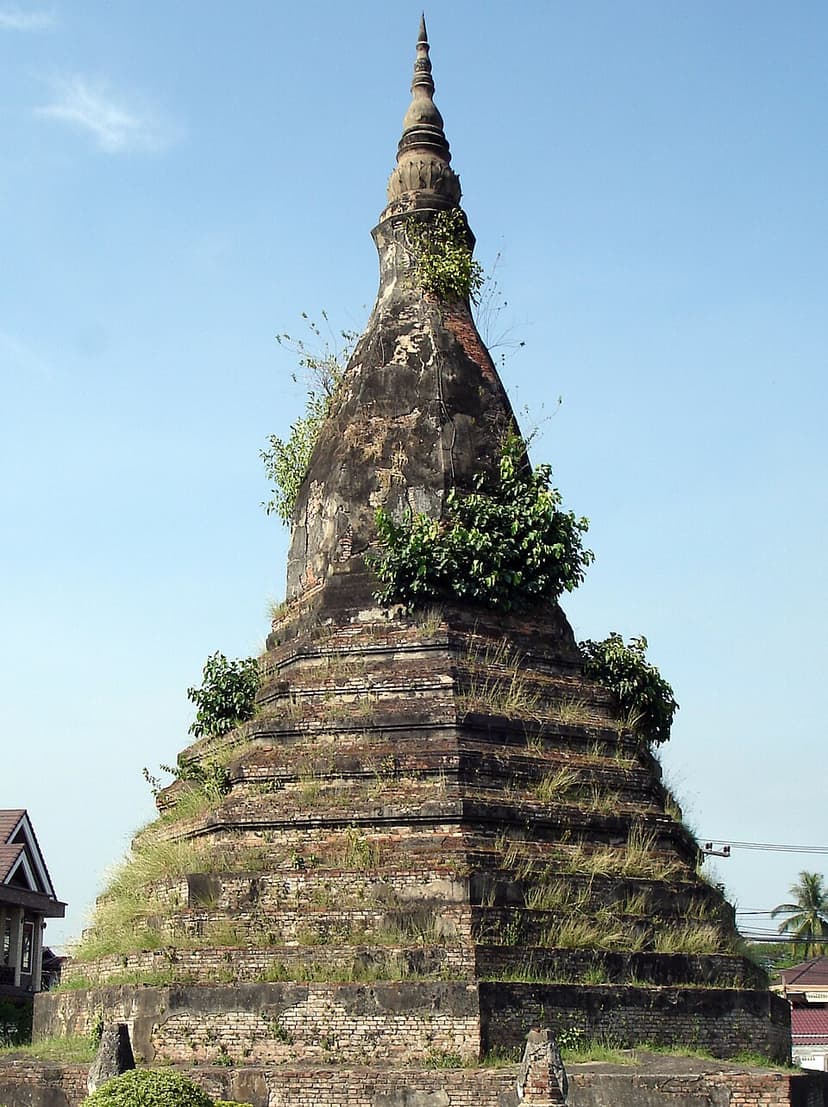
That Dam
That Dam, meaning "Black Stupa," is a significant stupa located in the center of a roundabout in Vientiane, Laos. It is a site of local belief, with many Lao people crediting a seven-headed nāga residing within it for protection against the Siamese invasion of 1827.

Kiri Vehera
Kiri Vehera is an ancient stupa located in Kataragama, Sri Lanka, believed to have been constructed in the 3rd century BC by King Mahanaga. It is recognized as one of the 16 most sacred Buddhist pilgrimage sites in ancient Sri Lanka and is a significant religious landmark.