
Parinirvana Stupa
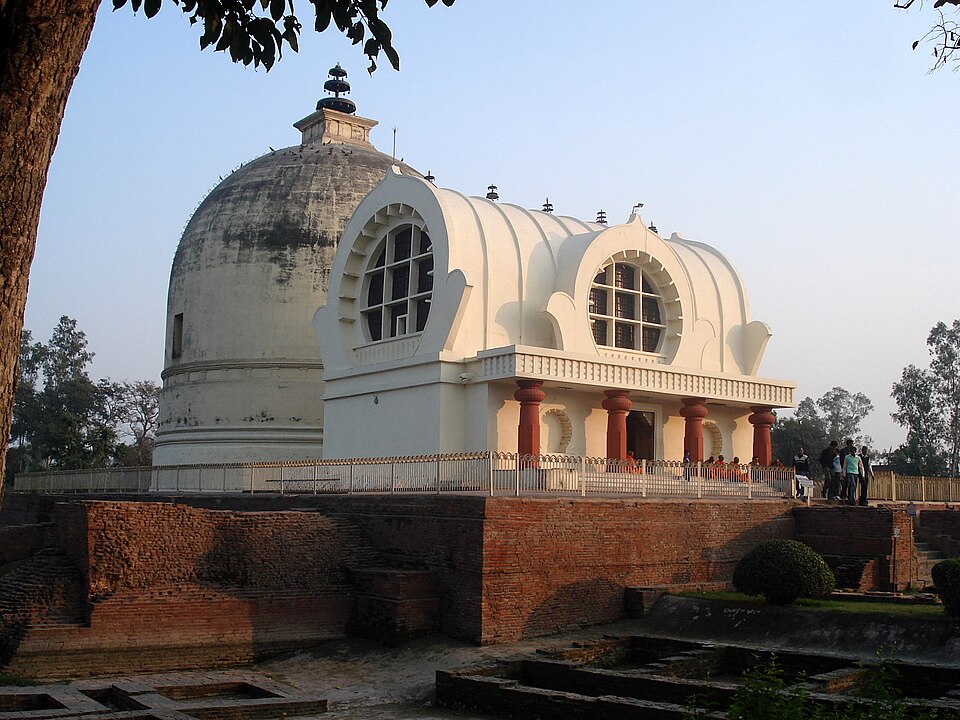
The Parinirvana Stupa in Kushinagar, India, is a significant Buddhist temple believed to be the site of Gautama Buddha's death and attainment of Parinirvana. The current temple was erected by the Indian Government in 1956 to mark the 2,500th anniversary of the Mahaparinivana, and it houses a large reclining Buddha statue.
Key Facts
- ›Believed to be the location where Gautama Buddha attained Parinirvana (final nirvana after death).
- ›The present temple was constructed by the Indian Government in 1956.
- ›Houses a 6.1-meter long reclining Buddha statue lying on its right side.
- ›Alexander Cunningham's work in the area confirmed Kushinagar as the site of Buddha's death.
- ›The site saw significant expansion during the Gupta empire, with reconstruction of the temple and a large reclining Buddha statue.
- ›The reclining Buddha statue and temple were excavated and restored in March 1877.
Important Relationships
- Alexander Cunningham
Reclining Buddha Image, Stone Couch For the Buddha Statue, Vaulted Chamber Enshrining the Statue
- Gautama Buddha Attained Parinirvana
- King Ashoka Visited and Built Caityas and Stupas
- Expansion During the Kushan Empire
- Golden Age and Major Expansion of the Stupa and Reconstruction of the Temple During the Gupta Empire
- Excavation and Restoration of the Statue and Temple
- Construction of the Present Temple
About Parinirvana Stupa
The Parinirvana Stupa, also known as the Mahaparinirvana Temple, is a revered Buddhist site located in Kushinagar, India. It is widely believed to be the hallowed ground where Gautama Buddha, the founder of Buddhism, attained his final nirvana, or Parinirvana, after his death. The current structure of the temple was established by the Indian Government in 1956, serving as a commemoration of the 2,500th anniversary of this pivotal event in Buddhist history.
History and Significance
Historical accounts suggest that after extensive missionary work, the Buddha, gravely ill, reached Kushinagar. It was here that he ordained his last disciple, spoke his final words to the monastic community, and passed into Parinirvana around 487 BCE. The Maurya king Ashoka is recorded to have visited the site in 260 BCE, initiating the construction of several caityas and stupas to honor the Buddha's place of Nirvana. The Kushan empire (c. 50-241 CE) saw further development of Buddhist sites in Kushinagar. The Gupta empire (c. 320-647 CE) marked a golden age for the area, during which the Parinirvana Stupa was significantly expanded, and the Parinirvana Temple was reconstructed, featuring a colossal reclining Buddha statue. British archaeologist Alexander Cunningham's extensive work in the region is particularly notable, as he conclusively identified Kushinagar as the location of Gautama Buddha's demise. His research noted a large vaulted chamber containing the reclining Buddha, which he dated to no later than 637 AD. The reclining Buddha statue and its adjoining temple were discovered and excavated, alongside the adjacent stupa, and subsequently restored in March 1877. The statue, found in numerous fragments, was meticulously reconstructed, and the temple was repaired and roofed by the Archaeological Survey of India. The temple's existence was also documented in a 14th-century historical text, the Jami' al-tawarikh.
Source: Wikipedia ↗
Frequently Asked Questions
Where is the Parinirvana Stupa located?
The Parinirvana Stupa is located in Kushinagar, India. This site is historically significant as the believed location of Gautama Buddha's death.
What is the significance of the Parinirvana Stupa?
The stupa is considered to be the place where Gautama Buddha attained his Parinirvana. It is a major pilgrimage site for Buddhists worldwide.
When was the current Parinirvana Temple built?
The present temple was built by the Indian Government in 1956. This construction was part of the commemoration of the 2,500th year of the Mahaparinivana.
What is inside the Parinirvana Temple?
Inside the temple is a large reclining Buddha image, measuring 6.1 meters long. The statue is depicted lying on its right side with its head facing north, resting on a stone couch.
Who is credited with confirming the site of Buddha's death?
Alexander Cunningham, a British archaeologist, is noted for his work in the area. His research conclusively proved that Gautama Buddha had died in the Kushinagar region.
Related Buddhist Temples
Amaravati
Amaravati is a village in Andhra Pradesh, India, renowned for its significant historical and cultural heritage, particularly its ancient Buddhist stupa and its role as the site of the ancient Satavahana capital, Dhanyakataka. It is notable as a place of pilgrimage for both Hindus and Buddhists and lends its name to the state's planned capital.

Chaukhandi Stupa
The Chaukhandi Stupa is a significant Buddhist monument located in Sarnath, India, a site of great importance for Buddhism. Originally built as a terraced temple, it was later modified to commemorate a historical event, making it a unique blend of religious and historical significance.

Dhamek Stupa
The Dhamek Stupa is a massive brick and stone structure located in the Deer Park at Sarnath, India. It is one of the most significant Buddhist pilgrimage sites, marking the spot where the Buddha is believed to have delivered his first sermon to his first five disciples, thus initiating the formation of the Sangha. The stupa's current form dates primarily to the Gupta era, though it is believed to incorporate elements from earlier constructions, possibly commissioned by Emperor Ashoka.