
Mahiyangana Raja Maha Vihara
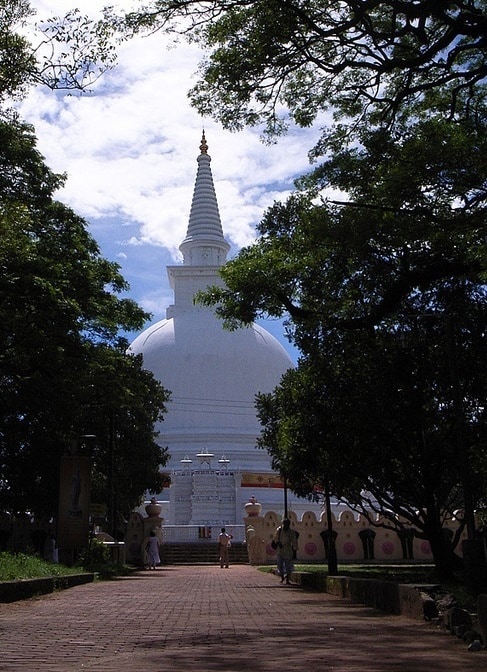
Mahiyangana Raja Maha Vihara is an ancient Buddhist temple in Mahiyangana, Sri Lanka, renowned as the site of Gautama Buddha's first visit to the island. It holds significant historical and religious importance as one of the 16 sacred religious locations in Sri Lanka and is recognized as an archaeological site.
Key Facts
- ›Believed to be the location of Gautama Buddha's first visit to Sri Lanka, occurring nine months after his enlightenment.
- ›Associated with the subduing of Yakshas by the Buddha and the subsequent gifting of a hair relic to chieftain Saman.
- ›Houses the first stupa built in Sri Lanka, originally a 10-foot structure enshrined with the Buddha's hair relic.
- ›The stupa has been renovated and enlarged by numerous Sri Lankan kings, including Devanampiyatissa, Dutthagamani, and Kirti Sri Rajasinha.
- ›Underwent major reconstruction from 1953 to 1980, culminating in the completion of a new stupa pinnacle.
- ›Designated as an archaeological site in Sri Lanka.
Important Relationships
- Gautama Buddha
- Chieftain Saman
- King Devanampiyatissa
- King Dutthagamani
- King Sena II
- King Vijayabahu I
- King Kirti Sri Rajasinha
- D. S. Senanayake
Stupa Enshrining Buddha's Hair Relic, Site of Buddha's First Visit To Sri Lanka
- Gautama Buddha's First Visit To Sri Lanka
- Subduing of Yakshas By the Buddha
- Enshrinement of Buddha's Hair Relic In the First Stupa
About Mahiyangana Raja Maha Vihara
Mahiyangana Raja Maha Vihara is an ancient Buddhist temple situated in Mahiyangana, Sri Lanka. It holds profound historical and religious significance as it is widely believed to be the very first location in Sri Lanka visited by Gautama Buddha. This sacred site is recognized as one of the Solosmasthana, a group of sixteen revered religious locations across the island, and has been officially declared an archaeological site.
Buddha's First Visit and the Origin of the Stupa
According to the ancient chronicle Mahavamsa, the Buddha made his first pilgrimage to Sri Lanka in the ninth month after achieving enlightenment, arriving in the Mahiyangana region. At that time, the island was said to be inhabited by Yakshas. The narrative recounts that the Buddha subdued these Yakshas and delivered a discourse on Dhamma. Following this, he bestowed upon Yakka chieftain Saman a handful of his hair, which Saman later enshrined in a small stupa, approximately 10 feet high. This act marked the construction of the very first stupa in Sri Lanka.
Historical Development and Renovations
Over centuries, the stupa and the temple complex have undergone numerous renovations and enlargements by various Sri Lankan rulers. King Devanampiyatissa, through his brother Moolabhaya, is recorded as having deposited a relic of a neck bone and increased the stupa's height. Subsequent kings, including Dutthagamani, who raised it to 120 feet, Voharika Tissa, Sena II, Vijayabahu I, and Kirti Sri Rajasinha, all contributed to the temple's maintenance and expansion. More recently, in 1942, a society was formed for its renovation, with significant reconstruction efforts taking place between 1953 and 1980, culminating in the completion of a new pinnacle for the stupa.
Source: Wikipedia ↗
Frequently Asked Questions
When did the Buddha visit Mahiyangana?
According to historical sources like the Mahavamsa, the Buddha visited the Mahiyangana area in the ninth month after attaining enlightenment. This visit is considered his first to Sri Lanka.
What is the significance of the stupa at Mahiyangana Raja Maha Vihara?
The stupa is significant as it is believed to be the very first stupa built in Sri Lanka. It was originally a small structure enshrining a handful of the Buddha's hair given to chieftain Saman.
Who were the original inhabitants present during the Buddha's visit?
Historical accounts suggest that Sri Lanka was inhabited by Yakshas at the time of the Buddha's first visit. The Buddha subdued them and delivered a discourse before they were relocated.
Which kings contributed to the development of the stupa?
Several Sri Lankan kings have been credited with renovating and enlarging the stupa over centuries. Notable among them are King Devanampiyatissa, King Dutthagamani, and King Kirti Sri Rajasinha.
Has the temple undergone recent renovations?
Yes, a society was formed in 1942 for the temple's renovation, with reconstruction work commencing in 1953 and concluding in 1980 with the addition of a new pinnacle for the stupa.
Related Buddhist Temples
Aluvihare Rock Temple
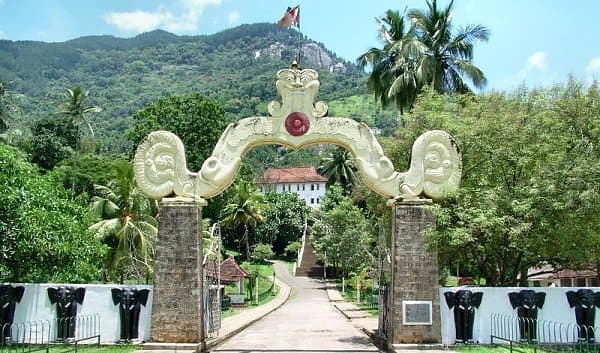
The Aluvihare Rock Temple, also known as Matale Alu Viharaya, is a significant Buddhist temple in Sri Lanka's Matale District. It holds historical importance as the site where the Pāli Canon was first transcribed onto palm leaves, preserving Buddhist scriptures during times of upheaval. The temple complex features numerous monastery caves, some adorned with ancient inscriptions, frescoes, and Buddha statues, making it a place of both historical preservation and religious devotion.
Asgiri Maha Viharaya
Asgiri Maha Viharaya, also known as Asgiriya Temple, is a significant Buddhist monastery in Kandy, Sri Lanka. It serves as the headquarters for the Asgiriya Chapter of the Siyam Nikaya, one of the two monastic orders responsible for the custodianship of the sacred Tooth Relic of the Buddha housed in the Temple of the Tooth (Sri Dalada Maligawa). The monastery plays a crucial role in the administration and religious life of Sri Lankan Buddhism.
Asokaramaya Buddhist Temple
Asokaramaya Buddhist Temple is a significant religious site in Kalutara, Sri Lanka, established in the 1870s. It was founded to provide a sanctuary for disciples of the revered monk Aluthgama Sangharatne and was generously funded by local resident Elliyas Fernando. Over time, the temple has undergone numerous expansions and renovations, evolving into a complex housing various important structures and relics.