
Kh'Leang Temple
Kh'Leang Temple is a prominent Theravada Buddhist temple located in Sóc Trăng, Vietnam, a city with a significant Khmer Krom population. First constructed in 1533 during the Khmer Empire, it has undergone numerous renovations over its five-century history and serves as a cultural and religious landmark in the Mekong Delta.
Key Facts
- ›First built in 1533, the temple has a history spanning over five centuries.
- ›It is situated on a 3.5-hectare site marked by numerous tall, shady trees.
- ›The main ceremonial hall features 12 pillars in the Corinthian style, adorned with black coating and gold dragon and fish paintings.
- ›A 6.80-meter tall statue of Gautama Buddha is centrally located in the main hall.
- ›The temple grounds include six stupas for enshrining the cremated remains of monks and laypeople.
- ›Kh'Leang Temple was declared a historic heritage site by the Culture Ministry on April 27, 1990.
- 12 Corinthian-Style Pillars With Gold Paintings
- Statue of Gautama Buddha
- Six Stupas
- Krud Ornaments
- Yeak Statues
- Reach Cha Sei Statues
- Teahu Statue
- Declared A Historic Heritage Site On April 27, 1990.
Corinthian
About Kh'Leang Temple
Kh'Leang Temple (Khmer: វត្តឃ្លាំង; Vietnamese: Chùa Khléang) is a significant Theravada Buddhist temple located in Sóc Trăng, a city in Vietnam's Mekong Delta region renowned for its substantial Khmer Krom population. The temple's construction dates back to 1533, a period when the region was under the dominion of the Khmer Empire. Over its more than five centuries of existence, Kh'Leang Temple has undergone numerous renovations, reflecting its enduring importance.
Historical Context and Construction
The temple was initially established as a wooden structure with a thatched roof, later replaced by a tiled roof. It is situated on a 3.5-hectare plot characterized by a large number of tall, shady trees. The original construction took place before the area was settled by Vietnamese populations in the 17th and 18th centuries. The temple features four entrances, oriented to the north, south, east, and west. Despite extensive renovations throughout its history, the temple has not been renovated in the last 80 years.
Architectural and Artistic Features
The main ceremonial hall of Kh'Leang Temple covers an area of 416 square meters, measuring 20 meters in width and 20.80 meters in length. It is elevated approximately one meter above ground level on a platform. The hall's roof is supported by 12 wide pillars, noted for their Corinthian style, which are coated in a shiny black finish and adorned with gold paintings of dragons and fish. A placard with Khmer inscriptions extends from the main altar to the ceiling. At the heart of the main hall stands a statue of Gautama Buddha, measuring 6.80 meters in height and 2.70 meters in width. A plaque indicates that this statue was erected in 1916, funded by the Lum Sum family, under the arrangement of the temple's 17th abbot.
Symbolism and Iconography
The temple is decorated with various objects in the Khmer tradition. The Krud, a representation of a god with a bird's head and wings and a human body, is depicted biting the tail of a snake, symbolizing its enmity towards serpents. These Krud figures are incorporated into the ornaments on the temple's roof. In Khmer folklore, Yeak represents evil and is often depicted causing harm. At Kh'Leang Temple, two Yeak statues are placed on either side, symbolizing the triumph of Buddhism over evil and their role as protectors. Additionally, statues of Reach Cha Sei, a creature associated with a combat between a female god and a Yeak, and Teahu, a figure depicted as angry and holding the sun and moon, are positioned at the entrance.
Legacy and Recognition
The temple grounds also contain six stupas, which serve as reliquaries for the cremated remains of various monks and laypeople associated with the temple. Recognizing its historical and cultural significance, Kh'Leang Temple was officially declared a historic heritage site by the Culture Ministry on April 27, 1990.
Source: Wikipedia ↗
Frequently Asked Questions
When was Kh'Leang Temple first built?
Kh'Leang Temple was first built in 1533. It has undergone many renovations since its initial construction over the past five centuries.
What are some notable architectural features of Kh'Leang Temple?
The main ceremonial hall is supported by 12 wide pillars, decorated in a Corinthian style with black coating and gold paintings of dragons and fish. The hall itself stands on an elevated platform and houses a large statue of Gautama Buddha.
What is the significance of the Krud and Yeak figures at the temple?
Krud, a Garuda representation, symbolizes the eternal enemy of the snake and is depicted on the temple roof ornaments. Yeak figures, representing evil in Khmer folklore, are placed at the sides of the temple to signify the defeat of evil by the Buddha and their conversion into protectors of Buddhism.
Is Kh'Leang Temple an active monastic residence?
The text mentions a succession of 21 abbots from the first to the current, suggesting it is an active religious site, though it does not explicitly confirm it is an active monastery in terms of residence.
What is the size of the main ceremonial hall?
The main ceremonial hall has an area of 416 square meters, measuring 20 meters wide and 20.80 meters long.
Related Buddhist Temples

Wat Ong Teu Mahawihan
Wat Ong Teu Mahawihan, meaning "Temple of the Heavy Buddha," is a significant Buddhist monastery in Vientiane, Laos, renowned for housing the largest Buddha image in the city. Originally built by King Setthathirath I in the 16th century, it has undergone several reconstructions after being destroyed by invasions, notably in the 19th century and then restored by the French in the early 20th century, maintaining its role as a center for Theravada Buddhist learning.

Thích Ca Phật Đài
Thích Ca Phật Đài is a significant Theravada Buddhist temple located in Vung Tau, southern Vietnam. Constructed between 1961 and 1963, it features a monastery at its base and the main temple complex further up Lớn mountain, attracting both religious pilgrims and tourists with its scenic location and religious iconography.
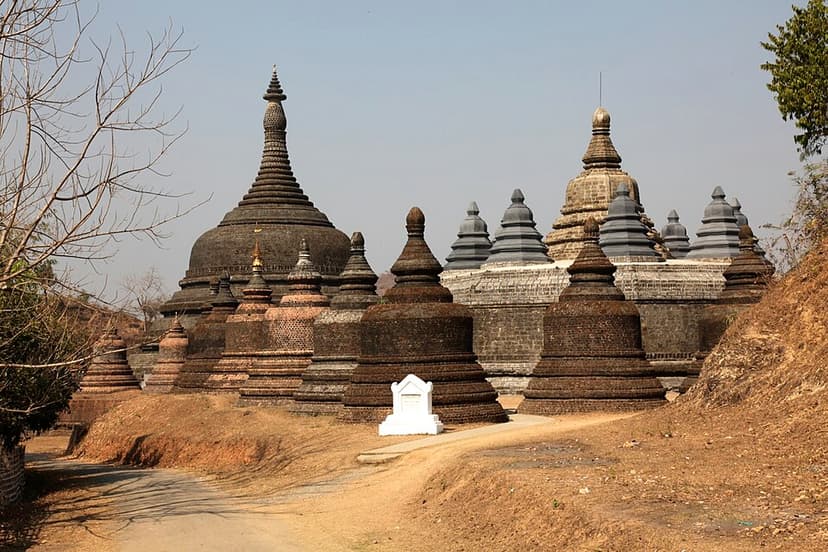
Andaw-thein Temple
Andaw-thein Temple, meaning 'Tooth Shrine,' is a significant Buddhist temple located in Mrauk U, Myanmar. Originally built as an ordination hall, it was later expanded to house a sacred tooth relic of the Buddha, brought from Sri Lanka. Its unique architecture and the presence of diverse reliefs highlight a blend of Buddhist and Hindu influences.