
Hawaii Shingon Mission
The Hawaii Shingon Mission, also known as Shingon Shu Hawaii, is a prominent example of Japanese Buddhist temple architecture in Honolulu, Hawaiʻi. Originally built in the early 20th century and subsequently renovated, it is renowned for its distinctive steep, hipped-gable roof and elaborate interior furnishings, signifying its historical ties to esoteric Shingon Buddhism.
Key Facts
- ›First constructed between 1915 and 1918 by master builder Nakagawa Katsutaro.
- ›Renovated in 1929 by Hego Fuchino, the first licensed architect of Japanese ancestry in HawaiʻI.
- ›Features an elaborate irimoya (hipped-gable) roof with decorative carvings.
- ›Houses glittering altar and interior furnishings imported from Japan.
- ›Added to the National Register of Historic Places on April 26, 2002.
- ›Commissioned a 600-square-foot ceiling panel depicting the Taizokai mandala.

Important Relationships
- Kōbō Daishi (Kūkai)
- Steep, Hipped-Gable Roof With Rounded-Gable Projection
- Elaborate Carvings On Roof Ends
- Glittering Altar and Interior Furnishings From Japan
- Taizokai Mandala Ceiling Panel
- Statues of Fujin and Raijin
- First Shingon Pilgrimage To Japan By Immigrants In Hawaii In 1929, Commemorated By An Obelisk.
- Addition of Worship Service In English In 2009, With Plans For A Transition To Primarily English Services.
Japanese Buddhist
About Hawaii Shingon Mission
The Hawaii Shingon Mission, also known as Shingon Shu Hawaii (真言宗ハワイ別院, Shingonshu Hawai Betsuin), stands as a significant example of Japanese Buddhist temple architecture in Honolulu, Hawaiʻi. Its construction began in 1915 and was completed in 1918 by Nakagawa Katsutaro, a master builder specializing in Japanese-style temples. The structure underwent further renovations in 1929 by Hego Fuchino, who became the first person of Japanese ancestry to be licensed as an architect in the Hawaiian Islands, and saw additional changes in 1978 and 1992.
Architectural and Symbolic Features
The temple is distinguished by its steep, hipped-gable roof, known as an irimoya, which features a rounded-gable projection. These roof elements are adorned with elaborate carvings. Within the temple, visitors can find a glittering altar and interior furnishings that were imported from Japan, underscoring its deep connection to esoteric Shingon Buddhism. The round tomoe symbol at the top of the entrance roof signifies the cycle of life and is a traditional emblem of the Koyasan Shingon sect, though the temple has maintained independence from sectarian affiliations since 2004. Symbolic carvings of a phoenix represent death and rebirth, while dragons embody power and good fortune.
Historical Context and Artistic Additions
An obelisk at the front of the property commemorates the first Shingon pilgrimage to Japan undertaken by immigrants from Hawaii in 1929. More recently, a statue of Kōbō Daishi (Kūkai, 774–835 CE), the founder of Shingon Buddhism, has been added. The temple's congregational nature reflects the diverse population of Hawaiʻi.
A notable artistic undertaking is the creation of a 600-square-foot ceiling panel, the tenjo-e, which depicts the Taizokai mandala. This artwork was created using original pigments mixed by Japanese artisans and applied to lacquered (urushi) panels.
In 2007, the temple's artistic enrichment continued with the installation of statues of Fujin (Wind God) and Raijin (Thunder God). Standing over ten feet tall and weighing more than 2800 pounds each, these statues, crafted from Japanese Cypress, are the largest depictions of these deities outside of Japan. Fujin was chosen to represent the prevailing trade winds of Hawaiʻi, while Raijin signifies an appreciation for nature's power. The temple was added to the National Register of Historic Places on April 26, 2002, recognizing its historical and architectural importance.
Source: Wikipedia ↗
Frequently Asked Questions
What is the significance of the symbols on the Hawaii Shingon Mission's roof?
The round tomoe at the top of the entrance roof represents the cycle of life and is a traditional symbol of the Koyasan Shingon sect. The carved phoenix symbolizes death and rebirth, while the carved dragons represent power and good fortune.
When was the Hawaii Shingon Mission established?
The temple was first built between 1915 and 1918. It has undergone several renovations and augmentations since its initial construction.
What are some of the notable artistic additions to the temple?
The temple features a 600-square-foot ceiling panel depicting the Taizokai mandala, created with original pigments. In 2007, statues of Fujin (Wind God) and Raijin (Thunder God), over ten feet tall and weighing over 2800 pounds each, were added to the entrance.
Does the Hawaii Shingon Mission still have sectarian affiliations?
While the tomoe symbol historically represents the Koyasan Shingon sect, the temple has been independent of sectarian affiliations since 2004.
What is the significance of the statues of Fujin and Raijin?
The Fujin and Raijin statues were chosen to represent the prevailing trade winds of Hawaiʻi (Fujin) and an appreciation for the power of nature (Raijin). These statues are the largest depictions of the Wind and Thunder Gods outside of Japan.
Related Buddhist Temples
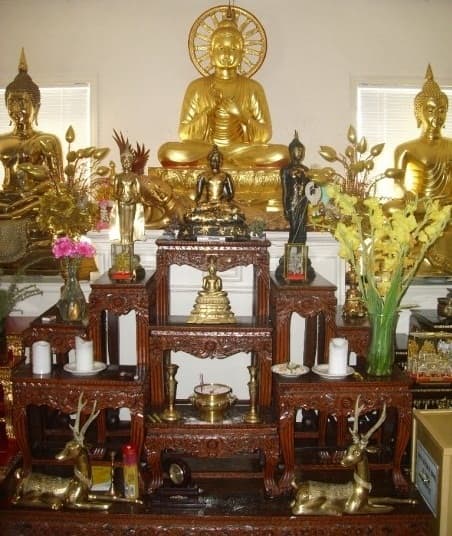
Wat Buddhananachat of Austin
Wat Buddhananachat of Austin is a Theravada Buddhist temple located in Del Valle, Texas, established in 1986 to serve as a religious and cultural center for various ethnic Buddhist communities in central Texas, primarily Thai, Laotian, and Cambodian. It is recognized as the first Asian temple in the area and has grown significantly since its founding, supporting resident monks and hosting numerous religious festivals and cultural events that attract both Buddhists and non-Buddhists.
City Of Ten Thousand Buddhas
The City of Ten Thousand Buddhas is a significant international Buddhist community and monastery located in Talmage, California. Founded by Hsuan Hua, it is recognized as one of the first Chan Buddhist temples in the United States and a major center for Buddhist practice in the Western Hemisphere, notable for its strict adherence to traditional monastic codes.

Spirit Rock Meditation Center
Spirit Rock Meditation Center, located in Woodacre, California, is a prominent center for Buddhist meditation, particularly focusing on the vipassanā (Insight Meditation) tradition. Founded in 1985, it has grown to become a significant hub for practitioners, drawing an estimated 40,000 visitors annually and recognized by the San Francisco Chronicle as a leading center for Buddhist meditation in the Bay Area.