
Hatadage
Relic Shrine·Sri Lanka·12th century
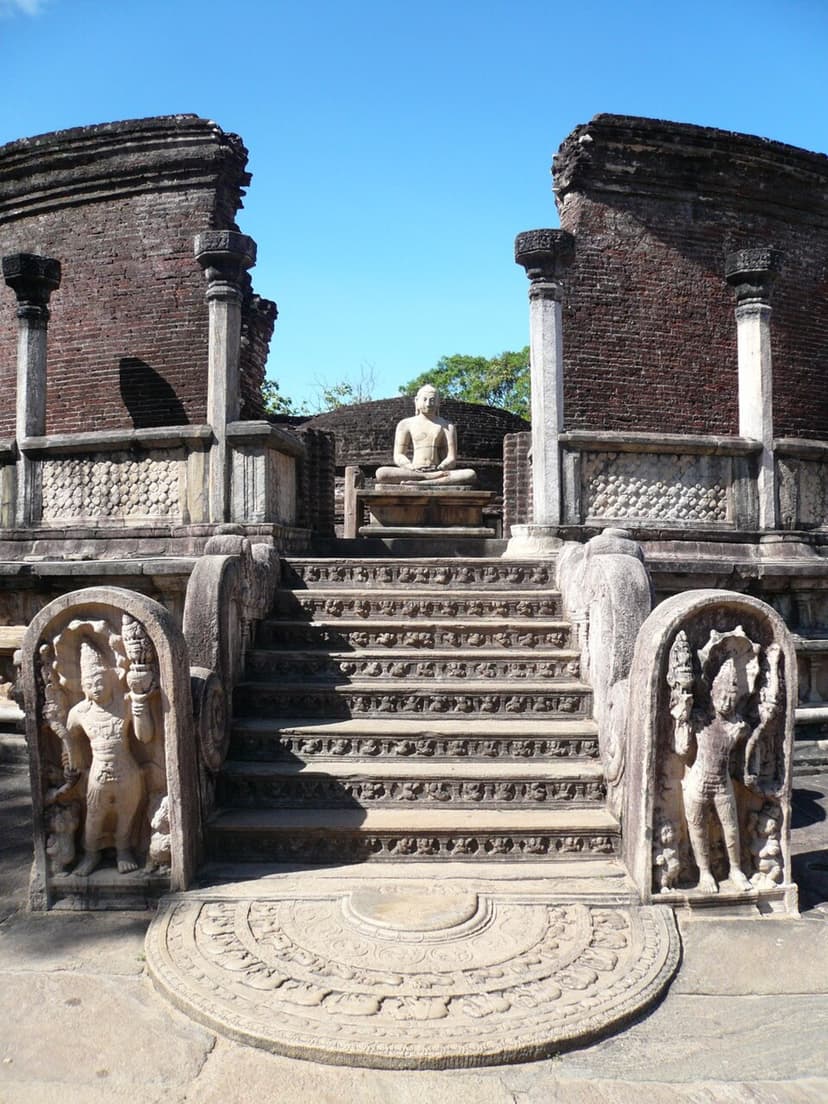
The Hatadage is an ancient relic shrine located in Polonnaruwa, Sri Lanka, constructed by King Nissanka Malla to house the sacred Relic of the tooth of the Buddha. Although much of its superstructure has been lost, the remaining brick and stone walls, along with granite Buddha statues, offer a glimpse into its historical significance as a royal reliquary.
Key Facts
- ›Built by King Nissanka Malla between 1187 and 1196 CE.
- ›Originally housed the Relic of the tooth of the Buddha.
- ›The name 'Hatadage' may derive from its construction in sixty hours or its housing of sixty relics.
- ›Composed of stone, brick, and wood, with only walls now substantially intact.
- ›Features three granite Buddha statues carved from rock within its main chamber.
- ›Located in the ancient city of Polonnaruwa, near the Polonnaruwa Vatadage.

Important Relationships
- King Nissanka Malla
Three Granite Buddha Statues, Stone and Brick Walls, Sandakada Pahana, Decorated Doorway With Stone Carvings
- Construction By King Nissanka Malla
- Housing of the Relic of the Tooth of the Buddha
Ancient Sri Lankan
About Hatadage
The Hatadage is an ancient relic shrine located in the historic city of Polonnaruwa, Sri Lanka. Constructed by King Nissanka Malla, who reigned between 1187 and 1196 CE, this structure served as a sacred repository for the Relic of the tooth of the Buddha. The shrine's name itself is thought to be derived from its rapid construction, possibly completed in sixty hours, or from its capacity to hold sixty relics.
History and Construction
King Nissanka Malla commissioned the Hatadage during his reign, intending it to be a significant religious monument. Historical sources, including the Rajaveliya and Pujavaliya, alongside the Galpotha inscription, attest to its construction. The shrine was built using materials such as stone, brick, and wood. While the exterior is encircled by a stone wall, much of the original wooden superstructure and tiled roof has been lost to time. Only the brick and stone walls, and the foundational elements, remain substantially intact today.
Architectural Features and Contents
The Hatadage appears to have been a two-storey structure, though the upper level is no longer present. The surviving walls are made of brick, with the outer surfaces often covered by stone plates. A notable entrance on the southern side is adorned with intricate stone carvings and features a sandakada pahana, a characteristic moonstone step. Inside, the main chamber, though partially ruined, once housed sixteen stone columns. At its center stand three granite Buddha statues carved directly from rock. The central statue measures approximately 9 feet (2.7 meters) in height, with the two flanking statues each standing about 7.5 feet (2.3 meters) tall.
Significance and Location
Located within the ancient city of Polonnaruwa, the Hatadage holds a prominent place in the city's sacred precinct, known as the Dalada Maluva. Its southern entrance faces the entrance of the Polonnaruwa Vatadage, another important religious structure. The presence of the tooth relic made the Hatadage a significant site for Buddhist pilgrimage and veneration during its active period. The site has also undergone modern documentation, with 3D scanning efforts undertaken by the Zamani Project in 2019 to preserve its digital record.
Source: Wikipedia ↗
Frequently Asked Questions
Who built the Hatadage?
The Hatadage was built by King Nissanka Malla, who reigned from 1187 to 1196 CE. He commissioned the shrine to house an important Buddhist relic.
What was the purpose of the Hatadage?
The primary purpose of the Hatadage was to serve as a relic shrine for the Relic of the tooth of the Buddha. It was intended to protect and display this sacred artifact.
What is the significance of the name 'Hatadage'?
The name 'Hatadage' is believed to have two possible origins. One theory suggests it refers to the rapid construction of the shrine in sixty hours, while another proposes it housed sixty relics.
What remains of the Hatadage today?
Today, only parts of the brick and stone walls of the Hatadage remain, as its upper storey and wooden superstructure have been destroyed. Three granite Buddha statues are still present within the shrine.
Where is the Hatadage located?
The Hatadage is situated in the ancient city of Polonnaruwa, in the North Central province of Sri Lanka. It is positioned near the northern edge of the Dalada Maluva, a sacred area within the city.
Related Buddhist Temples

Gal Vihara
Gal Vihara, originally known as Uttararama, is a significant rock-cut Buddhist temple located in Polonnaruwa, Sri Lanka. Commissioned by King Parakramabahu I in the 12th century, it is renowned for its four monumental rock relief statues of the Buddha, considered masterpieces of ancient Sinhalese sculpture. The temple's artistic and historical importance makes it a primary attraction in Polonnaruwa.

Rankoth Vehera
Rankoth Vehera is a significant brick stupa located in the ancient city of Polonnaruwa, Sri Lanka. Built by King Nissanka Malla between 1187 and 1196, it is one of the most revered stupas in Polonnaruwa and the fourth largest in the country. Its name, translating to "Gold Pinnacled Stupa," reflects its former grandeur.
Polonnaruwa Vatadage
The Polonnaruwa Vatadage is a well-preserved ancient Buddhist structure in Polonnaruwa, Sri Lanka, renowned for its architectural sophistication. It likely served as a reliquary for important Buddhist artifacts, such as the Buddha's tooth relic or alms bowl, making it a site of great religious significance during the Kingdom of Polonnaruwa.