
Diskit Monastery
Diskit Monastery is the oldest and largest Buddhist monastery in the Nubra Valley of Ladakh, belonging to the Gelugpa sect. Founded in the 14th century by Changzem Tserab Zangpo, it holds significant religious and cultural importance, serving as a center for festivals and education for local Tibetan children.
Key Facts
- ›Founded in the 14th century by Changzem Tserab Zangpo.
- ›Belongs to the Gelugpa (Yellow Hat) sect of Tibetan Buddhism.
- ›It is a sub-gompa of the Thikse Monastery.
- ›Features a large statue of Maitreya Buddha (Jampa Buddha) facing towards Pakistan.
- ›Hosts the popular Dosmoche festival in February.
- ›The monastery administration runs a school for local Tibetan children with support from a non-governmental organization.

Important Relationships
Statue of Cho Rinpoche, Huge Drum, Images of Fierce Guardian Deities, Fresco of Tashilhunpo Monastery, Large Statue of Jampa Buddha
- Founded In the 14th Century.
- Became A Sub-Gompa of Thikse Monastery In the Mid-Eighteenth Century.
- Consecration of the Maitreya Buddha Statue By the Dalai Lama On July 25, 2010.
About Diskit Monastery
Diskit Monastery, also known as Deskit Gompa or Diskit Gompa, stands as the oldest and largest Buddhist monastery in the Diskit village of the Nubra Valley, within the Leh district of Ladakh, India. It is situated approximately 115 kilometers north of Leh. Belonging to the Gelugpa sect of Tibetan Buddhism, the monastery was founded in the 14th century by Changzem Tserab Zangpo, a notable disciple of Tsong Khapa, the founder of the Gelugpa school. Diskit Monastery functions as a sub-gompa of the prominent Thikse Monastery.
History and Establishment
The monastery's establishment in the 14th century coincided with the rule of King Grags-pa-'bum-lde. Local rulers supported the Gelugpa order, leading to the construction of the monastery and the deification of an idol of Tsong Khapa within its walls. Over centuries, the monastery saw various historical developments, including periods of royal patronage and shifts in local governance. In the mid-eighteenth century, control of Diskit Monastery was transferred to the Rinpoche of Thikse Monastery, a relationship that continues to this day, solidifying its status as a sub-gompa.
Geography and Accessibility
Diskit Monastery is perched on a hill overlooking the flood plains of the Shyok River, in the Nubra Valley. The valley itself is known for its mild climate and lush vegetation, earning it the moniker "orchard of Ladakh." Historically, it served as a vital caravan route between Tibet and China. Access to the monastery is via a dusty road from Diskit village, which is reached from Leh by crossing the Khardung La pass. While the valley is accessible by road, winter snowfall can disrupt traffic between October and May.
Structures and Features
Stone steps lead to the monastery's prayer hall, which houses a statue of Maitreya Buddha (known locally as Jampa Buddha), a large drum, and various images of fierce guardian deities. An elevated cupola showcases a fresco of Tibet's Tashilhunpo Monastery. The monastery is also associated with local mythology, with legends of an anti-Buddhist demon whose remains are purportedly kept within a temple. While recent extensions are in fair condition, the older sections, including the main prayer hall, show signs of decay and require preservation.
The Maitreya Buddha Statue
A prominent recent addition is a colossal 32-meter (106-foot) statue of Jampa (Maitreya) Buddha, located on a hill below the monastery. Facing towards Pakistan, its construction began in April 2006 and it was consecrated by the Dalai Lama in July 2010. Primarily funded by local donations, the statue was envisioned for protection, the prevention of further conflict, and the promotion of world peace.
Education and Festivals
Diskit Monastery is home to around 100 monks and operates a school within its premises, educating local Tibetan children. With support from the non-governmental organization 'Tibet Support Group,' the school is equipped with computer facilities and teaches scientific subjects in English. The monastery is also the venue for the popular Dosmoche festival, or "Festival of the Scapegoat," held annually in February. This festival is a significant gathering for people from the Nubra Valley, featuring mask dances (Cham dance) performed by the lamas to symbolize the triumph of good over evil.
Source: Wikipedia ↗
Frequently Asked Questions
When was Diskit Monastery founded?
Diskit Monastery was founded in the 14th century by Changzem Tserab Zangpo, a disciple of Tsong Khapa.
What Buddhist tradition does Diskit Monastery belong to?
Diskit Monastery belongs to the Gelugpa (Yellow Hat) sect of Tibetan Buddhism.
What are the notable features of Diskit Monastery?
Notable features include a statue of Maitreya Buddha, a large drum, images of guardian deities, and a fresco depicting Tashilhunpo Monastery. It also houses a large statue of Jampa (Maitreya) Buddha at its base.
What is the Dosmoche festival?
Dosmoche, also known as the 'Festival of the Scapegoat', is a popular prayer festival celebrated in February at Diskit Monastery. It features mask dances performed by lamas and aims to avoid ill-fortune and usher in peace and prosperity.
Does Diskit Monastery have an active school?
Yes, the monastery runs a school within its precincts that teaches Tibetan children. The school has computer facilities and teaches scientific subjects in English, with support from a 'Tibet Support Group'.
What is the significance of the large Maitreya Buddha statue?
The 32-meter statue of Maitreya Buddha, completed in 2010, was commissioned for the protection of Diskit village, prevention of war, and world peace. It faces down the Shyok River towards Pakistan.
Related Buddhist Temples

Key Monastery
Key Monastery, also known as Kye Gompa, is a prominent Tibetan Buddhist monastery situated atop a hill in the Spiti Valley of Himachal Pradesh, India. It serves as the largest monastery in the region and a significant religious training center for lamas, dedicated to the reincarnation of the great translator Lotsawa Rinchen Zangpo.
Likir Monastery
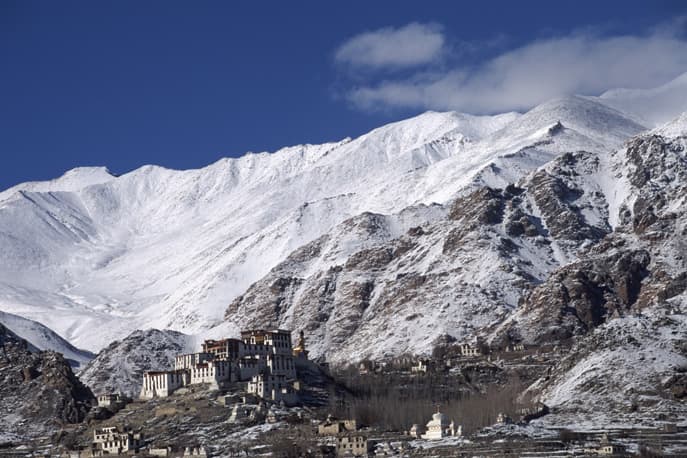
Likir Monastery, also known as Likir Gompa, is a significant Buddhist monastery located in Ladakh, India. Established in 1065, it is a prominent center for the Gelugpa sect of Tibetan Buddhism and serves as the seat for the Ngari Rinpoche.

Lingshed Monastery
Lingshed Monastery, also known as Lingshed Gompa, is a prominent Gelugpa Buddhist monastery located in Ladakh, India. Founded in the 1440s by Changsems Sherabs Zangpo, a disciple of Je Tsongkhapa, it holds historical significance as a monastic site previously established by the Translator Rinchen Zangpo. The monastery has been part of the religious estate of Ngari Rinpoche since 1779 and plays a vital role in the spiritual life of the surrounding villages.