
Baoguo Temple (Mount Emei)
Baoguo Temple is a significant Buddhist temple located on Mount Emei in Sichuan, China, serving as the headquarters for the Buddhist Association of Mount Emei. It is distinguished by its unique syncretism, enshrining not only Buddhist Bodhisattvas but also sages of Confucianism and deities of Taoism, reflecting the historical ideal of the "Three Teachings Harmonious as One."
Key Facts
- ›Founded as Huizong Hall during the Wanli period (1573–1619) of the Ming dynasty.
- ›Renamed 'Baoguo Temple' by Emperor Kangxi in 1703.
- ›Enshrines Buddhist Bodhisattvas, Confucian sages, and Taoist deities, symbolizing the harmony of the three traditions.
- ›Features the Ming dynasty bronze 'Huayan Pagoda' carved with the Avatamsaka Sutra.
- ›Houses a large bell cast in 1564, inscribed with over 60,000 words of Buddhist scriptures.
- ›Designated a National Key Buddhist Temple in Han Chinese Area by the State Council of China in 1983.

Important Relationships
- Kangxi Emperor
- Ming dynasty
- Qing dynasty
- Wanli period
- Huayan Pagoda
- Large Bell Cast In 1564
- Plaque With 'Baoguo Temple' Written By Kangxi Emperor
- Founded As Huizong Hall During the Wanli Period
- Moved To Present Site During Shunzhi Emperor's Reign
- Named 'Baoguo Temple' By Kangxi Emperor In 1703
- Enlarged In 1866
- Inscribed As A National Key Buddhist Temple In 1983
About Baoguo Temple (Mount Emei)
Baoguo Temple, situated on the sacred Mount Emei in Sichuan, China, is a significant Buddhist temple that also serves as the seat of the Buddhist Association of Mount Emei. Its unique characteristic lies in its syncretic approach, venerating not only Buddhist Bodhisattvas but also sages from Confucianism and deities from Taoism. This inclusive practice embodies the historical ideal of the "Three Teachings Harmonious as One," a concept prevalent during the Ming and Qing dynasties.
History and Development
The temple's origins trace back to the Huizong Hall, established by Mingguang during the Wanli period of the Ming dynasty (1573–1619). Initially, it enshrined deities from the three spiritual traditions, with Puxian at the center, flanked by the Taoist deity Guangchengzi and the Confucian sage Lu Tong. During the Shunzhi Emperor's reign in the Qing dynasty, the monk Wenda relocated the temple to its present site. A pivotal moment in its history occurred in 1703, during the Kangxi era, when Emperor Kangxi bestowed upon it the name "Baoguo Temple." The temple underwent further expansion in 1866 under the monk Guanghui. In recognition of its importance, Baoguo Temple was inscribed as a National Key Buddhist Temple in the Han Chinese Area by the State Council of China in 1983.
Architectural Highlights and Treasures
The existing main buildings of Baoguo Temple include the Shanmen (mountain gate), the Hall of Mi Le, the Mahavira Hall, the Seven Buddha Hall, and the Zangjing Ge (Scripture Repository). Above the eaves of the Shanmen hangs a plaque bearing "Baoguo Temple," inscribed by calligrapher Wang Fan from the handwriting of Emperor Kangxi himself.
Within the Hall of Mi Le, the central statue is of Mi Le, with the dharmapala Weituo standing behind. The Mahavira Hall is dedicated to the Three Saints of Hua-yan, featuring Shijiamoni in the center, with Wenshu and Puxian on either side, and statues of the Eighteen Arhats before the gable walls. The Seven Buddha Hall behind it houses statues of seven Buddhas, including Kassapa and Shakyamuni, with Guanyin and Dashizhi at the rear, accompanied by Longnü and Shancai.
Among its most significant treasures is the "Huayan Pagoda," a fourteen-story, six-meter-tall bronze pagoda from the Ming dynasty, intricately carved with the Avatamsaka Sutra. The temple also possesses a large bell, cast in 1564 by Huizong Biechuan during the late Ming dynasty. This bell, standing 2.8 meters high, weighs 12.5 kilograms and is renowned for its deep, sonorous tone. Its exterior is inscribed with over 60,000 characters from the Āgama and other Buddhist scriptures.
Source: Wikipedia ↗
Frequently Asked Questions
What is the history of Baoguo Temple?
Baoguo Temple originated as Huizong Hall in the late Ming dynasty and was moved to its current location during the Qing dynasty. It received its current name from Emperor Kangxi in 1703 and was later enlarged in 1866. It was recognized as a National Key Buddhist Temple in 1983.
What makes Baoguo Temple unique?
Baoguo Temple is unique because it enshrines deities and sages from Buddhism, Confucianism, and Taoism. This reflects the historical concept of the 'Three Teachings Harmonious as One' prevalent during the Ming and Qing dynasties.
What are the notable architectural features of Baoguo Temple?
Key structures include the Shanmen, Hall of Mi Le, Mahavira Hall, Seven Buddha Hall, and Zangjing Ge. The temple also preserves a Ming dynasty bronze pagoda called the Huayan Pagoda and a large, scripture-inscribed bell.
What deities are venerated at Baoguo Temple?
The temple venerates Buddhist Bodhisattvas such as Puxian and Guanyin, along with figures like Mi Le, the Three Saints of Hua-yan (Shijiamoni, Wenshu, and Puxian), and the Eighteen Arhats. It also includes Confucian sages and Taoist deities.
Is the bell at Baoguo Temple historically significant?
Yes, the bell was cast in 1564 during the late Ming dynasty and is 2.8 meters high. It is notable for its deep, sonorous sound and the inscription of over 60,000 words from Buddhist scriptures on its exterior.
Related Buddhist Temples

Baisui Palace
Baisui Palace is a significant Buddhist temple situated atop Chaxiao Peak in Chizhou, Anhui, China. It holds the distinction of being one of the "Four Great Buddhist Temples in Mount Jiuhua" and has a history marked by repeated destruction and reconstruction over 400 years.
Chokorgyel Monastery
Chokorgyel Monastery is a significant Gelugpa Buddhist monastery located in Gyatsa County, Tibet. Founded in 1509 by Gedun Gyatso, the 2nd Dalai Lama, it holds historical importance as a meditation site and a vital stopping point for senior lamas journeying to the sacred lake Lhamo La-tso. The monastery was severely damaged multiple times throughout its history, notably by Dzungar Mongols in 1718 and almost completely destroyed during the Cultural Revolution, but has since seen partial rebuilding and renewed monastic residency.
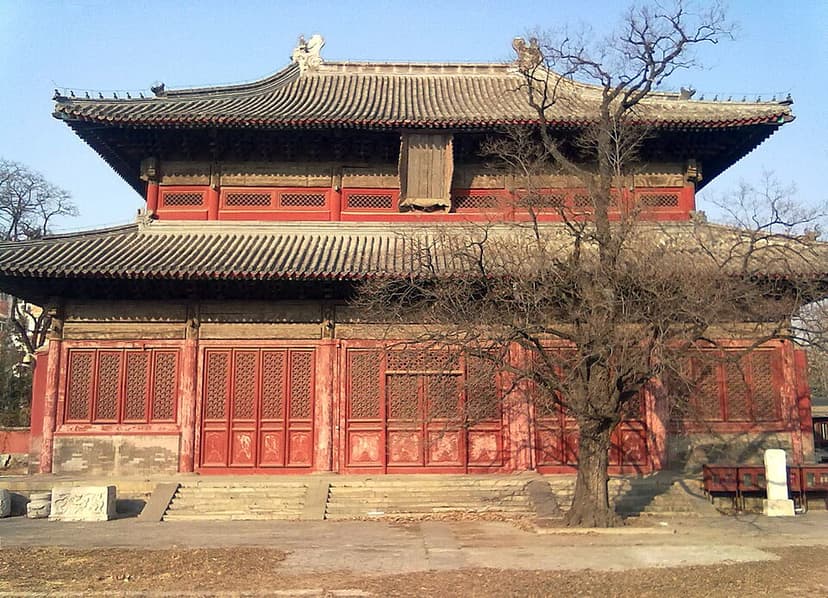
Dahui Temple
Dahui Temple, meaning "Temple of Great Wisdom," is a significant Ming Dynasty Buddhist temple situated in Beijing's Haidian District. Established in 1513 and later restored in 1757, the temple is particularly renowned for its collection of 28 large, colored Buddhist sculptures, each exceeding three meters in height, which are considered exceptional artistic achievements of the Ming era.