
Baisui Palace
Baisui Palace is a significant Buddhist temple situated atop Chaxiao Peak in Chizhou, Anhui, China. It holds the distinction of being one of the "Four Great Buddhist Temples in Mount Jiuhua" and has a history marked by repeated destruction and reconstruction over 400 years.
Key Facts
- ›Founded during the Wanli period (1573–1620) of the Ming dynasty by monk Haiyu (Master Wuxia).
- ›Haiyu, the founder, died at age 110, and his mummified body is preserved at the temple.
- ›The temple was destroyed and rebuilt multiple times due to wars and natural disasters, including a major fire in 1717 and destruction during the Taiping Rebellion in 1853.
- ›It was renovated and redecorated in the Qing dynasty in 1814 and 1826.
- ›Designated as a National Key Buddhist Temple in Han Chinese Area by the State Council of China in 1983.
- ›Occupies a building area of 2,987 square metres with existing main structures like the Shanmen, Mahavira Hall, and Body Hall.

Important Relationships
- Haiyu (Master Wuxia)
- Zhiyuan Temple
- Dongyan Chan Temple
- Ganlu Temple
Mummified Body of Haiyu, Shanmen, Mahavira Hall, Body Hall
- Destruction By Fire In 1717
- Restoration By Abbot Sancheng In 1721
- Refurbishment and Redecoration In 1814 and 1826
- Destruction During the Taiping Rebellion In 1853
- Partial Destruction By Fire In the Late Guangxu Period
- Refurbishment and Redecoration In 1982
About Baisui Palace
Baisui Palace: A Historic Buddhist Temple on Mount Jiuhua
Baisui Palace (simplified Chinese: 百岁宫; traditional Chinese: 百歲宮; pinyin: Baǐsuì Gōng) is a prominent Buddhist temple located on the summit of Chaxiao Peak, within the Mount Jiuhua region of Chizhou, Anhui, China. It is historically recognized as one of the "Four Great Buddhist Temples in Mount Jiuhua," a testament to its enduring spiritual and cultural significance. The temple's history spans over 400 years, marked by a recurring cycle of destruction and reconstruction due to warfare and natural calamities.
History and Reconstruction
The origins of Baisui Palace date back to the Wanli period (1573–1620) of the Ming dynasty. It was founded by the monk Haiyu, more widely known as "Master Wuxia." Master Wuxia achieved remarkable longevity, living to the age of 110, and his mummified body is a key relic preserved within the temple. The subsequent Qing dynasty (1644–1911) saw the temple undergo significant challenges. It was devastated by a major fire in 1717 during the Kangxi Emperor's reign, but was subsequently restored in 1721 by abbot Sancheng. Further renovations and redecorations took place in 1814 and 1826. However, the temple's resilience was tested again in 1853 when much of its structure was destroyed during the Taiping Rebellion. Additional damage occurred due to fire in the late Guangxu period, though crucially, the mummy of Haiyu and important seals survived these events.
During the Republic of China era, from 1931 to 1953, several abbots successively guided the temple. Following the establishment of the People's Republic of China, the local government undertook a significant refurbishment and redecoration of Baisui Palace in 1982. Its importance was further cemented in 1983 when it was designated a National Key Buddhist Temple in the Han Chinese Area by the State Council of China.
Architectural Features
Baisui Palace covers a total building area of 2,987 square metres (32,150 sq ft). The existing main structures include the Shanmen (the main entrance gate), the Mahavira Hall (the principal hall for worship), the Body Hall (肉身殿) where the mummified remains are housed, a Dining Hall, a storehouse, and residences for monks. These buildings represent the temple's ongoing efforts to maintain its spiritual function and architectural integrity.
Source: Wikipedia ↗
Frequently Asked Questions
When was Baisui Palace founded?
Baisui Palace was first constructed during the Wanli period, which falls between 1573 and 1620, in the Ming dynasty. Its establishment is attributed to the monk Haiyu, also known as Master Wuxia.
What is notable about the founder, Haiyu?
Haiyu, the founder of Baisui Palace, lived to be 110 years old. His body was preserved as a mummy and remains a significant artifact at the temple.
Has Baisui Palace always been in its current state?
No, the temple has a long history of destruction and rebuilding over 400 years. It has suffered damage from wars, such as the Taiping Rebellion, and natural disasters like fires, necessitating numerous renovations and restorations.
What is the significance of Baisui Palace in Mount Jiuhua?
Baisui Palace is recognized as one of the "Four Great Buddhist Temples in Mount Jiuhua." This designation highlights its importance within the Buddhist landscape of the region.
What are some of the main architectural features of Baisui Palace?
The temple covers a significant area and includes several key structures. Prominent buildings are the Shanmen (mountain gate), the Mahavira Hall (main hall), and the Body Hall, which houses the mummified remains of Haiyu.
Related Buddhist Temples

Baoguo Temple (Mount Emei)
Baoguo Temple is a significant Buddhist temple located on Mount Emei in Sichuan, China, serving as the headquarters for the Buddhist Association of Mount Emei. It is distinguished by its unique syncretism, enshrining not only Buddhist Bodhisattvas but also sages of Confucianism and deities of Taoism, reflecting the historical ideal of the "Three Teachings Harmonious as One."
Chokorgyel Monastery
Chokorgyel Monastery is a significant Gelugpa Buddhist monastery located in Gyatsa County, Tibet. Founded in 1509 by Gedun Gyatso, the 2nd Dalai Lama, it holds historical importance as a meditation site and a vital stopping point for senior lamas journeying to the sacred lake Lhamo La-tso. The monastery was severely damaged multiple times throughout its history, notably by Dzungar Mongols in 1718 and almost completely destroyed during the Cultural Revolution, but has since seen partial rebuilding and renewed monastic residency.
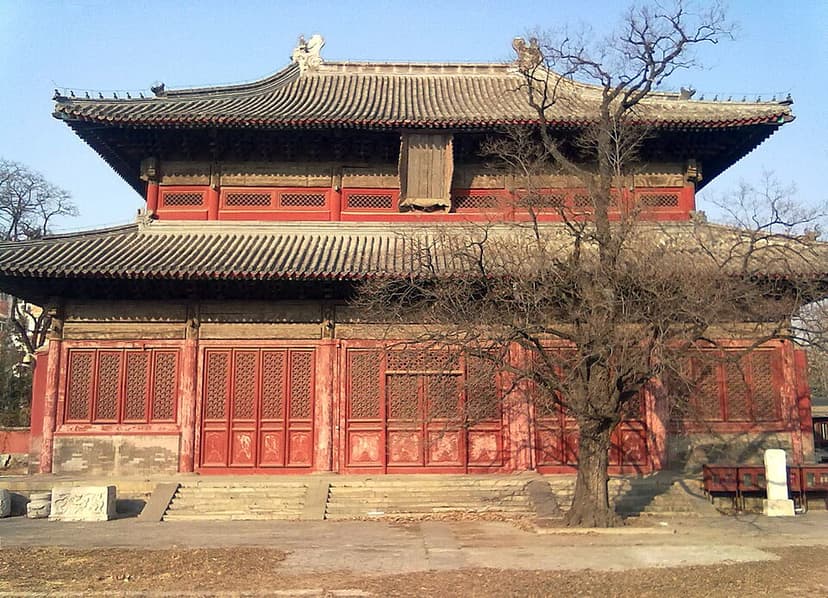
Dahui Temple
Dahui Temple, meaning "Temple of Great Wisdom," is a significant Ming Dynasty Buddhist temple situated in Beijing's Haidian District. Established in 1513 and later restored in 1757, the temple is particularly renowned for its collection of 28 large, colored Buddhist sculptures, each exceeding three meters in height, which are considered exceptional artistic achievements of the Ming era.