
Bagaya Monastery
Bagaya Monastery, also known as Maha Waiyan Bontha Bagaya Monastery, is a historic Buddhist monastery located in Inwa, Myanmar. Originally constructed of teak wood, it has undergone reconstruction and is renowned for its Burmese architectural style and extensive collection of palm-leaf manuscripts.
Key Facts
- ›Founded in 1593 during the reign of King Nyaungyan Min.
- ›The original teak structure was destroyed by fire in 1821 and subsequently rebuilt.
- ›Features a seven-tiered spire, Dhanu hall, Bhawga hall, and eight brick stairways.
- ›Built with 267 teak wood posts, measuring 188 feet in length and 103 feet in width.
- ›Known for its intricate Burmese architectural details, including carvings and floral arabesques.
- ›Houses a significant collection of palm-leaf manuscripts, many of which have been digitized for preservation.

Important Relationships
- Shin Dhammabhinanda
Seven-Tiered Spire, Dhanu Hall, Bhawga Hall, Eight Brick Stairways, 267 Teak Wood Posts, Palm-Leaf Manuscripts
- Burnt In A Great Fire On April 15, 1821
- Reconstruction Efforts In 1992
- Request For Manuscript Transfer To National Library In 2016
- Manuscript Digitization In Partnership With Pali Text Society In 2018
Burmese Architecture, Inwa Era Art
About Bagaya Monastery
The Bagaya Monastery, also known by its full name Maha Waiyan Bontha Bagaya Monastery, is a significant Buddhist religious structure located in Inwa, within the Mandalay Region of Myanmar. Its name, Bagaya, is a Burmese transliteration of a Mon phrase meaning 'starflower monastery.' The monastery is a notable tourist attraction and a testament to Burmese architectural heritage.
History and Construction
The original Bagaya Monastery was first constructed in 1593. During the reign of King Bagyidaw, a devastating fire on April 15, 1821, destroyed many important buildings, including the monastery. The government initiated reconstruction efforts, and a new brick building was erected in place of the old structure, designed to house Buddha images and Pitaka scriptures, reportedly based on the model of the original monastery. In more recent times, in 2016, the abbot of the monastery requested the transfer of its extensive collection of palm-leaf manuscripts to the National Library of Myanmar for preservation. These manuscripts were subsequently digitized in 2018 through a partnership with the Pali Text Society.
Architecture and Features
The Bagaya Monastery is distinguished by its impressive Burmese architectural style. It features a prominent seven-tiered spire and comprises the Dhanu hall and Bhawga hall. The structure is supported by 267 large teak wood posts and has substantial dimensions, measuring 188 feet in length and 103 feet in width. The monastery is adorned with intricate carvings, floral arabesques, curved figurines, and reliefs of birds and animals, all characteristic of the artistic works from the Inwa Era. It stands amidst wide paddy fields, surrounded by palms, banana trees, and thorny green bushes, contributing to its picturesque setting.
Source: Wikipedia ↗
Frequently Asked Questions
When was Bagaya Monastery founded?
Bagaya Monastery was first built in 1593. It was later rebuilt after a fire in 1821.
What is the architectural style of Bagaya Monastery?
The monastery is a prime example of Burmese architectural works from the Inwa Era. It features carvings, floral arabesques, curved figurines, and reliefs of birds and animals.
What is notable about the construction of Bagaya Monastery?
The monastery was constructed with 267 gigantic teak wood posts and has impressive dimensions, measuring 188 feet in length and 103 feet in width. It also features a seven-tiered spire.
What is the significance of the palm-leaf manuscripts at Bagaya Monastery?
Bagaya Monastery possesses a large collection of palm-leaf manuscripts. Efforts have been made to transfer and digitize these manuscripts for their long-term preservation and conservation.
Where is Bagaya Monastery located?
Bagaya Monastery is located in Inwa, within the Mandalay Region of Myanmar (Burma). It is situated to the southwest of Inwa Palace.
Related Buddhist Temples
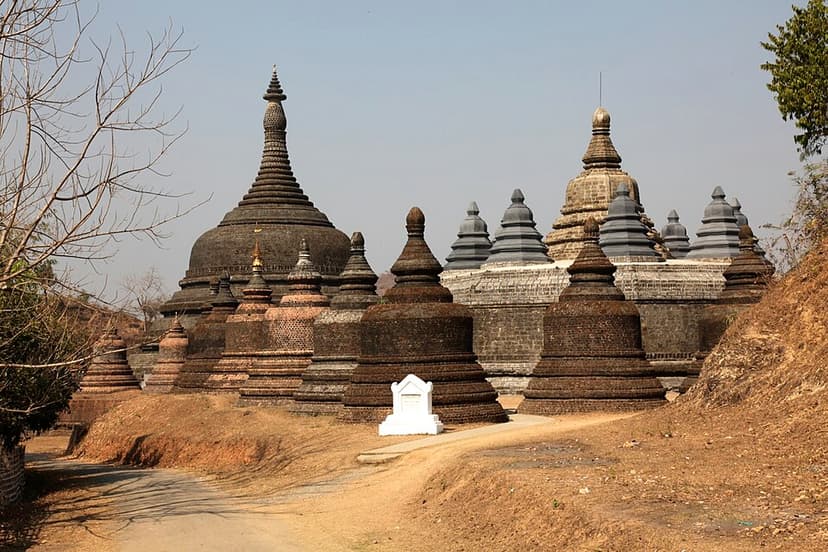
Andaw-thein Temple
Andaw-thein Temple, meaning 'Tooth Shrine,' is a significant Buddhist temple located in Mrauk U, Myanmar. Originally built as an ordination hall, it was later expanded to house a sacred tooth relic of the Buddha, brought from Sri Lanka. Its unique architecture and the presence of diverse reliefs highlight a blend of Buddhist and Hindu influences.
Chokorgyel Monastery
Chokorgyel Monastery is a significant Gelugpa Buddhist monastery located in Gyatsa County, Tibet. Founded in 1509 by Gedun Gyatso, the 2nd Dalai Lama, it holds historical importance as a meditation site and a vital stopping point for senior lamas journeying to the sacred lake Lhamo La-tso. The monastery was severely damaged multiple times throughout its history, notably by Dzungar Mongols in 1718 and almost completely destroyed during the Cultural Revolution, but has since seen partial rebuilding and renewed monastic residency.

Baoguo Temple (Mount Emei)
Baoguo Temple is a significant Buddhist temple located on Mount Emei in Sichuan, China, serving as the headquarters for the Buddhist Association of Mount Emei. It is distinguished by its unique syncretism, enshrining not only Buddhist Bodhisattvas but also sages of Confucianism and deities of Taoism, reflecting the historical ideal of the "Three Teachings Harmonious as One."