
Royal Basilica of St Francis the Great
The Royal Basilica of Saint Francis the Great is a prominent Roman Catholic basilica located in central Madrid, Spain, within the Palacio neighborhood. It forms part of a Franciscan convent and is renowned for its significant Neoclassic architecture, particularly its dome which is among the largest in Europe, and its collection of Spanish art. The basilica has a rich history, having served as a National Pantheon and housing the remains of notable figures.
Key Facts
- ›Founded on the site of a 13th-century Franciscan convent, tradition attributes its original founding to Francis of Assisi in 1217.
- ›The current Neoclassic structure was designed in the second half of the 18th century by Francisco Cabezas, with development by Antonio Pló and completion by Francesco Sabatini.
- ›The basilica houses significant Spanish paintings from the 17th to 19th centuries, including works by Zurbarán and Francisco Goya.
- ›Its dome measures 33 meters in diameter and 58 meters in height, reportedly making it the fourth largest dome in Europe.
- ›It was elevated to the status of a minor basilica by Pope John XXIII on February 2, 1963.
- ›The basilica holds the only peal of change ringing bells in Spain, cast by John Warner and Sons in 1882.
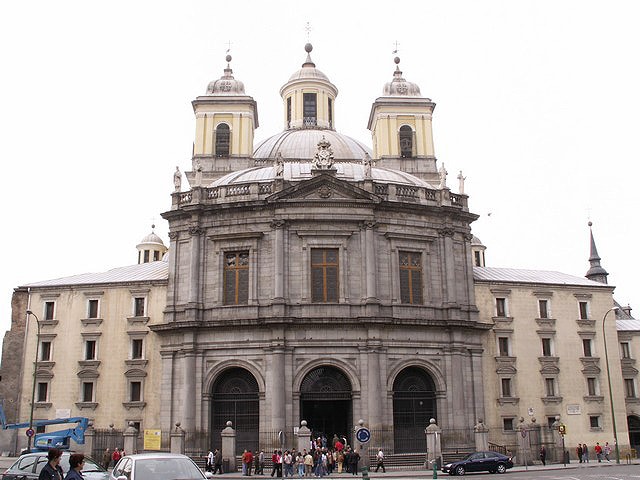
Neoclassic
Franciscan
Francisco Cabezas, Antonio Pló, Francesco Sabatini
About Royal Basilica of St Francis the Great
Royal Basilica of Saint Francis the Great
The Royal Basilica of Saint Francis the Great, known in Spanish as Real Basílica de San Francisco el Grande, is a significant Roman Catholic basilica located in the heart of Madrid, Spain, within the Palacio neighborhood. It is an integral part of the convent of Jesús y María, belonging to the Franciscan order.
History and Architecture
Tradition holds that the original Franciscan convent on this site was founded by Saint Francis of Assisi himself in 1217. The current structure, however, was commissioned by Charles III and designed in a Neoclassic style during the second half of the 18th century. The initial design was by Francisco Cabezas, with further development by Antonio Pló and completion by the renowned architect Francesco Sabatini. The main façade faces the Plaza of San Francisco, at the convergence of Bailén, Gran Vía de San Francisco, and Carrera de San Francisco.
Artistic and Religious Significance
The basilica is celebrated for its impressive dome, which measures 33 meters in diameter and 58 meters in height. Its circular shape is noted for its similarity to the Pantheon's dome and is considered the fourth largest in Europe. Internally, the church houses a valuable collection of Spanish paintings from the 17th to 19th centuries, including notable works by Zurbarán and Francisco Goya, with its walls adorned with 19th-century paintings. Historically, the temple served as the National Pantheon, preserving the remains of eminent artists and politicians, and it remains an important site for tourism.
Designation and Bells
On February 2, 1963, the temple was officially elevated to the status of a minor basilica through an edict issued by Pope John XXIII. In 1980, the building received recognition as a national historic-artistic monument. Notably, the basilica contains the only peal of change ringing bells in Spain, cast by John Warner and Sons in 1882. Although currently unringable, these bells were the sole peal of their kind in mainland Europe until 2017.
Source: Wikipedia ↗
Frequently Asked Questions
Where is the Royal Basilica of Saint Francis the Great located?
The Royal Basilica of Saint Francis the Great is situated in central Madrid, Spain, specifically in the Palacio neighborhood. Its main façade faces the Plaza of San Francisco.
What is the architectural style of the basilica?
The basilica is designed in a Neoclassic style. Its construction took place in the second half of the 18th century.
What makes the dome of the basilica significant?
The dome is notable for its dimensions, measuring 33 meters in diameter and 58 meters in height. It is reported to be the fourth largest dome in Europe, following those of the Pantheon, St. Peter's Basilica, and Florence Cathedral.
When was the basilica designated as a minor basilica?
The temple was elevated to the status of a minor basilica via an edict issued by Pope John XXIII on February 2, 1963, through the apostolic letter 'Gloria matriti'.
What notable artworks are housed in the basilica?
The church contains a collection of important paintings representing Spanish art from the 17th to 19th centuries. This includes works by renowned artists such as Zurbarán and Francisco Goya.
Related Basilicas
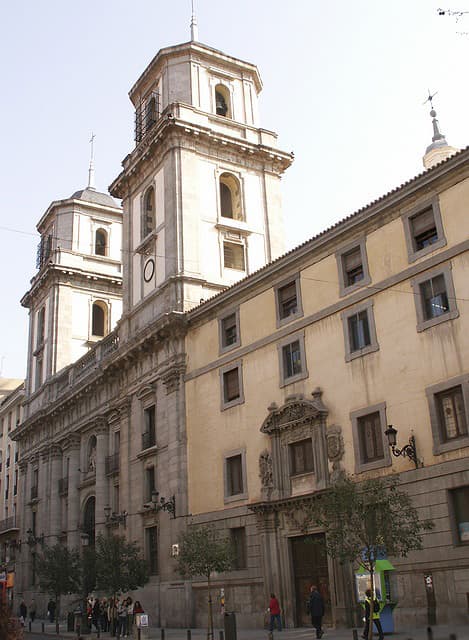
Ex-Cathedral Basilica of St Isidore
The Ex-Cathedral Basilica of St Isidore, also known as the Colegiata, is a Baroque Catholic church located in Madrid, Spain. It is significant for housing the relics of Saint Isidore, the patron saint of Madrid, and his wife, Saint Mary of the Head. The church has held the status of a minor basilica for centuries and played a role as Madrid's pro-cathedral before the completion of Almudena Cathedral.

Pontifical Basilica of St Michael
The Pontifical Basilica of Saint Michael is a Baroque Catholic church and minor basilica located in Madrid, Spain. It serves as the church of the Apostolic Nunciature to the Kingdom of Spain and is administered by priests of Opus Dei. Pope Pius XI elevated the shrine to the status of a minor basilica in 1930.

Royal Basilica of Our Lady of Atocha
The Royal Basilica of Our Lady of Atocha is a prominent church located in central Madrid, Spain, and is administered by the Dominican order. Its history is tied to a lost icon found among tall grasses, giving it its name, and it has undergone significant reconstruction after destruction during the Spanish Civil War.